By the time I returned to the office the next morning, I had stopped expecting every email to contain an answer.
I checked my inbox, opened the messages that needed attention, and started my regular work.
The Apex Logistics review remained somewhere in the background.
I couldn't see what the reviewers were discussing, and I had no way to know how close they were to a decision.
All I could do was keep my own work moving.
Shortly after nine, I received a meeting invitation.
It was scheduled for later that morning, and the subject referred to the continuing review of the Apex Logistics deductions.
Claire was listed as an attendee.
So were Derek, Blake, and members of the review team.
I accepted the invitation and opened my folder.
The responsibility form was still there, along with the assignment notice, the correspondence I had submitted, and my notes about the deductions.
I checked the pages one more time.
Nothing had changed since the last meeting.
The documents still showed what I had been assigned to do and what the company had decided to charge against my pay.
They still did not give me a clear answer about the technical cause of the failures.
I placed the folder beside my keyboard and returned to work until the meeting time arrived.
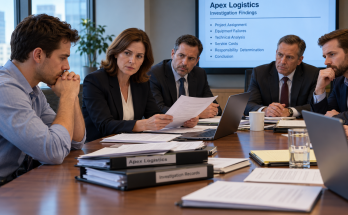
When I entered the conference room, Claire was reviewing a document.
Derek sat across from her, while Blake had several papers arranged in front of him. Two reviewers were seated near the end of the table.
I took my usual place.
Claire looked around the room before speaking.
"We've continued reviewing the records and the questions raised in the earlier meetings."
Nobody interrupted.
"I want us to be precise about what has been established and what still needs to be verified."
She turned toward the review team.
"Let's begin with the original responsibility determination."
One reviewer opened a document on a laptop.
"The records confirm that Evan was assigned to the Apex Logistics project," the reviewer said. "They also confirm that equipment failures occurred and that additional service costs were recorded."
Claire nodded.
"What do the records establish about the cause of those failures?"
The reviewer glanced at the screen.
"We're still examining the available material."
Derek shifted in his chair.
"The responsibility decision was made under the existing accountability policy."
Claire turned toward him.
"We've discussed the policy several times. I want to understand the evidence supporting its application here."
Derek placed his hands on the table.
"The project was within Evan's assigned responsibilities."
"That establishes his assignment," Claire replied. "What establishes that his actions caused the failures?"
He didn't answer immediately.
Blake leaned forward.
"I think we need to be careful not to separate project responsibility from the practical realities of managing work. Engineers are expected to take ownership of the results."
"Taking ownership of a project is not the same as accepting an unsupported conclusion," Claire said.
Her voice remained even.
She wasn't shouting, and she didn't appear interested in turning the meeting into an argument.
That made the silence afterward more uncomfortable.
I had become familiar with the pattern. Someone would explain the policy, Claire would ask about the evidence, and the conversation would return to the fact that I had been assigned to the project.
The distinction was simple.
The answers were not.
Claire looked toward me.
"Evan, has anyone provided you with a technical finding that identifies an action of yours as the cause of the failures?"
"No."
"Have you been given an explanation of how the deductions were calculated?"
"I've seen the amounts on my pay statement, but I haven't received a clear explanation connecting those amounts to a specific failure caused by my actions."
She wrote something on her notepad.
"Thank you."
I sat back.
I wanted to say more, but I had learned that repeating myself did not necessarily make an answer stronger.
The facts were already in the record.
The reviewers began asking about the sequence of events.
They confirmed the assignment dates and asked whether I had received any written instructions that changed my responsibilities during the project.
I answered as accurately as I could.
I did not claim to remember details that weren't supported by the documents.
When I couldn't confirm something from memory, I said so.
One reviewer asked about the responsibility form.
"You were asked to sign this document, correct?"
"Yes."
"And you declined?"
"Yes."
"Was your refusal based on the amount of the deduction or the responsibility stated in the form?"
"The responsibility stated in the form."
I paused before continuing.
"I wanted to understand the evidence behind the conclusion before agreeing that I had caused the failures."
The reviewer nodded and made a note.
Blake looked down at his papers.
Derek remained still.
Claire asked whether the original decision had been reviewed after I declined to sign.
Derek answered that the matter had been handled through the established process.
"Was the technical basis reconsidered?" Claire asked.
"I would need to confirm the exact sequence."
"Please do."
Derek nodded.
For once, he did not return immediately to the general language of accountability.
I noticed that, but I didn't know what it meant.
It could have meant that he needed to check the records. It could have meant that he didn't have the answer in front of him.
I had no evidence that would let me choose between those possibilities.
The review continued.
The team examined the information I had provided and asked whether I had any additional documents to submit.
I said I had already supplied everything available to me.
"If I locate anything else, I'll provide it," I added.
Claire thanked me.
Then she turned back to the reviewers.
"I want the final assessment to distinguish between the employee's assigned duties, the technical cause of the failures, and the basis for the financial deductions."
One reviewer repeated the three points while typing.
I watched the words appear on the screen.
For the first time, the questions in the meeting seemed organized around the problem I had been trying to explain.
That did not mean the review had reached a conclusion.
It meant the questions were finally being separated.
After another short discussion, Claire said the team would continue checking the records and return with a clearer assessment.
Nobody announced a decision.
I gathered my folder and left the conference room.
In the hallway, I stopped briefly to adjust the papers under my arm.
I felt a small measure of relief, but I didn't allow myself to confuse it with resolution.
The company had not told me that the deductions were wrong.
It had not told me that they were justified.
The review was still open.
Back at my desk, I placed the folder in the drawer and opened my regular work.
For the next hour, I managed to concentrate without checking my inbox.
Then a new message arrived asking me to confirm one of the dates in my earlier correspondence.
I checked the original email, confirmed the date, and replied.
It was a small task, but I completed it carefully.
I didn't want a mistake in my own records to distract from the question the review was supposed to answer.
Later that afternoon, I passed Derek near the meeting rooms.
He was carrying a stack of papers.
For a moment, I thought he might stop and explain something about the review.
He didn't.
He gave me a brief nod and continued walking.
I returned the gesture and went back to my desk.
I couldn't make his silence mean anything more than it did.
At the end of the day, I opened the drawer and looked at the folded pay statement.
The amount was still the same.
Three hundred and twelve dollars.
The meeting had changed the questions being asked, but it hadn't changed the number I had received.
I folded the statement along its existing crease and put it away.
Then I shut down my computer.
As I left the office, I thought about Claire's instruction to distinguish between assignment, cause, and financial responsibility.
Those had been three separate questions from the beginning.
Somehow, they had been treated as though answering the first automatically answered the other two.
I hoped the review would finally examine them separately.
That was all I could reasonably ask for.
Click here to continue reading: PART 14: The Difference Between a Decision and Proof
The Paycheck That Made No Sense Until the Company Finally Had to Explain Where My Money Went
Part 13 of 16