The following morning, I arrived at the office and went straight to my desk.
I turned on my computer, checked my messages, and opened the report I had been working on.
For the first hour, nothing happened beyond the usual work.
I answered a question from a colleague and checked a technical detail before sending my response.
I was beginning to appreciate the value of a quiet morning.
Then my calendar notification appeared.
The Apex Logistics review meeting was scheduled to continue later that day.
I had known another discussion was possible, but seeing the invitation still made me pause.
I opened my folder and checked the documents I had brought to the previous meeting.
The assignment notice was there.
The responsibility form was there.
My correspondence was there.
The folded pay statement remained tucked behind my notes.
I put everything in order and returned to my work.
Around midday, I received a brief message asking me to confirm that I would attend.
I replied that I would.
There was no other information.
I spent the next hour finishing a task that needed to be completed before the meeting. I checked the figures, reviewed the final version, and sent it to the appropriate team.
I wanted to enter the conference room with my ordinary responsibilities under control.
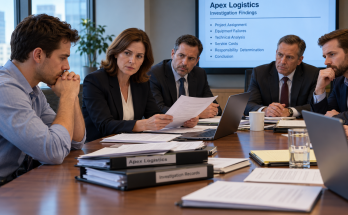
When the time arrived, I carried my folder down the hallway.
Claire was already seated when I entered.
Derek sat to her right, and Blake had a document open in front of him. The review team was present as well.
I took my seat.
Claire waited until everyone was ready.
"We've had several discussions about this matter," she said. "I want to make sure we address the outstanding questions directly."
She looked toward the reviewers.
"Please begin with the basis for the original determination."
One reviewer summarized the records that had been examined.
The assignment documents confirmed that I had been allocated the Apex Logistics work. The financial records confirmed that additional service costs had been recorded and that deductions had been applied under the accountability policy.
Claire listened without interrupting.
When the reviewer finished, she asked the question that had remained at the center of every meeting.
"What evidence establishes that Evan caused the equipment failures?"
The reviewer paused.
"The team is still determining whether the available documentation supports that conclusion."
Claire turned toward Derek.
"Does the original assessment identify a specific action by Evan that caused the failures?"
Derek looked down at the documents in front of him.
"The assessment was based on his responsibility for the project."
"That establishes the assignment," Claire said. "Does it establish the cause?"
He did not answer immediately.
Blake leaned forward.
"We need to remember that the accountability policy exists to make sure employees take responsibility for their work."
Claire nodded.
"Yes. But the policy cannot answer a technical question by itself."
The room fell silent.
I looked at the folder in front of me.
I had heard the same argument in several forms, and I no longer felt the need to respond to every repetition.
Claire was asking the question directly.
The reviewers needed to answer it.
Derek finally spoke.
"The original process treated the failures as falling within Evan's responsibilities."
Claire looked at him.
"Was he responsible for the equipment failures?"
Derek shifted in his chair.
"I would need to confirm the exact findings."
"Then please do that before the assessment is finalized."
Blake folded his arms.
"The company cannot function if every employee disputes an accountability decision."
Claire turned toward him.
"An employee asking for the basis of a financial deduction is not the same as refusing accountability."
She paused before continuing.
"If the evidence establishes responsibility, the company should be able to explain that evidence. If it doesn't, we need to understand why the decision was made."
I felt my shoulders relax slightly.
It was the clearest statement I had heard about the problem.
It didn't promise that I was right.
It didn't accuse anyone of acting improperly.
It simply required the decision to match the evidence.
Claire turned to me.
"Evan, is there anything you want to add before we continue?"
I looked at the documents in front of me.
"I've explained my position in the earlier meetings. I accept that I was responsible for the work assigned to me. I don't accept that the assignment alone proves I caused the failures."
I paused.
"If the records show that I missed a required step or made an error that caused a failure, I want to see that information. I'll answer for what the evidence establishes."
Claire nodded.
"And if the records don't establish that connection?"
"Then I want the decision reviewed on that basis."
Nobody spoke for a moment.
I had not said anything different from what I had said before.
But this time, the question was no longer being treated as a disagreement over whether I should accept responsibility in general.
It was being treated as a question about what the records could prove.
The reviewers asked a few more questions about the sequence of events and the documentation associated with the responsibility form.
Derek said he would verify the timing of the original determination against the available correspondence.
Claire asked that the review distinguish the date of the assignment, the date of the decision, and the information available when the decision was made.
One reviewer entered the request into the meeting notes.
Blake did not argue further.
He sat back and listened while the team discussed what remained to be checked.
I couldn't tell whether the change in tone meant the final assessment was close.
I didn't want to guess.
The meeting continued for several minutes, then Claire said the review team would complete its remaining checks before issuing a conclusion.
There was no announcement about my pay.
There was no final finding about the equipment failures.
The meeting ended with the same unresolved question that had brought us there.
But it had been stated clearly enough that nobody could mistake it for a complaint about the existence of the policy.
I left the conference room and returned to my desk.
For a few minutes, I sat without opening anything.
I felt drained, but I also felt that I had done what I could.
I had answered every question honestly.
I had supplied the documents available to me.
I had acknowledged the responsibilities I could confirm without accepting a conclusion that had not been demonstrated.
The next step belonged to the review team.
I opened my laptop and returned to my regular work.
The afternoon passed without another request.
I completed a technical check and responded to a colleague who needed clarification on a separate assignment.
Before I left, I checked my inbox.
There was no final decision.
I closed the laptop and took the folder from the drawer.
The pay statement was still inside.
I held it for a moment, then placed it back between the other documents.
I no longer expected the paper itself to explain what had happened. It recorded the result, not the reasoning behind it.
That reasoning had to come from the company.
I shut the drawer and turned off my monitor.
As I walked toward the exit, I thought about how many times I had been told to trust the process.
I had tried to do that.
I had attended the meetings, answered the questions, and provided the records.
Trust, however, did not mean pretending that unanswered questions had already been settled.
It meant giving the review a chance to examine the facts while continuing to ask for a clear explanation.
I left the office without knowing what the next update would contain.
I could not say whether the deductions would be reversed or whether the company would maintain its original decision.
I could only wait for the assessment to be completed.
The answer, whatever it turned out to be, needed to match the evidence.
That was the standard I had asked for from the beginning.
And until the company gave me a final explanation, I had no reason to abandon it.
The End
Read more original stories on Feel Every Story.
The Paycheck That Made No Sense Until the Company Finally Had to Explain Where My Money Went
Part 16 of 16