
The next few days passed without a final answer.
I continued checking my email each morning, but I no longer expected the first message I opened to resolve the investigation.
Instead, I concentrated on my work and responded whenever the review team requested information.
I had learned that waiting was easier when I stopped treating every quiet hour as a sign that something had gone wrong.
On Wednesday morning, I received a request to confirm that the documents in my earlier submission were complete.
I opened the folder on my computer and compared the list against the files I had sent.
The assignment notice was there.
The correspondence about the responsibility form was there.
My explanation of the deductions was there.
I replied that the submission was complete to the best of my knowledge.
Then I returned to a technical report that needed my attention.
The report had nothing to do with Apex Logistics, and I was grateful for that.
It reminded me that the rest of my job had not stopped simply because one decision remained under review.
A little before lunch, I received another invitation.
This time, the meeting was shorter and included only me and a member of the review team.
I accepted.
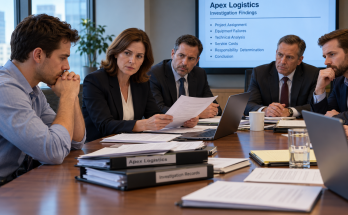
When I entered the small conference room, the reviewer had several documents spread across the table.
"Thanks for coming," they said.
"Of course."
"We're trying to make sure the record reflects your position accurately."
I sat down.
The reviewer asked me to explain what I understood the original decision to mean.
I said the company had treated the equipment failures and the additional service costs as my responsibility because I had been assigned to the project.
"And what do you believe is missing from that reasoning?"
"The evidence connecting my actions to the failures."
The reviewer looked at the papers.
"Would you agree that the engineer assigned to a project has responsibilities for its outcome?"
"Yes."
"Even when other people or circumstances may be involved?"
"Yes. But that doesn't tell us what caused a particular failure."
The reviewer nodded slowly.
I continued before the conversation could return to the same general point.
"I'm not saying that assignment carries no responsibility. I'm saying that the specific responsibility needs to be established. If I failed to do something required of me, I want to know what it was."
The reviewer made a note.
"And if the evidence showed that you had failed to follow a required procedure?"
"Then I would expect the company to address that evidence and explain the decision."
"Even if the outcome involved a financial consequence?"
"If the consequence was supported by the applicable rules and the facts, I would expect the company to explain it. I can't agree to a conclusion before I understand the basis for it."
The reviewer set down the pen.
"That's clear."
I wasn't sure whether the conversation would lead to anything new.
Still, I was glad the questions were being asked directly.
For months, or perhaps only days that felt much longer, I had been caught between a policy that everyone could describe and a conclusion that nobody had clearly explained.
I needed the company to decide what the evidence showed.
I did not need anyone to promise me a particular result.
The reviewer asked whether I had anything else to add.
I thought about the pay statement in my desk drawer.
"I want the financial decision to be reviewed along with the technical one," I said. "The deductions affected my pay before I had a clear explanation of why I was considered responsible."
The reviewer wrote that down.
"Understood."
We finished a few minutes later.
I returned to my desk and tried to put the meeting out of my mind.
It was difficult not to wonder what the reviewers were finding in the documents. I had no access to their discussions, and I knew better than to treat a routine question as a sign of a particular outcome.
So I continued working.
That afternoon, I reviewed an engineering drawing and found a detail that needed clarification.
I contacted the appropriate colleague, explained the issue, and waited for confirmation before proceeding.
It was a small example of the kind of care I believed the Apex review should require.
When something was uncertain, I asked.
When I needed confirmation, I waited for it.
I didn't treat uncertainty as proof.
The same principle should have applied to the decision about my pay.
The following morning, Derek approached my desk again.
He looked tired, although I couldn't tell whether that had anything to do with the investigation.
"Have you been meeting with the review team?" he asked.
"They asked me to clarify a few points."
"What points?"
"My understanding of the responsibility decision and the evidence needed to support it."
Derek glanced toward the conference rooms.
"These reviews take time."
"I understand."
"People are trying to make sure everything is handled correctly."
"I hope so."
He looked back at me.
"You know the policy was not created to target you."
"I haven't said it was."
The answer came out more firmly than I intended.
I took a breath.
"I'm asking whether the policy was applied correctly in my case. That's different from saying anyone created it to target me."
Derek remained quiet.
I wondered whether he had expected me to accuse him of something.
I hadn't.
I didn't know enough to make claims about anyone's intentions, and I wasn't going to start making them now.
After a moment, he nodded.
"All right."
He walked away.
I returned to my work.
The conversation had not changed the investigation, but it reinforced something I had been trying to remember.
I could challenge a decision without claiming to know why someone had made it.
I could ask for evidence without accusing everyone involved of dishonesty.
And I could acknowledge that a policy served a legitimate purpose while still questioning whether the company had followed it correctly.
That afternoon, I checked my personal budget again.
I had become careful about every planned expense. I wrote down the payments due before my next payday and made sure I wasn't counting money that had not arrived.
It was a practical exercise, but it also reminded me how much the disputed deductions had changed my routine.
At work, the issue was discussed in terms of policy and procedure.
At home, it was a matter of deciding what I could afford.
Those were two sides of the same decision.
The next day, the review team sent another brief update.
It confirmed that the assessment was still underway.
No further action was requested from me.
I read the message, closed it, and returned to the project I was working on.
For the rest of the afternoon, I managed not to check my inbox every few minutes.
I finished my report and submitted it before leaving.
At the end of the day, I opened my drawer to put away a printed document.
The pay statement was underneath the folder.
I took it out and looked at it again.
The paper was beginning to look worn around the folds.
I considered throwing it away.
Then I decided to keep it until the review was complete.
It was not proof of why the deductions had been made, but it was a record of what had happened to my pay.
I placed it back in the drawer.
As I left the office, I reminded myself that the review had not yet established whether the original decision was right or wrong.
I would not pretend otherwise.
But I also would not accept the idea that a decision became correct simply because it had already been made.
That was the difference I wanted the company to recognize.
A decision could be documented.
A policy could be cited.
A form could be prepared.
None of those things replaced the need to establish the facts.
Click here to continue reading: PART 15: What the Records Could Actually Show
The Paycheck That Made No Sense Until the Company Finally Had to Explain Where My Money Went
Part 14 of 16


One Comment on “PART 14 – The Difference Between a Decision and Proof”