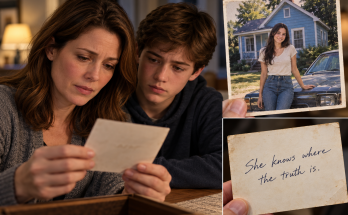
There were things about David I could remember without trying.
The way he wrote his letters.
The way he paused before answering a difficult question.
The little habits that had become so familiar that I barely noticed them anymore.
I had carried those memories for years.
I had never expected them to become evidence of how much I did not know.
Yet that was what the photograph had done.
It had taken something familiar and placed it beside something unknown.
Now I could not look at David's handwriting without wondering what else he might have left unexplained.
I did not think that meant he had been dishonest with me.
I had no reason to make that accusation.
But I could no longer tell myself that I had understood every important part of his life.
I had mistaken familiarity for completeness.
That was my mistake.
The realization was uncomfortable because it made me question memories I had always trusted.
I remembered our conversations.
I remembered the ordinary details of our days.
I remembered the notes he had written and the things he had said without thinking much about them.
But memories are not records of every moment.
They are pieces.
Some remain sharp.
Others disappear.
And sometimes, when you need a particular memory, all you find is a blank space where you thought something should be.
I had begun to feel that blank space whenever I looked at the photograph.
I tried to remember whether David had ever mentioned a small blue house.
Nothing came to me.
I tried to remember whether he had spoken about a young woman who resembled him.
Again, nothing.
I could not tell whether those conversations had never happened or whether I had forgotten them.
I hated that I could not distinguish between the two.
It would have been easier if I had a clear memory of him telling me he knew the woman.
It would also have been easier if I remembered him saying he had never met her.
Either answer would have given me something to work with.
Instead, I had only the photograph and his handwriting.
One afternoon, I sat alone and looked at the picture again.
I tried to see it without the message.
A woman outside a house.
An old sedan.
A quiet moment captured on paper.
Without the sentence, it might have seemed like an ordinary photograph from someone's past.
Then I turned it over.
The words changed everything.
I wondered what David had been feeling when he wrote them.
Was he worried?
Was he angry?
Was he simply trying to preserve a thought before he forgot it?
I could not know.
I had no right to assign him an emotion merely because I needed an explanation.
That was another lesson I had been slow to learn.
Love made me feel close to David.
It did not make me the authority on every thought he had ever had.
I could remember him honestly and still admit that some parts of his story were beyond me.
The admission hurt.
It also made me feel less trapped.
I did not have to choose between believing I knew everything about him and deciding that I had known nothing at all.
Both extremes were wrong.
I had known him.
I had loved him.
And there were still things I did not understand.
Those truths could exist together.
When Ethan joined me, I told him what I had been thinking.
I did not tell him every fear that had crossed my mind.
I simply said that the photograph had made me realize how much we could miss about another person, even when we believed we knew them well.
He listened.
Then he asked, "Does that make you think differently about Dad?"
I considered the question.
I wanted to say no.
I wanted to protect the memories I had of David from the uncertainty surrounding the photograph.
But that would not have been honest.
"Not about everything," I said. "But it makes me realize there were things I didn't know."
Ethan looked down.
"Maybe that's normal."
"Maybe it is."
He was right.
No one knows another person completely.
Even people who share a home can carry private worries and unspoken questions.
I had always understood that in theory.
I had found it much harder to accept when the unknown part of someone's life appeared in front of me.
I wanted to know what the woman meant.
I wanted to know what David had been thinking.
I wanted to know whether the photograph had been meant for Ethan.
But I could not make those answers appear simply by wanting them.
Ethan touched the edge of the picture.
"I don't want to think he kept things from us because he didn't trust us."
I looked at him.
Neither did I.
That possibility had crossed my mind, but it was not the only one.
People keep things to themselves for many reasons.
Sometimes they are protecting someone.
Sometimes they are afraid.
Sometimes they do not know how to explain what they are carrying.
Sometimes they believe they will have more time.
I could not say which, if any, applied to David.
I did not want to turn uncertainty into a judgment against him.
"I don't think we should assume that," I said.
Ethan nodded.
The conversation ended there.
It did not need to become anything larger.
I felt grateful that he had trusted me enough to say what frightened him.
I also felt a quiet sadness that we were having this conversation because of a photograph neither of us understood.
Later, I put the picture away.
I did not hide it.
I did not want it to become something we were afraid to discuss.
But I stopped taking it out simply to stare at the handwriting.
I had learned what I could from the sentence.
It was a clue.
It was not an explanation.
I needed to leave room for whatever else might eventually help us understand it.
That night, I thought about the word trust.
I had used it many times when talking to Ethan.
I had told him I trusted him.
I had asked him to trust me.
But I was beginning to understand that trust did not require either of us to know everything.
It required us to be honest about what we knew and what we did not.
It required us to accept that the other person might have questions we could not answer.
And it required us to keep listening even when the answers were incomplete.
I had not always done that.
I wanted to do better.
Not because it would solve the mystery of the photograph.
Because Ethan deserved a mother who could sit beside him without demanding that he make her fear disappear.
I could not change the things I had missed before.
I could only change how I listened now.
Click here to continue reading: PART 12: When Ethan Asked Whether We Should Keep Searching for an Answer, I Finally Understood That Patience Did Not Mean Pretending the Question Was Gone
I Thought My Son Was Hiding Something Small Until One Question Made Me Wonder What He Had Been Carrying Alone
Part 11 of 20