I used to believe that every important message had an answer waiting somewhere.
You found the right person.
You asked the right question.
You looked carefully enough.
Eventually, the meaning became clear.
I had wanted the photograph to work that way.
I wanted the woman to become recognizable.
I wanted the blue house to connect to a memory.
I wanted David's sentence to explain itself.
I wanted to understand why the picture had appeared in Ethan's backpack and what it had to do with 3025.
I wanted those questions settled so that we could move forward without carrying them.
But wanting an answer did not make one appear.
The photograph remained what it had always been.
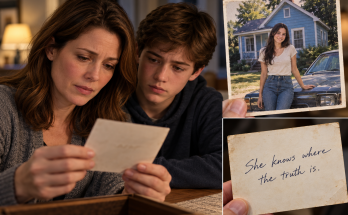
A young woman stood outside a small blue house.
An old sedan was parked beside her.
She looked toward the camera with a familiar expression.
And on the back, David had written a sentence that neither Ethan nor I could fully explain.
She knows where the truth is.
I had read those words so many times that I could almost hear David's voice when I remembered them.
That was the strange part.
I could recognize his handwriting instantly.
I could remember the way he wrote notes and the small habits that made his words feel like his.
Yet I could not tell what he had meant when he wrote that sentence.
The familiarity of his hand did not give me access to his thoughts.
I had to accept that.
It was not the ending I had imagined.
But it was the truth of where we stood.
Ethan and I had not discovered who the woman was.
We had not learned what she knew.
We had not established why the photograph had appeared in his backpack.
And we had not found an explanation that connected the message to his repeated visits to 3025.
Those questions remained open.
I could have treated that as a failure.
For a while, I did.
I had wanted to protect Ethan from whatever might be hidden behind the photograph.
I had wanted to make sure that David's message did not leave my son carrying something frightening alone.
I had wanted to be the mother who could look at a problem and find a way through it.
But I had been trying to do something no mother could promise.
I had been trying to guarantee that love would always provide an answer.
It could not.
Love could make me listen.
It could make me patient.
It could help me admit when I was wrong.
But it could not tell me what David had been thinking when he wrote those words.
It could not identify a woman I had never met.
And it could not turn an unexplained photograph into a complete story.
I had to stop asking it to do those things.
One evening, Ethan sat with me while the photograph rested on the table.
We had not taken it out for some time.
I wanted to look at it once more, not because I expected it to reveal anything new, but because I wanted to acknowledge what it had come to mean in our lives.
Ethan looked at the woman.
Then he looked at the sentence on the back.
"I still wish we knew."
I nodded.
"Me too."
He was quiet for a moment.
"Do you think we did something wrong by not figuring it out?"
I turned toward him.
"No."
The answer came more quickly than any I had given him before.
I wanted him to understand that I meant it.
"We didn't have enough information. We can't make ourselves responsible for knowing something we haven't been able to discover."
He looked down at the table.
I continued.
"And we shouldn't have to invent an answer just to feel better."
He nodded.
I could see that he was still disappointed.
I was, too.
But the disappointment no longer felt like something we had to hide from each other.
We could want the truth without pretending we had found it.
We could hope for an explanation without making promises about what would happen.
And we could admit that David had left something unexplained without deciding that his silence meant he had failed us.
I had spent so much time trying to understand what he wanted us to know.
I had not spent enough time considering that the message might remain incomplete for us.
That possibility had frightened me because it meant I could not control the ending.
But life had never promised me that kind of control.
I had simply grown accustomed to believing that if I loved someone enough, I could understand what they needed.
Now I knew better.
Sometimes the people we love carry questions they cannot explain.
Sometimes they leave words behind that make sense only to them.
Sometimes we inherit an uncertainty without receiving the information that would resolve it.
And sometimes the only honest thing we can do is acknowledge what has been left to us.
I looked at the photograph again.
The woman seemed less mysterious in one sense.
Not because I had learned anything about her.
Because I had stopped demanding that her face provide an answer it could not give me.
She was a woman standing outside a house.
She had a life beyond that picture.
She might have known David.
She might have known something important.
The sentence suggested that connection, but it did not explain it.
I could not tell her story for her.
I could only admit that I did not know it.
That realization brought a kind of sadness I had not expected.
I had spent so much time trying to make the woman into a clue that I had forgotten how little I knew about her as a person.
I did not know what she had experienced.
I did not know what she remembered.
I did not know whether she had ever seen the photograph again.
I could not assume that her life had been simple or difficult, ordinary or extraordinary.
The image did not tell me.
For the first time, I allowed that ignorance to remain without trying to fill it.
I turned the photograph over one last time.
David's handwriting was still there.
I ran my eyes across the sentence.
I remembered the grocery lists and birthday cards.
I remembered the little notes that had once made me smile.
I remembered the person whose handwriting I could recognize without thinking.
Those memories were still mine.
The photograph did not erase them.
It did not prove that I had misunderstood every part of David's life.
It simply reminded me that there had been parts I did not know.
I could live with that.
Not because it was easy.
Because it was honest.
I placed the photograph back in its safe place.
Then I closed the drawer.
I did not feel that I had solved anything.
I felt that I had finally stopped pretending I needed to solve everything before I could move forward.
Ethan was waiting for me when I returned.
He looked at me.
"Are you okay?"
I thought about the question.
I was still curious.
I was still worried about the unanswered connection between the photograph and 3025.
I still wished David had written something more that could have helped us understand.
But I was no longer trapped by the belief that I had to find the answer immediately.
"I'm getting there," I told him.
He nodded.
Then he moved closer, and I put my arm around him.
We sat together without talking.
I did not ask him what he was thinking.
He did not ask me to explain the photograph again.
We were simply together.
That moment mattered more to me than I expected.
I had spent so much time worrying about what David had left behind that I had nearly overlooked what was still in front of me.
My son was here.
He was willing to sit with me.
He was willing to admit that he did not understand something.
And he was allowing me to admit the same.
I could not give him the answer he wanted.
I could give him my attention.
I could give him honesty.
I could give him the reassurance that he did not have to pretend to know more than he did just to make me feel better.
Those were things I could actually offer.
I had learned that trust was not the absence of unanswered questions.
It was the decision to remain honest when the answers were missing.
It was listening without assuming.
It was admitting uncertainty without turning it into blame.
And it was loving someone without demanding that they make every mystery disappear.
I wished I had understood that earlier.
I wished I had been more patient when Ethan first began keeping things to himself.
I wished I had asked fewer questions simply to calm my own fear.
I wished I had trusted that a conversation could be valuable even when it ended without an explanation.
But I could not change those earlier moments.
I could only remember them and do better now.
The photograph remained unresolved.
The woman remained unknown.
The blue house remained a place we could see but could not explain.
And David's sentence remained a message whose meaning we had not discovered.
I did not want to pretend otherwise.
Perhaps one day we would learn more.
Perhaps another detail would help us understand why David had kept the picture.
Perhaps the connection to 3025 would become clearer.
I could leave room for those possibilities without treating them as promises.
For now, the truth was simple.
We did not know.
And we were learning how to live honestly with that fact.
I had once believed that the most important thing a mother could give her son was an answer.
Now I understood that sometimes the more important gift was the freedom to admit there wasn't one yet.
Ethan rested his head against my shoulder.
I held him close.
For a little while, I stopped thinking about the photograph.
I did not forget it.
I did not decide it was meaningless.
I simply allowed myself to be present with the person I loved.
That was what I had nearly lost while trying to understand what David had left behind.
I would not make the same mistake again.
The End
Read more original stories on Feel Every Story.
I Thought My Son Was Hiding Something Small Until One Question Made Me Wonder What He Had Been Carrying Alone
Part 20 of 20