
I thought the hardest part would be waiting for an answer.
I was wrong.
The hardest part was learning how to live with the questions without letting them change everything else.
The photograph stayed where I had put it.
I checked on it more often than I wanted to admit.
Sometimes I told myself I was making sure it had not been damaged.
Sometimes I simply needed to see that it was still there.
The paper had not changed.
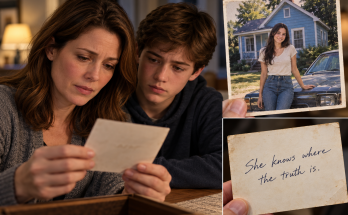
The woman still stood beside the old sedan, one hand resting on the hood.
The blue house remained behind her.
And David's sentence waited on the other side.
I had started to recognize how easily my thoughts returned to those few words.
She knows where the truth is.
The sentence had become familiar enough that I could remember it without looking.
That frightened me a little.
I did not want a message I could not explain to become the center of our lives.
Ethan had other things to think about.
So did I.
We still had ordinary responsibilities, ordinary conversations, and days when nothing seemed connected to the photograph at all.
I tried to let those moments remain ordinary.
I did not ask him about 3025 every time he mentioned going somewhere.
I did not watch his backpack whenever he entered the room.
I wanted him to feel that I trusted him.
More importantly, I wanted to learn how to do it without pretending I had stopped worrying.
One evening, Ethan came into the room while I was putting away some things.
He stood by the table for a moment.
Then he looked at me.
"Can I ask you something?"
"Of course."
He glanced toward the place where I had kept the photograph.
I knew what he wanted to discuss before he said another word.
"Do you think Dad left it for me?"
I stopped what I was doing.
It was a question I had tried not to ask myself.
Until then, I had thought of the photograph as something that had appeared in Ethan's backpack.
I had wondered whether David had meant for someone to find it.
But I had not considered carefully enough whether he might have intended Ethan to be that person.
I could see why the thought had occurred to my son.
The photograph had appeared among his belongings.
The message had been written by his father.
And now Ethan was the one holding the questions neither of us could answer.
Still, I could not tell him that the photograph had been meant for him.
I had no proof.
"I don't know," I said.
He lowered his eyes.
I could tell he had hoped I would say something more definite.
"Maybe Dad wanted me to find it."
"Maybe."
I sat down so that we were looking at each other rather than speaking across the room.
"But we don't know that yet."
He nodded.
I hated how often I had to give him that answer.
I hated it because I wanted to make things easier for him.
I also hated it because I had spent so much of my life believing that a mother's job was to make frightening things feel manageable.
Sometimes that meant offering comfort.
Sometimes it meant giving a child a clear answer.
And sometimes it meant refusing to invent certainty just because uncertainty hurt.
I was learning that last part later than I should have.
Ethan sat beside me.
For a while, neither of us spoke.
Then he asked another question.
"Did Dad ever tell you about a woman who looked like him?"
I thought carefully before answering.
I could not remember a conversation that clearly matched the photograph.
I could not recall a name connected to that face.
If David had spoken about her, I had no memory of it.
"No," I said. "Not that I remember."
He looked disappointed.
I felt the same disappointment.
But I also felt something else.
A strange sense that we were beginning to understand the limits of what we could learn from our own memories.
We could remember the things David had told us.
We could remember the things he had written.
We could not recover a conversation simply because we needed it now.
I reached for the photograph.
I did not turn it over.
I looked at the woman's face.
There was something unsettling about how ordinary she seemed.
She was not standing in a dramatic scene.
She was not holding a letter or pointing toward the house.
She was simply there, smiling at whoever had taken the picture.
If David had wanted someone to recognize her, he had given that person very little to work with.
Unless, of course, he believed the resemblance itself would be enough.
I looked at Ethan.
"Does she remind you of him?"
He nodded.
"Yes."
I did not ask him to explain.
We both saw it.
The slight lift at the corner of her mouth.
The thoughtful eyes.
The familiar way she held her shoulders.
It was not proof of a relationship, but it made the question difficult to ignore.
I placed the photograph back on the table.
"I wish I knew what he was trying to tell us."
Ethan looked at the writing on the back.
"Maybe he thought we'd understand."
I had wondered that, too.
Perhaps David had assumed the person who found the photograph would already know the story behind it.
Perhaps he had expected someone to recognize the woman and understand why she mattered.
Perhaps he had simply written down a thought that made sense to him at the time.
We could not tell.
The more possibilities I considered, the more careful I became about choosing one.
I did not want to build a story around David that was not true.
I had loved him.
That made it tempting to believe I could understand his intentions better than anyone else.
But love did not give me access to every thought he had ever had.
I needed to accept that.
Ethan seemed to be thinking about the same problem.
He picked up the photograph, examined the front, and turned it over.
Then he put it down again.
"If he wanted me to know something, why wouldn't he just tell me?"
I felt that question more deeply than I expected.
It was not an accusation.
It was a son's attempt to understand why a father might leave a message that created more confusion than clarity.
I had no answer that would make the question easier.
"I wish he had," I said.
Ethan remained quiet.
I wondered whether he was hurt.
I wondered whether he was angry with David.
I wondered whether he felt responsible for discovering something he had never asked to find.
I could have asked him all of those questions.
Instead, I let him sit with his own thoughts.
After a while, he stood.
"I'm going to put my bag away."
"All right."
He picked up the backpack and carried it toward his room.
I watched him leave.
The photograph remained on the table.
I looked at it once more.
For the first time, I understood that whatever David had intended, the message had reached us in a form that neither of us could fully understand.
We could not know whether he had meant Ethan to find it.
We could not know whether he had expected me to recognize his handwriting.
We could not know whether the woman had any idea that her photograph had been preserved.
All we could do was admit those limits.
I had once believed that unanswered questions were signs of failure.
Now I wondered whether the real failure would be to force an answer simply because I could not bear the silence.
I placed the photograph somewhere safe again.
Then I left it alone.
Not because it had become less important.
Because I was finally learning that taking something seriously did not mean thinking about it every minute.
Sometimes it meant giving yourself enough room to see it clearly.
Click here to continue reading: PART 10: The Blue House Kept Returning to My Thoughts, and I Began to Wonder Whether the Place Mattered More Than the Woman Standing Outside It
I Thought My Son Was Hiding Something Small Until One Question Made Me Wonder What He Had Been Carrying Alone
Part 9 of 20

One Comment on “PART 9 – I Thought We Had Learned to Live With the Photograph Until Ethan Asked Whether His Father’s Message Had Been Meant for Him”