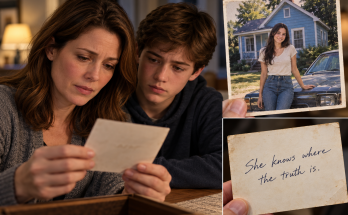
By then, the photograph had become part of our daily lives.
Not because we talked about it constantly.
We did not.
But I could feel its presence whenever I thought about Ethan's backpack or the number he kept returning to.
It was like an unanswered question sitting quietly in the next room.
I had begun to understand that I could not force the answer to arrive.
That did not stop me from wanting it.
Sometimes I took the photograph out and studied the woman's face.
Sometimes I read the sentence on the back.
Sometimes I put it away without looking at either side for more than a few seconds.
None of those things helped me understand what David had meant.
They only reminded me that I did not know.
I used to think not knowing was a temporary condition.
You asked enough questions.
You searched carefully enough.
Eventually, you found the missing piece.
I had lived long enough to know that was not always true.
Still, I had held on to the belief because it made uncertainty easier to bear.
Now I had to face a different possibility.
Perhaps the answer would take time.
Perhaps it would come from a detail we had not yet noticed.
Perhaps the photograph would remain a mystery for longer than either of us wanted.
I did not like any of those possibilities.
But I could not honestly rule them out.
Ethan seemed quieter in a different way now.
He was no longer trying to avoid every conversation about the photograph.
He would look at it when I took it out.
He would answer my questions when he knew the answers.
When he did not, he said so.
I was grateful for that small change.
It reminded me that trust was not something I could demand simply because I was his mother.
It was something we had to keep giving each other.
I had made mistakes.
I had pushed too hard when I was frightened.
I had accepted short answers because I did not want to risk hearing a difficult truth.
I had told myself I was protecting our relationship when I was sometimes only protecting myself from uncertainty.
Looking back, I could see how much of my worry had been tangled up with my need to understand.
I wanted to know what was happening because I wanted to help.
But I also wanted to know because not knowing made me feel powerless.
Those were not the same thing.
I had to admit that.
One evening, Ethan sat across from me with the photograph between us.
He studied the young woman's face for a while.
Then he looked at the writing.
"Do you think she really knows?"
I considered the question.
David had written the sentence as though he believed she did.
That much seemed clear.
But a person's belief was not proof.
"I think he wanted someone to look for her," I said.
Ethan looked at me.
"Why wouldn't he just write her name?"
I had wondered the same thing.
Perhaps he had not known whether the photograph would reach the right person.
Perhaps he had expected the person who found it to recognize the woman.
Perhaps there was another reason entirely.
I could not choose an explanation simply because it sounded convincing.
"I don't know," I told him.
He nodded.
There was no anger in his face.
Only frustration.
I felt it, too.
The photograph had brought us closer to a question without bringing us closer to its answer.
For a while, we sat quietly.
Then I turned the photograph over and read the sentence once more.
I tried to imagine David writing it.
I could picture his hand moving across the paper.
I could picture him pausing before the final word.
But I could not know whether that was what had happened.
The image existed only in my mind.
I had to be careful not to mistake it for a memory.
That realization made me put the photograph down.
I was tired of inventing scenes around the edges of what we knew.
I wanted the truth.
Not a version I had assembled from fear, hope, and a few familiar letters.
Ethan reached for the photograph.
He held it by the edges, careful not to bend it.
Then he placed it back on the table.
"We should keep it safe," he said.
"Yes."
He looked at me.
"And we shouldn't pretend we understand it."
I felt a small, unexpected relief.
He had said aloud what I had been trying to teach myself.
We did not need to solve the mystery by inventing an answer.
We needed to admit what we knew and leave room for what we did not.
I nodded.
"You're right."
He seemed surprised that I agreed so quickly.
Perhaps I had not always made it easy for him to disagree with me.
That thought stayed with me.
Parents often talk about trust as though it belongs entirely to their children.
We want them to trust our judgment.
We want them to come to us when something goes wrong.
We want them to believe that we will listen.
But trust moves in both directions.
I had to trust that Ethan could tell me what he knew.
I had to trust him when he admitted what he did not know.
And I had to trust myself enough to sit with an unanswered question without turning it into an accusation.
That was harder than I expected.
The photograph remained on the table.
The woman still looked toward the camera.
The old sedan still stood beside her.
The small blue house still gave us no explanation.
And David's sentence remained exactly as it had been.
She knows where the truth is.
I no longer read those words as an answer.
I read them as a reminder that the truth, if we ever found it, might belong to someone whose story I had never heard.
That thought changed the way I looked at the woman.
She was no longer simply a face that resembled David.
She was someone who had stood outside that house, at some unknown point in the past, and had become important enough for him to leave a message about her.
I did not know whether she had ever seen the photograph.
I did not know whether she understood what David had written.
I did not know whether she was still connected to the place shown behind her.
Those questions remained open.
For once, I did not try to close them with guesses.
I placed the photograph somewhere safe and returned to the room where Ethan was waiting.
He looked at me.
"Are we going to be okay?"
The question was quiet.
I could have promised him that everything would turn out well.
I could have told him there was nothing to worry about.
Instead, I sat beside him.
"I don't know exactly what we're going to find," I said. "But we can face it honestly."
He looked down for a moment.
Then he leaned back in his chair.
It was not a perfect answer.
It was the truest one I had.
And for the first time since the photograph appeared, I felt that we were no longer standing on opposite sides of the same uncertainty.
We were facing it together.
Click here to continue reading: PART 9: I Thought We Had Learned to Live With the Photograph Until Ethan Asked Whether His Father’s Message Had Been Meant for Him
I Thought My Son Was Hiding Something Small Until One Question Made Me Wonder What He Had Been Carrying Alone
Part 8 of 20