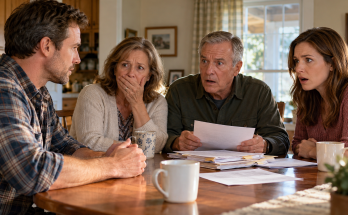
For several days, the photograph remained where we had put it.
We did not discuss it every morning.
We did not take it out every evening.
But it had not disappeared from our thoughts.
I could tell by the way Ethan sometimes glanced toward the place where it was kept.
I did the same thing.
We had learned to leave the question alone for a while without convincing ourselves it no longer mattered.
That was progress.
Small progress.
Still, I wondered what we were supposed to do next.
The photograph had given us no name.
The sentence had given us no explanation.
The woman's resemblance to David remained striking, but it did not prove anything about their relationship.
The blue house offered no information beyond the fact that she had stood in front of it.
I could not see a clear path from those details to an answer.
I was beginning to accept that we might need something beyond our own memories.
But I did not know what that something would be.
I had no reason to assume another clue existed.
I could not pretend that the photograph promised one.
All I could do was remain open to what we might learn without deciding in advance what the truth had to be.
One evening, Ethan sat down beside me.
He seemed to have been thinking about something for a while.
"Do you think we should keep looking?"
I turned toward him.
I knew what he meant.
He was asking whether the photograph deserved more of our attention or whether we should leave it alone until we understood something else.
I wanted to give him a clear answer.
Instead, I took a moment to think.
I did not want us to become consumed by the mystery.
I did not want the number 3025, the photograph, and David's sentence to take over every part of our lives.
But I also did not want to dismiss something that had clearly unsettled both of us.
There was a difference between refusing to obsess over a question and refusing to ask it at all.
"We can keep trying to understand it," I said. "We just shouldn't pretend we know more than we do."
Ethan nodded.
"That makes sense."
I felt relieved.
Not because we had chosen a direction.
Because we had found a way to agree without forcing an answer.
He looked toward the place where the photograph was kept.
"I keep thinking about what Dad wrote."
"So do I."
"She knows where the truth is."
He said the words slowly.
I could hear the frustration in his voice.
The sentence seemed so direct.
It pointed toward a person.
It suggested that something was known.
Yet it gave us no way to understand what that something might be.
I knew how he felt.
The words had become a kind of weight.
Every time I remembered them, I felt that there was something just beyond my reach.
I wanted to move closer.
I wanted to find the missing piece.
But I did not want to make a careless decision just to feel that I was doing something.
"We'll keep the photograph safe," I said. "And we'll remember what we actually know."
Ethan looked at me.
"What do we know?"
The question was simple enough that I answered carefully.
"We know the woman was photographed outside that house. We know the writing is your father's. And we know neither of us can explain why the photograph ended up in your backpack."
He listened.
"We also know that we don't know who she is."
He nodded.
I could see him thinking through the details.
"And 3025," he added.
"Yes. And 3025."
We sat quietly.
I was struck by how little we could say with certainty.
Yet those few facts mattered.
They gave us a place to begin without allowing our imaginations to take over.
I had once believed that the right answer would make everything else fall into place.
Now I wondered whether the truth would arrive more slowly.
Perhaps it would come through a memory.
Perhaps through something we had not yet noticed.
Perhaps we would have to accept that some parts of David's past would remain unknown.
I could not promise Ethan that we would discover everything.
I could promise that I would not stop listening simply because the questions made me uncomfortable.
That felt like a promise I could keep.
He stood and went to retrieve the photograph.
When he returned, he placed it carefully on the table.
We looked at the woman together.
I tried to see her as a person rather than a puzzle.
She had stood in front of a house.
She had rested one hand on a car.
She had looked toward a camera.
Whatever else was true about her, she had once been someone living a life we knew almost nothing about.
That thought made me feel a little ashamed of how quickly I had turned her into a collection of clues.
I wanted to know what she knew.
I wanted to understand why David had written those words.
But she was not merely an answer waiting for us to find.
She was a person whose story had not yet been explained to us.
I could not assume that her life existed only because it connected to ours.
I turned the photograph over.
David's handwriting was still there.
I read the sentence once.
Then I put the photograph down.
I did not need to read it ten times to prove that I was taking it seriously.
Ethan watched me.
"Are you worried?"
I considered telling him no.
It would have been easier.
But I had promised myself that I would stop using reassurance as a way to avoid difficult conversations.
"Yes," I said. "A little."
He nodded.
"Me too."
There was something comforting about hearing him say it.
Not because I wanted him to be frightened.
Because neither of us had to pretend that the situation was simple.
I reached across the table and rested my hand beside his.
"We don't have to solve it tonight."
He looked at our hands.
Then he nodded again.
We put the photograph away.
The room felt ordinary afterward.
The same table.
The same chairs.
The same quiet evening.
But I no longer felt that the unanswered question was something we had to defeat before we could move forward.
It could remain unanswered for now.
We could continue living.
We could continue talking.
And if something helped us understand the photograph later, we would face that information when it came.
I had spent too much time treating patience as a kind of surrender.
Now I understood it differently.
Patience meant refusing to invent an answer.
It meant giving the truth room to be something other than what I feared.
And it meant accepting that I could love my son, remember David, and still admit that I did not understand the story connecting them to that photograph.
I was not satisfied.
I was not finished wondering.
But I was no longer trying to make the uncertainty disappear simply because I could not bear to look at it.
For that evening, it was enough.
Click here to continue reading: PART 13: I Had Stopped Expecting the Photograph to Explain Itself, but One Ordinary Conversation Made Me Realize How Much We Still Had Not Understood
I Thought My Son Was Hiding Something Small Until One Question Made Me Wonder What He Had Been Carrying Alone
Part 12 of 20