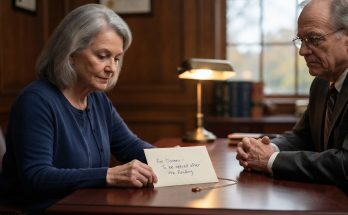
The pounding began while I was standing at the kitchen sink with Harold’s letter spread beneath the window. Not a neighbor’s knock. Not the light double tap of a delivery driver. Someone struck the front door with the flat of a hand and waited only a second before doing it again.
Through the curtain, I saw Melissa on the porch holding a cardboard box. Kevin stood behind her in sunglasses, although evening had turned the yard gray. A folded document protruded from his jacket pocket.
I called Bernard before opening the door.
“They’re here.”
“Who?”
“Both of them. Kevin has papers.”
“Do not sign anything.”
“You have repeated that enough for me to understand.”
“I am going to repeat it until they leave.”
I slipped Harold’s pages and the survey into a kitchen drawer, locked it, and put the key in my pocket. Then I opened the door but left the storm door latched.
Melissa lifted the box. “These are your things.”
“What things?”
“Clothes, kitchen items, photographs. Whatever we found that obviously belonged to you.”
The word obviously concerned me. Fourteen years of shared possessions did not divide neatly into his and hers. Harold’s coffee mug had been mine every morning because I filled it. The quilt on our bed was mine because I made it, though he had slept beneath it.
“You packed my belongings without permission?”
“We’re preparing the house for sale.”
“Nine days after his funeral.”
Kevin leaned against the railing. “Keeping it empty costs money.”
“Then you have inherited your first responsibility.”
Melissa’s fingers whitened against the box. Something inside clinked when she set it down. “We also need the fourth garage remote.”
“One broke last winter. Bernard has the remaining keys.”
“There should be four.”
“There should also be a living man inside that house. Circumstances change.”
Kevin took off his sunglasses. His face showed strain beneath the impatience. “We didn’t come to argue.”
“That is fortunate. You are not dressed for the weather.”
Melissa gave him a warning glance. He ignored it and pulled out the folded paper.
“There’s an old boundary problem involving the Route 9 parcel,” he said. “This acknowledges the corrected line so we can clear title to the house.”
“The house is not connected to Route 9.”
His eyes sharpened. “Who told you that?”
“The deeds.”
“You have seen them?”
I did not answer.
Melissa stepped closer to the storm door. “Nobody wants your trailer, Doreen. We’re cleaning up Dad’s estate, and one description overlaps another. Sign the acknowledgment and everybody can move on.”
“Leave it with Bernard.”
“It does not need a lawyer.”
“Anything that does not need a lawyer can survive being read by one.”
Kevin unfolded the paper and held it against the glass. The print was small, but the heading was large enough to see: QUITCLAIM ACKNOWLEDGMENT AND BOUNDARY RELEASE. Beneath that appeared the name VANCE FAMILY HOLDINGS LLC.
“What is Vance Family Holdings?”
Neither replied.
“Kevin?”
“We created it to manage estate property.”
“When?”
“That isn’t relevant.”
“It became relevant when you put its name above mine.”
Melissa shifted the box with her foot. “You’re making this difficult because you’re angry about the will.”
“No. I am being careful because Harold asked me to be.”
Her head snapped up. “When did he ask you?”
The question revealed more than she intended. She was not surprised that Harold had given instructions. She wanted to know when and, perhaps, where they had been kept.
“Before he died,” I said.
“What exactly did he tell you?”
“To recognize impatience when it came to my door.”
Kevin lowered the document. “You think we’re trying to steal a weed field?”
“I think you drove here before dinner with a paper you did not want my lawyer to see.”
His mouth tightened. Melissa reached for the storm-door latch, found it locked, and stared at me through the glass.
“Dad felt sorry for you,” she said. “That is why he left you something at all.”
She designed the sentence to enter beneath the ribs. Once, it might have. But Harold’s handwriting waited in the drawer behind me, and his care occupied four pages no one else had read.
“Perhaps he did,” I said. “But he trusted me.”
Melissa lifted the box so abruptly that glass cracked inside. She thrust it into Kevin’s arms and walked toward the car. At the steps, she turned.
“You have until Saturday to remove everything else.”
“Bernard will arrange access.”
“It is not your house anymore.”
“No,” I said. “But my property is still mine.”
Kevin remained another moment. His eyes moved toward the kitchen behind me. “What did Bernard give you after we left?”
“Advice.”
“Was that all?”
“It was enough.”
He followed his sister to the car.
I waited until their taillights disappeared, then photographed the tire tracks, the box they had left despite my refusal, and the broken edge of whatever lay inside. Bernard listened without interrupting while I described the quitclaim document.
“They brought it directly to your home?” he asked.
“Yes.”
“Did you see who prepared it?”
“Only the company name.”
“Vance Family Holdings?”
“Yes.”
His keyboard clicked in the background. “The company was registered six days after Harold died. Kevin is the organizer.”
“What does it own?”
“Nothing, according to the filing.”
“Then why claim estate assets?”
“I intend to ask their lawyer.”
“They have a lawyer?”
“They do now. Thomas Redding filed a notice of representation this afternoon.”
I sat at the kitchen table. “They knew about the survey before the will reading.”
“Possibly.”
“That is lawyer language.”
“It means I will not accuse them without evidence.”
“I found their evidence in my trailer.”
I told him about the swept counter, the boot prints, and the torn phrase. His silence lasted so long that I checked the phone.
“Are you there?”
“Yes. Put that paper somewhere secure. Tomorrow morning, bring it to my office.”
“What could they gain from my signature?”
“If the release uses the description I suspect, it could transfer the disputed acreage to their company or surrender rights essential to your negotiating position.”
“They called it a corrected boundary.”
“Fraud often arrives under a boring title.”
After we hung up, I returned to Harold’s letter.
The second page explained the acreage. In 1978, Harold’s father had divided the old Vance property. A clerk copied one deed description incorrectly, and later tax maps treated parcel 44-118 as roughly ten acres. The legal boundary, properly traced, crossed the creek and followed the ridge. Because the land had little market value then, no one paid to reconcile the records.
Until surveyors wearing expensive boots began standing in the creek with satellite equipment.
I could hear Harold in that observation. He had distrusted men whose footwear cost more than their tools.
The third page disclosed that mineral rights had never been severed from twenty-nine acres. Harold warned me not to imagine an oil field. The rights might prove worthless, he wrote, or they might matter greatly. Either way, anyone claiming they belonged elsewhere was lying or had failed to examine the chain of title.
Then came the reason he had hidden everything from me.
He knew I would worry. Worse, he believed I might try to divide the property with Melissa and Kevin out of guilt. I had spent years making peace by giving up the larger piece, the better chair, the first choice, the last word. Harold had watched me do it and understood the cost before I did.
He wrote that I had given him fourteen good years. I sat beside him when he was ill, never asked how much money he possessed, and never treated him like a dying man. I had made him feel like a husband. In return, he wanted me protected from the moment his children stopped pretending I was family.
The last instruction had no legal phrasing.
You do not owe anyone the same inheritance twice.
I reached his signature before the words blurred. Harold had never apologized with flowers. He repaired a loose hinge, filled my gas tank, or placed a cup of coffee beside my hand. Even dead, he had chosen land and paperwork over eloquence. Yet I heard him more clearly in those pages than I had heard anyone at his funeral.
At Bernard’s office the next morning, I handed him the torn document fragment. He sealed it in an evidence envelope and summoned his paralegal, Anna, to witness where I had found it. Then he placed two acquisition files on the conference table.
The first bore Cardinal Midstream’s blue logo. Its preliminary offer was one million eight hundred fifty thousand dollars.
I stared at the figure until the commas lost meaning. “For the parcel?”
“For the corridor, a facilities site, and specified access rights.”
“For weeds.”
“For location.”
A second provision proposed annual site-use payments between eighty and one hundred twenty thousand dollars, subject to the final agreement. Harold and I had once postponed replacing a refrigerator because nine hundred dollars seemed extravagant. Now the burned trailer could produce more money each year than either of us had ever earned.
“Do we accept?”
“No.”
The answer came so quickly that I laughed. “I have never been wealthy enough to call nearly two million dollars inadequate.”
Bernard opened the second folder. “Appalachian Infrastructure Partners approached Harold in January. They need ridge access. Their route overlaps Cardinal’s at the northeast corner, and their alternatives require extensive grading and a bridge.”
“Have they offered anything?”
“Not formally.”
“Then Cardinal is the only buyer.”
Bernard slid Harold’s yellow legal pad toward me. Three blunt lines filled the page. Appalachian preferred to buy rather than lease. Cardinal did not know Appalachian had entered discussions. Harold had underlined one final warning: DO NOT NAME A PRICE FIRST.
“He was setting them against each other,” I said.
“Harold would say he was allowing adults to reveal their priorities.”
That sounded exactly like him.
Cardinal’s land agent called while I was still there. Ruth Ann’s voice remained professional, but a new caution threaded through it when Bernard joined the line. She described the offer as generous compared with ordinary rural values.
I asked whether Cardinal needed my land.
“We have alternative routes,” she replied.
Bernard wrote on his pad and turned it toward me: ASK THEIR COST.
“How expensive is the alternative?”
A pause followed—short, but not short enough.
“That information is outside my authority to discuss.”
The questions she declined answered the one that mattered. Cardinal could go elsewhere, but not cheaply. Bernard smiled for the first time all morning.
Twenty minutes after that call ended, Appalachian’s land director contacted us. Evan Markham skipped condolences and spoke with the briskness of a man whose project schedule had begun slipping. He wanted eighteen acres for a service corridor and access road.
Before discussing value, he asked whether Cardinal had approached me.
Bernard wrote: DO NOT ANSWER.
“Why does that concern you?” I asked.
“Because our proposed routes overlap.”
“I know.”
Silence changed his voice. He stopped speaking to me as though I were an uninformed widow holding a patch of brush. When the conversation ended, he promised a formal offer by Monday.
“What range?” Bernard asked.
“More than Cardinal,” Evan said, and disconnected.
Bernard looked almost delighted. “Now we wait.”
His secretary appeared in the doorway before I could answer. “Mr. Skiles, Kevin Vance is here. He says the matter is urgent.”
Kevin entered carrying a brown folder. He looked first at Harold’s letter, then at the corrected survey, then at Cardinal’s proposal partly visible beneath Bernard’s hand.
His face drained of color.
“I went to the county records office,” he said. He opened the folder and pulled out his own copy of the survey. “That lot is almost fifty acres.”
Neither Bernard nor I answered.
Kevin’s gaze dropped to Cardinal’s logo. Understanding assembled itself across his face—acreage, corridors, corporate interest, the document I had refused to sign.
“That land isn’t worthless,” he whispered.
I let the silence confirm it.
“How much did they offer?”
Bernard covered the proposal. “That information belongs to Mrs. Vance.”
Kevin turned on me. “Dad was sick. You were with him every day. You made him change the will.”
“He was ill,” I said. “He was not incapable.”
“We can challenge it.”
“You may try,” Bernard replied.
Kevin’s anger faltered at the lawyer’s calm. “Melissa has already spoken to counsel.”
“Then counsel should explain Harold’s forfeiture clause.”
Kevin stared. “What clause?”
Bernard folded his arms. “Any beneficiary who contests the will without probable cause and loses may forfeit every inheritance received under it.”
“The house?”
“Potentially.”
“The account?”
“Potentially.”
Kevin looked at the survey in his hands, then at the papers on Bernard’s desk. Greed had brought him into the room. Fear escorted it out.
At the doorway, he turned toward me.
“This is not finished.”
“No,” I said. “Your father made certain of that.”
Click here to continue reading: PART 5: When I Returned for My Belongings, Harold’s Empty Desk Revealed That His Children Had Taken More Than Furniture
Before Harold Was Buried, His Children Had Already Decided Which Parts of Our Life Belonged to Them
Part 4 of 20