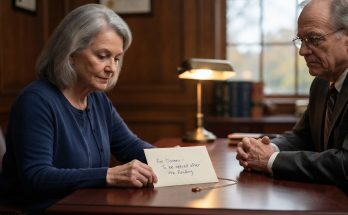
Melissa placed the document pouch on Harold’s desk but kept the brass key in her palm. Dust streaked one side of her face. A pry bar lay on the rug beside the loosened panel.
“How did you find it?” I asked.
“I was looking for the Bible.”
“The Bible had already been returned.”
“I did not know that.”
Kevin stood in the doorway. “Why were you still searching?”
Melissa ignored him. “There was a pencil mark behind the bottom drawer. Dad used to mark wall studs when he repaired things. This mark was shaped like an arrow.”
She gave me the key.
“Why did you not open it?”
“My name is not on the envelope.”
The answer surprised all three of us.
I called Bernard. He told us not to move the pouch and arrived with Anna forty minutes later. Ruth Ann came after him wearing work trousers and Cardinal boots, her hair still damp from the rain.
When she saw her name, she stopped in the doorway.
“He told you about this?” I asked.
“No.”
Bernard photographed the compartment, pouch, key, seal, and every hand that touched them. Harold would have enjoyed the solemnity. He had once stored the title to his truck in a coffee tin marked ROOFING NAILS.
The key opened a small lock beneath the flap. Inside were two signed trust agreements, a letter to Ruth Ann, and a video drive wrapped in waxed paper.
The first trust was the conservation instrument we already knew. The second bore a longer name: THE VANCE-LAWSON WATERSHED AND COMMUNITY TRUST.
Ruth Ann sat down.
Harold had signed as holder of the Vance interest. A blank acceptance line waited for the Lawson successor. If Ruth Ann executed it, both halves of the historic watershed approval would join one structure. Neither family could sell separately. The trust would license access, fund conservation, and direct part of all revenue toward community water systems.
“He offered me this in January,” Ruth Ann said.
“You knew it existed?”
“I knew the proposal existed. I did not know he had prepared a final signed copy.”
“Why did you refuse then?”
“I did not refuse. I told him I needed time.”
“Ten months?”
“My grandmother spent fifty years saying a Vance would steal our rights if we gave him the chance.”
Kevin shifted near the door. “Dad was a Vance.”
“Yes.”
“So are we.”
Ruth Ann met his eyes. “Exactly.”
Bernard read Harold’s letter aloud only after Ruth Ann agreed. Harold acknowledged the old feud without trying to decide which dead relative had lied first. He wrote that both families had protected half a right so fiercely that neither had used it to protect anything else.
He proposed one trust because divided authority made them vulnerable. Companies could isolate one heir, offer quick money, and use that agreement against the other. Combined control would force every bidder to negotiate openly.
Harold’s letter ended with an instruction to judge Doreen by what she did when offered more money than she could imagine.
I looked at Ruth Ann. “That seems unfair.”
“To you?”
“To anyone being examined by a dead man.”
The corner of her mouth lifted. “He said you would object.”
The video drive contained a recording made in Bernard’s office on January seventeenth. Harold sat upright at the conference table, thinner than I remembered but alert. A physician asked him the date, location, names of his children, description of his property, and consequences of the transfers.
He answered every question correctly.
Then Bernard asked why he was placing Vance Ridge in trust for me rather than dividing it between Melissa and Kevin.
Harold looked directly into the camera.
“My children think ownership means getting to sell first,” he said. “Doreen thinks ownership means being responsible for what happens afterward. The land needs the second kind.”
Melissa turned her face away.
Harold explained the Route 9 deed, the watershed right, the Northstar negotiations, and the risk that his death would trigger a family contest. His speech was occasionally slow, but his reasoning was precise. When the doctor asked whether medication influenced his judgment, Harold replied that medication influenced his digestion and patience, neither of which was relevant to title.
Even Bernard laughed on the recording.
The doctor certified Harold’s capacity. Two independent witnesses confirmed the signatures. The video dismantled Dr. Pike’s affidavit without accusing Pike of lying. Harold had experienced intermittent confusion in November. But he signed the trust in January while fully competent and reaffirmed the will during documented lucid periods.
Kevin watched his father describe the no-contest clause.
“I do not want to disinherit them,” Harold said. “I want them to pause long enough to understand what they are risking.”
Melissa covered her mouth.
“If they challenge because they honestly believe something is wrong, Bernard can show them this. If they keep going after that, they have chosen the fight over what I gave them.”
The recording ended with Harold alone for a moment after the witnesses left. He believed the camera had stopped. Bernard stepped offscreen, and Harold rubbed both hands over his face.
“Think it will work?” he asked.
Bernard’s voice answered. “Which part?”
“Any of it.”
“I do not know.”
Harold looked toward the empty chair beside him. “They are not bad children. They just started measuring the wrong things.”
The screen went black.
No one spoke for several minutes.
Kevin walked to the window. Melissa sat in Harold’s chair, tears slipping silently down her cheeks. Ruth Ann held the unsigned trust in both hands.
“I need air,” she said.
We went to the back porch. The hydrangeas had gone brown beneath the cold. Harold’s swing was missing because Kevin had removed it with the other furniture, leaving two empty hooks above us.
Ruth Ann leaned against the railing. “My grandmother would tell me not to sign.”
“What would you tell yourself?”
“That I do not know you.”
“That is true.”
“You could take the companies’ money and leave me responsible for the restrictions.”
“The trust does not allow that.”
“Trusts can be amended.”
“Not this one without both family votes and independent approval.”
“You have lawyers.”
“So do you.”
She looked toward the garden. “Harold said you would resist selling everything.”
“He knew me when money meant nine hundred dollars for a refrigerator.”
“It means more now.”
“I still need somewhere to keep food cold.”
That drew a quiet laugh.
I told her I would not sign either corporate proposal until independent hydrologists evaluated the spring. I wanted permanent monitoring, restoration obligations, and penalties large enough that no company would treat them as operating costs. I also wanted money directed to homes with contaminated or failing wells.
“Why community water?” she asked.
“Because owning control over water while someone nearby cannot drink from a tap would make us exactly like the people Harold distrusted.”
Ruth Ann studied me for a long time. “He said something similar.”
“What?”
“That rights matter only when they protect someone who cannot buy their own.”
She did not sign that night.
The next morning, Northstar raised its proposal to one hundred twenty million dollars. Allegheny answered with one hundred twenty-four million and broader environmental protections. Both offers assumed they could separately negotiate Ruth Ann’s share.
Bernard rejected both.
The federal investigation recovered the original 1992 deed from Caleb’s locked file cabinet. Franklin had remembered correctly: it conveyed Vance Ridge to Harold alone and contained no continuing descendant interest. Caleb had concealed it while circulating the preliminary draft.
Kevin’s claim collapsed.
David Mercer resigned from Northstar after internal emails showed he had approved payments to Caleb’s acquisition firm, though investigators had not yet determined whether he knew about the stolen documents. Franklin demanded an independent committee control all future negotiations.
Caleb was charged with possession of stolen estate records, wire fraud, and making false title representations. The criminal case would take time, but he could no longer negotiate for Vance Family Holdings.
Redding withdrew the probate notice. Dr. Pike supplemented his affidavit, clarifying that Harold’s confusion had been intermittent and that he had never declared Harold incapable of making decisions. He expressed anger that his narrow medical statement had been presented as a conclusion about legal capacity.
The will remained intact.
Kevin retained his interest in the house after Bernard negotiated additional time with the lender. Melissa returned my mother’s china, Harold’s brown jacket, and the porch swing. She had found the jacket folded inside a donation bag in the garage.
Neither apologized in a grand way. Kevin helped rehang the swing. Melissa polished the china cup she had cracked and set it on my kitchen table with the fracture still visible. Their behavior had not become kind, exactly, but it had stopped being careless.
Three weeks after the hidden pouch was opened, Ruth Ann asked me to meet her at Route 9.
We stood beside the burned trailer while wind moved through the dry weeds. Survey flags from Cardinal, Appalachian, Allegheny, and Northstar marked the ground in four colors. What once looked abandoned now resembled a board on which powerful companies had placed their pieces.
Ruth Ann held the Vance-Lawson trust agreement.
“I watched how you handled the offers,” she said.
“I have handled nothing. Bernard keeps telling everyone to wait.”
“That counts.”
She signed the acceptance on the hood of her truck.
The Lawson half joined the Vance half.
For the first time since 1963, one conservation structure controlled the entire recorded watershed right.
Ruth Ann capped the pen and handed it to me.
“Now,” she said, “let’s find out what they were trying not to pay for.”
Click here to continue reading: PART 12: With Both Families’ Water Rights United, the Bidding Stopped Being About Land and Became a Decision About What Survived
Before Harold Was Buried, His Children Had Already Decided Which Parts of Our Life Belonged to Them
Part 11 of 20