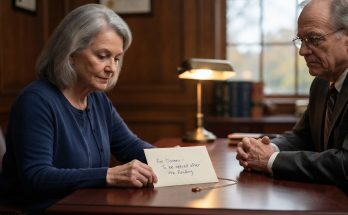
Kevin left Bernard’s office without another word. The outside door struck its frame hard enough to tremble through the floorboards, and then the building settled into the ordinary noises of a weekday morning: pipes ticking, a telephone ringing beyond the reception desk, tires brushing wet pavement below. I kept looking at the doorway as if Kevin might return with a different face.
“You knew about the forfeiture clause,” I said.
Bernard gathered the survey pages Kevin had left crooked on the table. “Yes.”
“And you neglected to mention it.”
“I retained it until it became useful.”
“That sounds like something Harold taught you.”
“Your husband regarded timing as part of the truth.”
The clause did not make a challenge impossible. Bernard explained that courts applied such provisions carefully, especially when beneficiaries alleged incapacity or undue influence. If Kevin and Melissa produced credible evidence, they might pursue the case without forfeiting their inheritance. But if they filed accusations merely to frighten me into surrendering the land, Harold had made the cost unmistakable.
By Friday, Melissa had called seven times. Kevin called twice. I answered neither. A third number left a message from a man named Thomas Redding, who identified himself as counsel for both of them “regarding probate irregularities and unresolved real-property concerns.” His voice was smooth, unhurried, and expensive. I forwarded the recording to Bernard.
His response contained four words: Do not call him back.
Saturday morning arrived cold and cloudless. Bernard sent his paralegal, Anna, to accompany me to the house on Ashwood Lane. I had thought that unnecessary until I saw half my belongings stacked inside the foyer like freight awaiting collection.
Coats hung over cardboard wardrobe boxes. My mother’s china had been wrapped in old newspaper and jammed into a produce carton. Books, photo albums, shoes, kitchen utensils, and Christmas ornaments covered the hardwood floor. Someone had placed my sewing basket upside down. Spools of thread rolled beneath the radiator.
Melissa stood at the foot of the stairs holding a mug that had belonged to Harold. “We made it easier for you.”
Anna took out her phone and began photographing the boxes.
Melissa’s gaze sharpened. “What is she doing?”
“Recording the condition of my property.”
“This is a house, not a crime scene.”
Anna photographed the cracked china cup visible beneath the cardboard flap. “No one called it a crime scene.”
The hallway already looked unfamiliar. The family photographs had been removed, leaving pale rectangles against the wallpaper. Harold’s recliner was gone from the den. So was the wooden rack where he had kept his walking sticks. The house did not seem emptied so much as edited.
“Where is his chair?” I asked.
“Kevin took it.”
“And the boat?”
“He moved it to storage.”
“You mean he moved estate property before Bernard authorized him.”
Melissa took a measured sip from the mug. “The boat belongs to Kevin.”
“When probate is finished.”
“Are you here for your things or another lecture?”
I went upstairs.
Our bedroom smelled of dust and the lavender sachets Melissa’s mother had used in the closets decades earlier. My dresser drawers stood open and empty. Harold’s side of the closet had been cleared. Even the wire hangers were gone.
“What happened to his clothes?”
Melissa remained in the doorway. “We donated them.”
“All of them?”
“He cannot wear them, Doreen.”
The answer was cruel because it was also true. I saw Harold in his green flannel shirt, standing at the kitchen counter and peeling an apple in one continuous strip. I pictured the brown jacket that had hung behind the study door, its pockets always filled with screws, receipts, and peppermints.
“The brown field jacket was left to me.”
“If we find it, you can have it.”
“It hung in the same place for twelve years.”
“Then maybe Dad moved it.”
“He was barely able to cross the room during his last week.”
Melissa looked away first.
I checked the bedside table. Empty. Harold had kept reading glasses, cough drops, two pencils, and his black Bible inside the upper drawer. The glasses were in a box downstairs. The Bible was missing.
“Where is it?”
“What?”
“Harold’s Bible.”
She folded her arms. “We donated books.”
“You donated the Bible beside his bed?”
“I did not personally inventory every paperback.”
“It was black leather. His name was stamped on the cover.”
“Why do you care? You already have your private letter from him.”
Anna lowered her phone.
I turned slowly. “How do you know about that?”
Melissa’s lips parted, then pressed together.
“Kevin saw papers on Bernard’s desk,” she said.
“He saw an envelope. He could not read the letter.”
“Then Bernard mentioned it.”
“No.”
She lifted one shoulder. “I don’t know what Kevin saw.”
I walked past her, down the stairs, and into Harold’s study. The room had been searched. Desk drawers gaped open. Envelopes and outdated insurance statements lay scattered across the rug, but the gray metal filing box was gone from beneath the desk.
The space where it had sat was outlined in dust.
“Where is the filing box?”
Melissa followed me into the room. “What filing box?”
“Gray metal. Two latches. Heavy enough to mark the carpet.”
“No idea.”
“It contained our tax records.”
“Maybe Dad threw it out.”
“He did not.”
“How can you know everything he did?”
“Because I lived here.”
Her eyes shifted toward the empty space under the desk. The movement lasted no more than a second, but grief had taught me to study small physical betrayals: the hand Harold hid when it trembled, the tightness near his mouth when pain sharpened, the way a nurse avoided my eyes before delivering bad news.
I looked at Anna. “Photograph the desk and the floor.”
Melissa stepped between her and the empty space. “Are you accusing me of stealing from my own father?”
“I am saying his records are missing.”
“This is our house now.”
“His files are part of the estate,” Anna said. Her voice remained calm. “Removing them could violate the probate order.”
“Stay out of family business.”
“I am here because family business has become legal business.”
Anna took the photograph.
The missing box mattered for reasons I had only begun to remember. Years earlier, Harold had shown me a manila folder filled with letters concerning Route 9. I had glanced at survey maps, tax notices, and correspondence bearing company logos. When I asked why he kept old papers, he said old papers were often the only ones that remembered what people had agreed to.
Someone had known where he kept those papers.
I found three photographs of us behind a row of tax books. One showed Harold repairing the porch rail. Another had been taken at the county fair, his hat tilted back and powdered sugar clinging to his shirt. The third showed us beside the Route 9 gate on a summer afternoon. Behind Harold, almost hidden by brush, stood a white survey marker.
I turned the photograph over. In his handwriting, he had written: NORTHEAST CORNER—CHECK OLD LINE BEFORE ANY SALE.
Melissa watched me read it.
“What does that say?”
“A grocery list.”
Her expression hardened. “You think you are clever now.”
“No. I think your father was careful.”
“Dad was confused during his last months. He wrote things down because he forgot them.”
“Then why did you take the box?”
“I did not.”
“Kevin?”
“You should ask him.”
“I am asking you.”
The front door opened. Kevin entered carrying flattened cartons. When he saw Anna, he stopped. His eyes moved from her phone to the empty space beneath Harold’s desk.
Melissa spoke first. “Doreen says the metal box is missing.”
Kevin set the cartons against the wall. “What metal box?”
Neither of them was a convincing liar, but they lied differently. Melissa became offended. Kevin became still.
“The one you found Harold’s papers in,” I said.
His jaw tightened. “We have not touched his legal documents.”
“That was not my question.”
“You came for your belongings. Take them.”
“I will. Then Bernard will request a complete inventory of every file removed from this room.”
Kevin’s face reddened. “You are turning Dad’s death into a war.”
“No. Harold anticipated one. I am only beginning to understand why.”
A knock sounded at the open front door. A courier stood on the porch with an envelope requiring my signature. The return address belonged to Cardinal Midstream.
Melissa saw the logo before I could turn it over.
“What does a pipeline company want with you?”
“Perhaps they need a refrigerator.”
Kevin crossed the foyer too quickly. “Is that about Route 9?”
I placed the envelope inside my handbag. “You told me the property was worthless.”
“That does not answer me.”
“It answers enough.”
Melissa looked from my bag to Kevin. Something silent passed between them. Not surprise. Confirmation.
I carried what I could to Anna’s car. Neither stepchild offered to help. On my final trip, I paused at the study door and looked once more at the clean rectangle beneath the desk.
The filing box was not misplaced. Harold’s Bible had not been donated by accident. Someone had searched the house, found his private letter or notes, and learned about the survey before bringing a quitclaim to my porch.
As Anna started the car, Kevin came down the front steps.
“Doreen.”
I lowered the window.
“If Dad hid assets,” he said, “those assets belong to the estate.”
“Not if he transferred them while he was alive.”
The words came from instinct, not knowledge. Yet Kevin’s reaction was immediate. His eyes narrowed, and the color left his face.
I understood then that the missing box contained more than Route 9 correspondence.
Kevin knew Harold had signed something before he died.
He simply did not know whether I had found it first.
Click here to continue reading: PART 6: Two Companies Raised Their Offers While a Doctor’s Affidavit Gave Harold’s Children the Weapon They Needed to Challenge Everything
Before Harold Was Buried, His Children Had Already Decided Which Parts of Our Life Belonged to Them
Part 5 of 20