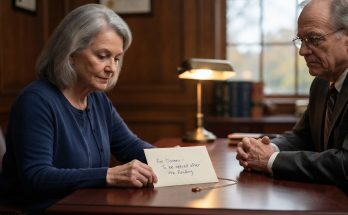
Melissa moved my name card while the funeral director was still adjusting the flowers around Harold’s casket. She pinched the little folded card between two fingers, carried it past the first row, and set it beside an empty chair in the second. Then she smoothed her black dress and returned to her brother as if she had corrected an innocent mistake.
I stood beneath the chapel’s weak amber lights with my coat buttoned wrong and watched her do it. The air smelled of lilies, furniture polish, and wet wool. Outside, November rain tapped the stained-glass windows. Inside, Harold’s daughter had quietly removed his wife from the family row before the service began.
Kevin noticed me first. His gaze flicked toward the displaced card, then back to my face. For half a second, embarrassment softened him. Melissa leaned close and murmured something. Whatever she said hardened his mouth again. He turned away and resumed greeting cousins who had not visited their father once during his final month.
The funeral director approached with his hands clasped at his waist. “Mrs. Vance, I’m sorry. There seems to be some confusion about the seating.”
“There isn’t,” I said.
He hesitated. He was young enough to wish every grief could be managed through tact and careful lighting. “I can move your card back.”
“That would only make her move it twice.”
Across the room, Melissa was accepting condolences beside the casket. She touched each visitor’s arm and spoke in the fragile voice she used whenever strangers were listening. “Daddy fought so hard,” she told them. “Kevin and I were with him through everything.” Kevin lowered his eyes on cue.
They had been with him through three holiday dinners, two brief hospital visits, and one argument about whether he should sell the boat. I had been there for the dialysis alarms at two in the morning, the sour smell of antiseptic in our bedroom, and the afternoon Harold became too weak to lift a coffee cup. Grief did not keep accounts, but people did.
I sat in the second row. The chair beside me remained empty until Ruth Ann Kessler, a woman I knew only from town meetings and the pharmacy line, slipped into it without asking. She wore a dark blue coat spotted with rain. She placed her handbag beneath her knees and faced forward.
After a moment, she whispered, “He knew where you belonged.”
I looked at her.
“Harold,” she said. “Whatever they do today, he knew.”
Before I could ask what she meant, the organ began. Everyone stood. The chapel filled with the rustle of coats and programs. Melissa and Kevin took their places in front of me, their shoulders forming a wall between Harold’s casket and the woman who had buttoned his shirts when his fingers stopped working.
The minister spoke about Harold’s patience, his stubborn thrift, and the way he could repair nearly anything with a coffee can full of mismatched screws. Those details were true. So was the story about him returning a wallet containing nine hundred dollars. The minister did not mention that Harold had spent three weeks arguing with me over a nine-hundred-dollar refrigerator.
That memory found me at the wrong moment. I pictured him standing in the appliance aisle with his reading glasses low on his nose, asking a salesman whether an ice dispenser was worth two hundred dollars. My breath caught. I pressed my thumbnail into my palm until the chapel came back into focus.
Kevin delivered the eulogy. He spoke about fishing trips, the boat, and the house where he and Melissa had grown up. The house had been mine for fourteen years too, though no one would have guessed it from his speech. I had painted its bedrooms, replaced its kitchen floor beside Harold, and planted the hydrangeas that now brushed the back fence.
Melissa followed. She cried without disturbing her mascara. “After Mom died, Daddy was lonely,” she said. “We’re grateful he had companionship in his later years.”
Companionship. Not marriage. Not love. Fourteen years reduced to a polite word people used for paid caregivers and small dogs.
Ruth Ann shifted beside me. “That was deliberate.”
“I know.”
“Are you going to let it pass?”
I watched Melissa fold her speech. “Today, yes.”
At the cemetery, the rain sharpened. Mud gathered around the heels of Melissa’s shoes, and she complained to Kevin in a fierce whisper about the burial tent. I stood close enough to hear but far enough that they pretended not to notice me. Harold’s casket descended beneath a rectangle of artificial grass, the machinery making a low mechanical groan.
When the others began leaving, I remained. My fingers had gone stiff around the damp funeral program. I wanted a private word with my husband, but privacy proved difficult even after death. Melissa returned from the limousine and stopped behind me.
“Bernard scheduled the will reading for ten tomorrow,” she said.
“I know.”
“You’ll be there?”
I turned. “Why wouldn’t I be?”
She adjusted the pearl at her ear. “You’ve had an exhausting few months. Kevin and I can handle the estate details.”
“That sounds generous.”
Her eyes narrowed at the mildness of my voice. “We’re trying to spare you unnecessary stress.”
“You mean unnecessary information.”
“That isn’t what I said.”
“No. It rarely is.”
Kevin called from the car. Melissa glanced toward him, then back at me. “Dad’s assets are complicated. The house alone requires decisions, and the brokerage account has tax consequences. Bernard will explain what applies to you.”
What applies to you. The phrase carried the confidence of someone who had already read an answer sheet.
I looked down at Harold’s grave. “Your father spent his whole life making his own decisions.”
“He was also heavily medicated near the end.”
The rain ticked against my umbrella. “Be careful, Melissa.”
“About what?”
“About turning his illness into an excuse for saying he did not know his own mind.”
For the first time that day, her practiced grief slipped. Something cold showed beneath it. Then Kevin sounded the horn, and she walked away without saying goodbye.
Ruth Ann was waiting beside my car. Water ran from the brim of her hood. “Did Harold ever discuss the Route 9 property with you?”
The question was so unexpected that I checked her expression for a joke. “The old trailer lot?”
“That’s what people call it.”
“What else would they call it?”
She rubbed rain from her glasses. “Parcel 44-118.”
I knew the number only because I had seen it on tax bills. The property lay beyond town where Route 9 curved along the creek. Harold had bought it long before we married. A singlewide trailer had burned there years ago, leaving a blackened shell among sumac and weeds.
“Why are you asking?”
Ruth Ann looked past me toward Melissa’s departing limousine. “Because men with surveying equipment were on that land in August.”
“Harold told me they were checking utility lines.”
“Maybe they were.”
Her tone said otherwise.
“What do you know?”
“Not enough.” She opened her handbag and took out a business card. RUTH ANN KESSLER, LAND SERVICES, CARDINAL MIDSTREAM. “But Harold asked me to wait until after the funeral before I contacted you.”
Cardinal Midstream meant pipelines, compressor stations, and public meetings where engineers displayed maps nobody could read. I held the card by one corner. Rain dotted the ink.
“Why would Harold speak to you?”
“Because my company has been studying a corridor near Route 9.”
“A corridor across his property?”
“Possibly.”
“How much land?”
“That depends on the final route.”
“And you waited until today to tell me?”
“He insisted.” She glanced again toward the cemetery road. “He also told me not to discuss it with his children.”
A cold sensation moved through me that had nothing to do with the rain. Harold kept ordinary secrets badly. He hid birthday gifts in the linen closet and forgot invented excuses halfway through them. But important matters disappeared into him completely. I had learned that during fourteen years of marriage.
“What exactly did he say?”
Ruth Ann lowered her voice. “He said that after the will was read, somebody would probably call the Route 9 parcel worthless. If that happened, I was to give you my card and tell you not to sign anything.”
My fingers tightened around the wet rectangle.
“Who would ask me to sign?”
“I don’t know.”
“That isn’t reassuring.”
“It wasn’t meant to be.”
Ruth Ann walked to her truck before I could stop her. I sat behind the wheel of my car with rain crawling down the windshield and her card in my lap. At the cemetery entrance, Melissa’s limousine turned onto the road. Kevin followed in his SUV.
They had arrived expecting to inherit something.
Harold had expected them to laugh at something else.
And before the dirt had been packed over his grave, I understood that my husband’s final argument with his children had already begun.
Click here to continue reading: PART 2: At the Will Reading, the Things That Looked Most Valuable Went to the People Who Had Already Counted Them
Before Harold Was Buried, His Children Had Already Decided Which Parts of Our Life Belonged to Them
Part 1 of 20