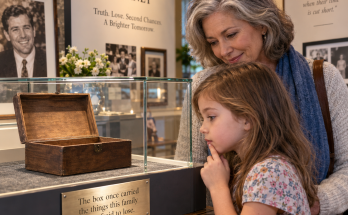
The empty box remained in the attic for nearly a year.
Nobody touched it.
Nobody needed to.
Life continued.
Mom's health became a little more fragile.
Noah's children grew taller.
The foundation expanded.
Samuel retired.
Eleanor moved closer to her daughter.
Maria visited more often.
The world kept moving.
One evening, Noah called.
“Come over.”
“Why?”
“I want to show you something.”
I arrived at his house.
He had the old drawing framed on the wall.
Beside it was a photograph of Dad.
Underneath both was a small brass plate.
It read:
“Remember the truth. Then live.”
I smiled.
“Where did you get that?”
“I wrote it.”
“It sounds like Dad.”
“I know.”
His children were asleep upstairs.
We sat in the living room.
For a while, neither of us spoke.
Then Noah said, “Do you think we're ready?”
“For what?”
“To stop talking about it.”
I knew what he meant.
Dad's murder.
The case.
The conviction.
The prison years.
The investigation.
The trust.
The records.
Everything.
I looked at the photographs.
“I don't think we'll ever stop remembering.”
“I know.”
“But maybe we can stop investigating.”
He smiled.
“That's what I mean.”
I thought about it.
The temptation was to say yes immediately.
But I had learned not to rush important decisions.
“What would stopping mean?”
“No more searching for documents.”
“Okay.”
“No more asking people what they remember.”
“Okay.”
“No more wondering whether there was another clue.”
I smiled.
“That one will be harder.”
He laughed.
“Probably.”
“But yes.”
He leaned back.
“I think we've done enough.”
I nodded.
Enough.
The word returned again.
The same word Dad had written.
The same word Mom had unknowingly repeated.
Enough.
We did not need another confession.
Another photograph.
Another document.
Another explanation.
The truth was already complete.
Noah poured us coffee.
“Mom will hate this.”
“Why?”
“She likes knowing everything.”
I laughed.
“She does.”
The next morning, we visited her.
We told her.
She listened.
Then she smiled.
“I've been waiting for you two to figure that out.”
“You knew?”
“Of course.”
“When?”
“The day you stopped asking me what happened.”
I stared at her.
“You noticed?”
“I notice everything.”
Noah laughed.
Mom looked toward the garden.
“Your father used to think every problem could be solved if he had enough information.”
“He wasn't wrong.”
“No.”
She smiled.
“But information isn't the same as life.”
That sentence stayed with me.
We had spent years collecting information.
Dates.
Names.
Records.
Statements.
Transactions.
Photographs.
Evidence.
We had needed it.
Without it, Mom might still have been in prison.
Without it, Greg might never have been convicted.
Without it, the truth might have remained buried.
But information had done its job.
Now life had to take over.
Mom looked at both of us.
“Go live.”
Noah smiled.
“We are.”
“Then keep doing it.”
That afternoon, we went to the cemetery.
Not because it was an anniversary.
Not because something had happened.
Just because we wanted to.
We brought no papers.
No photographs.
No letters.
Only flowers.
We stood before Dad's grave.
Noah said, “We're done.”
I smiled.
Mom touched the stone.
“Not done loving you.”
She paused.
“Just done being afraid.”
The wind moved through the trees.
Leaves rustled.
For a moment, nobody spoke.
Then Noah said, “Goodbye, Dad.”
I said it too.
Mom stayed a little longer.
Then she turned.
“Let's go.”
We walked toward the car.
This time, I did not look back.
I didn't need to.
Dad was not behind us.
He was not waiting in the cemetery.
He was in the photograph at home.
In the stories Samuel told.
In Noah's children.
In Mom's garden.
In the scholarship recipients.
In the lessons we carried.
In the ordinary jokes we still remembered.
He had become part of the life that continued.
That was enough.
When we reached the car, Noah opened the door for Mom.
She smiled.
“Thank you.”
He shrugged.
“Still your son.”
“Yes.”
She looked at both of us.
“My boys.”
I smiled.
For years, those words had belonged to childhood.
Now they felt like a blessing.
We drove home.
No one discussed the case.
No one mentioned Greg.
No one wondered about another clue.
We talked about dinner.
The weather.
Noah's children.
Mom's garden.
Ordinary things.
The kind of things Dad had been denied.
The kind of things we had nearly forgotten to value.
That night, I went into my study.
The wooden box was still there.
Empty.
I picked it up.
For a moment, I considered throwing it away.
Instead, I put it on the shelf.
Not because it contained anything.
Because it had once held everything we were afraid to lose.
Now it held nothing.
And that was the point.
The story no longer needed a box.
It lived in us.
I turned off the light.
The house was quiet.
For the first time in years, quiet did not feel like waiting.
It felt like peace.
And somewhere between the last light of evening and the first darkness of night, I realized something simple.
We had not defeated the past.
We had learned how to live beyond it.
That was different.
And better.
Click here to continue reading: PART 25: The Empty Box Sat Beside Me When Mom Called With News That Made Us Question Whether Goodbye Had Come Too Soon
Six Years After My Father’s Murder, I Returned to the Prison Where My Mother Was Waiting for Her Final Goodbye
Part 24 of 27