Thomas Brennan placed my old financial power of attorney on the conference table and tapped Jennifer’s name with the blunt end of his pen.
“Does she know she has this job?”
I hesitated.
“She knew when we signed it.”
“That was when?”
I checked the date.
Nine years earlier.
Thomas raised his eyebrows.
“That isn’t an answer to my question.”
The Thursday meeting had already lasted forty minutes, and we had barely begun. I had arrived expecting signatures, deletions, perhaps a new will.
Instead Thomas was making me explain my life.
Jennifer was my primary financial agent if I became unable to manage my affairs.
Michael was backup.
For medical decisions, Jennifer came first and Lisa second.
My old will divided most of what remained among my three children in equal shares. Other assets had separate beneficiary arrangements. Richard and I had created much of the structure when the children were younger and our assumptions about family responsibility were entirely different.
Thomas turned another page.
“When did you last ask Jennifer whether she is willing to handle your finances if you become incapacitated?”
“I haven’t.”
“Michael?”
“No.”
“Lisa about medical decisions?”
“No.”
He leaned back.
“Maggie, this is why I don’t want to begin with inheritance.”
“I thought inheritance was the reason people came to estate lawyers.”
“It’s one reason. Being alive and unable to manage your own affairs can create a much more immediate problem.”
The thought made me uncomfortable.
Richard’s death had been sudden. Because of that, I had spent thirteen years imagining death as the danger.
I had thought much less about surviving something.
A stroke.
A fall.
Surgery.
Cognitive decline.
Some temporary illness that left me alive but dependent.
Thomas asked me to imagine being in a rehabilitation facility for six weeks while bills continued arriving.
Who would pay them?
Who would monitor my accounts?
Who would deal with insurance?
Who would speak with doctors if I could not?
My old answer had been automatic.
My children.
The hospital had exposed the weakness in that answer.
“I don’t know if Jennifer would come,” I said.
Thomas nodded.
That was all.
He did not call her selfish.
He simply wrote something on his legal pad.
“What?”
“Uncertainty.”
“That sounds ominous.”
“It’s practical. A person doesn’t have to be malicious to be the wrong choice for a role. They can be loving and unavailable. Honest and disorganized. Responsible but overwhelmed.”
I thought of Jennifer sending a text while I lay in the hospital.
“She’s very capable.”
“I’m sure she is.”
“She handles enormous projects.”
“That doesn’t mean she has agreed to handle yours.”
The distinction irritated me because it was so obviously correct.
Thomas spent the next two hours asking questions I should have asked myself years earlier.
What did I need my money to accomplish while I was alive?
How much had I set aside for possible long-term care?
Did I want to remain in my house indefinitely?
What charitable organizations mattered to me?
Did I want to help my grandchildren directly?
Which family members had access to my accounts, passwords, house, records, or medical information?
By lunchtime, I had stopped thinking about punishing my children.
I was too busy realizing how many pieces of my life rested on habit.
When Thomas asked the purpose of my money, I actually laughed.
“What kind of question is that?”
“A basic one.”
“To pay for things.”
“What things?”
“My life.”
“Good. Be specific.”
So we were.
Housing.
Food.
Medical care.
Insurance.
Emergency reserves.
Travel, if I wanted it.
Help at home if I needed it.
Long-term care.
Gifts I deliberately chose to make.
Charities I valued.
Support for grandchildren, if appropriate.
Inheritance came last.
Seeing it last unsettled me.
For years I had behaved as though the money I owned had already begun its journey toward my children.
I avoided certain purchases because they seemed extravagant.
I postponed trips.
I worried about reducing principal.
Somewhere along the way, I had become caretaker of my children’s hypothetical inheritance.
Thomas seemed to recognize the expression on my face.
“What?”
“I think I’ve been treating my own money as if I borrowed it from them.”
He smiled slightly.
“That happens.”
“I don’t like hearing that.”
“You’re paying me to say useful things, not flattering ones.”
I remembered why Richard had liked him.
Over the following three weeks, we worked through everything.
The will was only part of it.
Retirement accounts and other beneficiary-designated assets required separate attention. Insurance had its own rules. Trust arrangements mattered. Account ownership mattered. Powers of attorney mattered. Medical directives mattered.
Thomas made me understand each category instead of allowing me to sign whatever he placed in front of me.
At one point I complained that Richard had always handled these things more easily.
Thomas looked up.
“Richard isn’t here.”
“I’m aware.”
“I mean you don’t need to do this the way Richard did it.”
That stopped me.
My husband had been good with paperwork, investments, insurance renewals, taxes, and all the administrative debris of adulthood.
I had let him be good at it.
After he died, I learned enough to keep everything running, but a small part of me still regarded financial expertise as a language other people spoke more fluently.
At seventy-one, I decided that had to end.
Not because I needed to perform every task myself.
Because I needed to understand what I was delegating.
Thomas introduced me to a licensed professional fiduciary named Karen Moss.
Karen was perhaps fifteen years younger than I was, wore square glasses, and possessed the reassuring habit of answering exactly the question asked.
She explained her responsibilities.
Her fees.
Reporting.
Oversight.
Limits.
What happened if she became unavailable.
What she could do and what she could not.
“You’d be a stranger managing my finances,” I said.
“If you appointed me and later became incapacitated, yes.”
“That sounds cold.”
Karen folded her hands.
“Professional management doesn’t prevent your family from loving you.”
The sentence embarrassed me.
“I didn’t say it did.”
“No. But people often hear ‘professional fiduciary’ and imagine replacing family. I’m not your daughter. I wouldn’t try to be. I would have a defined job.”
A defined job.
That phrase stayed with me.
My children could visit.
They could bring soup.
They could argue with me about television.
They could sit beside my bed.
They could love me.
None of that required one of them to balance my accounts or become legally responsible for decisions they had never agreed to make.
By the end of the meeting, Karen no longer felt impersonal.
She felt specific.
I named her for financial responsibilities after satisfying myself that the arrangement made sense, with a trusted longtime friend as backup.
For medical matters, I kept family involvement where I believed it could work, but the order and backup structure became clearer.
I also revised beneficiary arrangements.
Not in one furious sweep.
Thomas would not let me.
When I said perhaps I should leave the children nothing, he asked whether that had been my considered intention before the argument.
“No.”
“Then don’t confuse anger with planning.”
“I am angry.”
“You’re allowed to be.”
“That sounds contradictory.”
“Feelings can inform decisions. They shouldn’t make every decision for you.”
So I thought.
I wanted my grandchildren protected from adult conflict.
I wanted certain charities Richard and I had supported for years to receive meaningful gifts.
I wanted professional administration so one child would never control another child’s share.
Above all, I wanted enough resources reserved for whatever happened to me.
When Thomas eventually showed me a summary of the revised structure, guilt rose unexpectedly.
My children’s names were still there.
But they no longer dominated the page.
Thomas noticed.
“What bothers you?”
“I feel selfish.”
“For planning for your own care?”
“For changing what they’ll get.”
“They don’t own it yet.”
“I know that.”
“Do you?”
I stared at him.
“Mothers give.”
“Yes.”
“I’ve always given.”
“Yes.”
He closed the folder.
“Maggie, your estate plan is not a final measurement of whether you were a good mother.”
I looked away because the sentence found a place in me I had not known was exposed.
I had paid for braces.
College expenses.
Wedding help.
Emergency loans.
Summer camps.
Christmas presents.
Babysitting.
Home repairs.
Trips with grandchildren.
Thousands of small things no ledger could properly represent.
Yet I had somehow imagined that motherhood ended with one final financial distribution, and reducing it meant reducing my love.
It did not.
That evening, I went home and opened the refrigerator.
A laminated emergency card hung beneath a magnet.
Jennifer.
Michael.
Lisa.
Their names were arranged by birth order, as though age automatically determined usefulness in a crisis.
I removed it.
A week later, I replaced it with a new card.
My physician.
Karen.
Building and home security contacts.
Family medical contacts and backups in the order we had actually discussed.
The change looked trivial.
It felt enormous.
Then I turned to the house itself.
My children had keys.
They knew the alarm code.
Michael knew the garage code.
Jennifer had once let herself in while I was showering because she wanted to leave some boxes in the basement.
At the time, I had laughed.
Now I reconsidered.
Access had accumulated over decades without anybody consciously granting it anew.
My children had once lived there.
They no longer did.
A burglary two streets away gave me the practical excuse I almost wished I did not need.
I hired a security company.
They installed cameras, upgraded the alarm, and helped arrange a gate system at the front of the property.
I changed the locks.
Changed entry codes.
Changed passwords carefully, account by account, confirming recovery information as I went so I would not create a mess for myself.
I told no one dramatically.
No family email.
No announcement.
No speech about consequences.
Thomas had convinced me that legal and security arrangements should accomplish practical purposes rather than carry emotional messages.
If I wanted my children to know I was hurt, I could tell them.
A password did not need to do that job.
For three months, none of them called.
Neither did I.
The silence was terrible at first.
Every time the phone rang, I expected one of their names.
Every time it was a pharmacy, a neighbor, an unknown number, or a political survey, disappointment moved through me before I could stop it.
But something else happened.
My days continued.
The furnace still came on.
Mail arrived.
Snow melted.
I bought groceries.
I read.
I walked.
I began organizing Richard’s old photographs.
The world did not punish me for stopping pursuit.
What hurt was discovering how little remained of certain relationships when I was not doing the maintenance.
Then, two weeks before Christmas, Jennifer called.
Her voice was so cheerful that for a moment I thought the previous months had somehow vanished.
“We’ve decided we’re doing Christmas at your place.”
I stood at the kitchen counter holding an apple.
“You’ve decided?”
“All of us. Michael, Lisa, the kids, everybody. Like we used to.”
I set the apple down.
Nobody had visited in more than a year.
“Why?”
“Because you shouldn’t be alone.”
“I’ve been alone for three months.”
“Maggie—”
She only called me Maggie when she wanted to sound reasonable.
Then came the rest.
“We also think it’s a good time for all of us to sit down and talk about what comes next. The house, your long-term plans, maybe something more manageable.”
There it was.
I looked around the kitchen they were apparently already planning to help me leave.
“I’m not hosting Christmas.”
Jennifer laughed.
Not cruelly.
Disbelievingly.
“Mom.”
“No.”
“We’ll bring everything.”
“No, Jennifer.”
“We’re coming on the twenty-third.”
“I’m telling you not to.”
“We need to talk.”
“No.”
She went quiet.
Then she said, “You’re being ridiculous.”
I hung up.
For the next two weeks, I wondered whether I had overreacted.
On December twenty-third, at precisely two in the afternoon, my phone chimed.
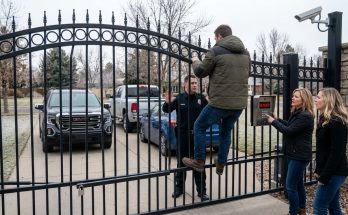
VEHICLE AT FRONT GATE.
I opened the camera feed.
Three vehicles were lined up outside.
Jennifer’s SUV.
Michael’s truck.
Lisa’s sedan.
For several seconds, I could not move.
Then Michael stepped from his truck and walked toward the keypad.
He entered the old code.
The display flashed red.
DENIED.
He frowned.
Entered it again.
DENIED.
Jennifer approached the intercom.
A second later my phone rang through the system.
“Mom,” she said, “open the gate.”
I looked at my three adult children standing outside the property I had explicitly told them not to visit.
“No.”
Nobody moved.
Then Michael put both hands on the iron gate.
And began to climb.
Click here to continue reading: PART 3: When My Son Climbed the Locked Gate After I Said No, I Had Seconds to Decide Whether My New Boundaries Meant Anything
The Night I Came Home From the Hospital Alone, Three Short Messages Forced Me to Question Everything I Believed About Family
Part 2 of 28