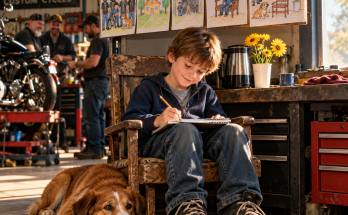
The morning after Tommy showed me the drawing of his mother's house, I found myself thinking about Helen.
I had spent so much time wondering what Tommy needed that I hadn't stopped to consider how often Helen might be wondering the same thing.
That didn't erase the things I'd heard her say.
It didn't make every decision she made right.
But it reminded me that I knew only a small part of their lives.
I arrived at the shop early and found Tank already working.
He had the garage door halfway open, and the morning light fell across the concrete in long, pale strips.
The old wooden chair sat beside the workbench.
Tommy's drawings were still on the shelf.
Tank looked at them while wiping his hands.
"That little house looks familiar," he said.
"Tommy drew it yesterday."
"Did he tell you about his mother?"
I nodded.
Tank leaned against the bench.
"That's a hard thing for a boy to carry."
"Hard for his aunt, too."
Tank looked at me for a moment.
"You're thinking about what she said."
"I am."
He didn't offer an easy answer.
That was another reason I trusted him.
We had known each other long enough to understand that not every problem needed an immediate opinion.
Sometimes you needed to sit with the facts before you decided what they meant.
Tommy arrived just before ten.
He had his backpack over one shoulder and a small yellow object in his hand.
When he entered, he looked toward the shelf first.
Both drawings were still there.
He smiled.
Then he held up the object.
"Look what I found."
It was a plastic toy car with one missing wheel.
"Where did you find that?"
"In my room."
"Does it still work?"
Tommy pushed it across the workbench.
The car rolled a short distance before tipping onto its side.
He picked it up and examined the missing wheel.
"Can you fix it?"
I took a closer look.
"I can see what we can do."
He watched me search through a container of small spare parts.
I found a wheel that was close to the right size, although the axle needed a little adjustment.
Tommy stood on his toes to see what I was doing.
I showed him how the wheel fit onto the axle.
Then I explained why it needed to turn freely.
He listened with the same serious attention he gave Tank's motorcycles.
When I finished, I set the car on the bench.
Tommy pushed it.
It rolled across the wood and stopped against his backpack.
His face lit up.
"You fixed it!"
"We fixed it."
He looked at the little wheel.
"Can I keep it here?"
"You can take it home if you want."
He shook his head.
"I want to play with it here."
"Then here it stays."
He put the car on the shelf beside his drawings.
For a while, he sat quietly in the old chair, rolling the car back and forth along the edge of the bench.
I went back to my work.
Every so often, I heard the small plastic wheels click against the wood.
It was a pleasant sound.
It reminded me that a place didn't need to be grand to become important to someone.
Sometimes it only needed to be safe enough for a child to leave a broken toy on a shelf and trust that it would still be there later.
Around noon, Helen came to the shop.
She didn't call Tommy from the doorway.
She stood there for a moment, watching him roll the little car.
Tommy noticed her and sat up.
"Aunt Helen."
"Hello, Tommy."
He picked up the car and showed it to her.
"Bear fixed the wheel."
Helen examined it.
"That's good."
"He showed me how it works."
She nodded.
Then she looked at me.
"Could I talk to you for a minute?"
I glanced toward Tommy.
"Sure."
I asked Wheels to keep an eye on him while Helen and I stepped just outside the entrance.
We stayed close enough that Tommy could see us through the open door.
Helen folded her arms.
"I wanted to explain something."
I waited.
She looked down at the pavement.
"When my sister got sick, I thought I understood what was happening."
Her voice was careful.
"I visited when I could. I helped with groceries. I took Tommy for afternoons when she had appointments."
She paused.
"But I didn't understand what it would mean to have him with me every day."
I said nothing.
Helen rubbed her forehead.
"My sister was the one who knew his routines. She knew which foods he liked, what made him nervous, and how to help him when he couldn't explain what was wrong."
She swallowed.
"I thought I could learn all of that quickly."
"Some things take time," I said.
"Everything takes time."
There was no anger in the words.
Only fatigue.
She looked toward Tommy.
"He wakes up some mornings and asks when his mother is coming home."
I felt my chest tighten.
"What do you tell him?"
"That she isn't coming back."
Helen looked away.
"Then he cries, and I don't know how to make it better."
I understood why she might feel helpless.
A grown man could spend an entire lifetime trying to find the right words for grief and still come up empty.
For a seven-year-old, the truth could be both simple and impossible to accept.
"Maybe you don't have to make it better every time," I said.
Helen looked at me.
"What do you mean?"
"Maybe sometimes he just needs you to stay with him while he's sad."
She let out a breath.
"I try."
"I believe you."
She seemed surprised by that.
For a moment, she didn't speak.
Then she said, "People keep telling me how lucky he is to have family."
I waited.
"They say it as if that makes everything easy."
Her eyes were tired.
"I love my sister. I love Tommy. But I have a job, bills, and a life that was already difficult before all this happened."
She stopped herself.
I could tell she was afraid I would judge her for saying it aloud.
I thought about the way Tommy watched the window.
I thought about his question about whether everyone needed a place.
I also thought about Helen opening her front door every evening and being responsible for whatever happened after that.
"You can love him and still be overwhelmed," I said.
She looked at me for a long moment.
"I didn't expect you to say that."
"Why?"
"Because of what you heard me say on the phone."
I didn't pretend I hadn't heard it.
"I was worried when I heard you talking about finding a place for him."
"I know."
She folded her arms more tightly.
"I was looking for information. I didn't know what options existed. I thought if I found out what help was available, I might be able to understand what I was supposed to do."
"That makes sense."
"But I shouldn't have talked about him as if he were a problem to be moved somewhere."
Her voice became quieter.
I appreciated that she could admit it.
I also knew an apology made in private didn't automatically change what a child heard at home.
Still, people had to start somewhere.
"Tommy doesn't need you to be perfect," I said. "He needs to know he's wanted."
Helen looked toward the shop again.
"He seems to know that here."
"We want him here."
"All of you?"
I smiled a little.
"Even Wheels, although he'll deny it if you ask."
She gave a small, unexpected laugh.
It didn't last long, but it changed her face.
Then she looked at me seriously.
"I don't want him thinking he can stay here whenever he wants."
"He won't."
"And I don't want him getting attached if this is only temporary."
I understood the concern.
"I can't promise what every day will look like," I said. "But I can promise we won't deliberately make him feel unwanted."
Helen studied me.
"That's a careful answer."
"It's the honest one."
She nodded.
For a while, we watched Tommy play with his repaired car.
Wheels was showing him how to roll it along a strip of tape on the workbench without letting it fall off the edge.
Tommy concentrated so hard that his tongue pressed against the corner of his mouth.
Helen watched him with a look I couldn't quite name.
"He hasn't played like that in a long time," she said.
"Maybe he needs a chance to be a kid."
"He needs a lot of things."
"Then we can start with this one."
Helen turned toward me.
"I can let him visit a few afternoons a week, if that's all right with you."
I felt relief, but I didn't let it turn into a celebration.
"That would be fine."
"I'll bring him over when I can. If something changes, I'll tell you."
"That works."
She glanced toward the street.
"I need to get back to work."
Before she left, she looked at me again.
"Thank you for listening."
I nodded.
"Thank you for talking to me."
She crossed the street and continued toward her house.
I returned to the shop.
Tommy was still guiding his toy car along the strip of tape.
When he saw me, he looked up.
"Is my aunt mad?"
"No, buddy."
"Did I do something wrong?"
"No. We were just talking."
He looked toward the window.
"Can I come again?"
I crouched beside his chair.
"Your aunt and I talked about that. She said you can visit a few afternoons a week."
His eyes widened.
"Really?"
"Really."
He hugged the little car against his chest.
Then he set it carefully on the bench.
"Can I come tomorrow?"
I smiled.
"We'll check with your aunt when the time comes."
He accepted that answer more easily than he might have a few days earlier.
Perhaps he was beginning to understand that a promise didn't need to cover every day in the future to mean something.
Sometimes it only needed to be true today.
Click here to continue reading: PART 14: The Men in My Shop Had Become Part of Tommy’s Routine, but I Was Learning That Being There Meant More Than Opening Our Door
The Little Boy Behind the Window Had Lost His Mother, and None of Us Knew What He Was Waiting to Ask
Part 13 of 20