Helen came by on a Thursday afternoon without Tommy.
I was replacing a worn handle on a toolbox when I saw her standing outside the open door.
She had a paper bag in one hand.
“Am I interrupting?”
“Not unless you're here to tell me my work looks terrible.”
She glanced at the toolbox.
“I wouldn't know where to begin.”
“That makes two of us.”
She laughed softly.
Then she stepped inside.
The shop was quieter than usual.
Tank had gone to pick up a part, Wheels was out front talking to a customer, and Tiny was behind the building checking Buddy's water bowl.
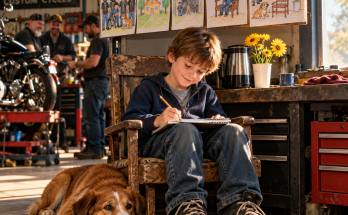
Helen looked toward Tommy's chair.
It was empty.
She seemed to be making sure it was still there.
I wiped my hands.
“Everything all right?”
“Yes. I think so.”
She lifted the paper bag.
“I brought some cookies. Tommy wanted to know if you liked the kind with chocolate chips.”
I took the bag.
“Chocolate chips are one of the few things in this world nobody has to explain to me.”
“He said you might say that.”
I smiled.
Helen looked at the cardboard shelf.
The drawings had started to curl at the corners, so I had added fresh tape to keep them from falling.
She noticed.
“You take good care of those.”
“They matter to him.”
“I know.”
She stood in front of the shelf for a moment.
Then she asked, “Can I ask you something?”
“Sure.”
“What does Tommy actually do here?”
I set the toolbox handle down.
She seemed embarrassed by the question.
“I don't mean that badly. I know he comes here, and I know he likes it. But when I ask him about his afternoon, he tells me things like Tiny cleaned Buddy's paw or Wheels lost a bolt.”
“Those are important events.”
“I know.” She smiled a little. “But I wonder what he gets out of being here.”
I thought about giving her an easy answer.
I could have told her that Tommy was learning about tools.
I could have said he was making friends.
I could have pointed to the drawings and described his growing confidence.
All of those things were true.
But none of them was the whole truth.
“He gets to be a kid,” I said.
Helen looked at me.
“What does that mean?”
“It means he doesn't have to spend every afternoon thinking about being the boy whose mother died.”
Her eyes lowered.
“He doesn't talk about her much at home.”
“That doesn't mean he isn't thinking about her.”
“I worry when he doesn't talk. Then I worry when he does talk, because I don't know whether I'm saying the right thing.”
I leaned against the workbench.
“You're trying to find a perfect answer.”
“Isn't that what I'm supposed to do?”
“No. You're supposed to keep showing up.”
She looked toward the front windows.
A motorcycle passed on the street, its engine rumbling briefly before fading.
“I keep thinking that if I were better at this, he wouldn't have so many difficult days.”
“Tommy would still have difficult days.”
“I know that in my head.”
“Your heart hasn't caught up yet?”
She nodded.
I understood more than I wanted to admit.
People sometimes believed love should make them good at everything.
They thought caring enough would somehow give them the right words, the right patience, and the right instincts.
But love didn't make a person an expert.
Sometimes it only made a person more afraid of making a mistake.
“Helen,” I said, “when Tommy comes here, we don't try to make him happy all the time.”
“What do you do?”
“We work on motorcycles. We argue about baseball. Wheels tells bad jokes. Tiny feeds a dog that thinks he's a restaurant customer.”
She smiled.
“And Tommy?”
“He sits with us. Sometimes he draws. Sometimes he helps. Sometimes he doesn't want to do either.”
“Doesn't that bother you?”
“No.”
“Not even when he just sits there?”
I shook my head.
“Why would it?”
She rubbed her thumb along the paper bag's folded edge.
“I guess I'm used to thinking that if a child is quiet, something needs fixing.”
“Sometimes something does. Sometimes he's just quiet.”
She absorbed that slowly.
“His mother used to sit with him when he was quiet,” she said.
I waited.
“She would sit beside him on the couch and let him lean against her. She didn't always ask what was wrong. I remember thinking it was strange that she could do that without needing to say anything.”
“Maybe she understood him.”
“She did.”
Helen's voice softened.
“She could tell when he was tired before he knew how to tell her himself.”
I didn't interrupt.
“She used to sing while she made breakfast. Tommy would stand beside her and tap a spoon against the cupboard. He still does it sometimes.”
I remembered the yellow sun in Tommy's drawing.
I remembered him telling me that his mother liked yellow flowers.
“Does it make you sad when he does that?” I asked.
“Yes.”
She looked down.
“Then I feel guilty because I think he might see that I'm sad and stop doing it.”
I knew there was no simple answer to that.
“You can tell him you miss her, too.”
“What if that makes him sadder?”
“He already misses her.”
Helen looked at me for a long time.
Then she nodded.
“I suppose I keep trying to protect him from a feeling he already has.”
“Most people do that when they love somebody.”
She took a breath and let it out slowly.
“I don't want him to think he has to be cheerful for me.”
“Then tell him.”
“I did tell him.”
“Tell him again.”
She laughed a little.
“You make it sound easy.”
“It isn't. But it doesn't have to be complicated.”
We sat quietly for a minute.
Then Helen glanced at the drawings again.
“Could I take a picture of those?”
“Of course.”
She took out her phone and photographed each one.
When she reached the picture of the chair, she paused.
“That's the one he made on the day he was sad.”
“That's right.”
“He told me about it at home. He said the chair didn't mind if he was quiet.”
I smiled.
“It's a good chair.”
“It's an ugly chair.”
“It's a very good ugly chair.”
She laughed, and this time the sound came more easily.
Then she put her phone away.
“I've been thinking about the afternoons,” she said. “I don't want him to feel like he can only come here when I'm having a difficult day.”
“That's not how we see it.”
“I know. But I want to be more consistent.”
“We can keep the same days when it works for everyone. If something changes, just let me know.”
She nodded.
“I think a routine would help him.”
“It might.”
“And maybe it would help me, too.”
“That wouldn't hurt.”
She looked toward the door.
“I used to think asking for help meant I wasn't handling things properly.”
“Most people think that until they need help.”
“I needed it before I admitted it.”
I didn't tell her she should have asked sooner.
She had been trying to keep a child safe while carrying her own grief, work, and responsibilities.
There was no point in making her ashamed of the time it had taken to speak honestly.
“You asked now,” I said.
She looked at me.
“Thank you for not making me feel worse about it.”
“I'm a mechanic. I make people feel worse about their engines all the time.”
She laughed again.
When she left, she took one cookie for the road and left the rest on the workbench.
I watched her cross the street.
Then I put the cookies beside the coffee pot.
Tank came back with the part a few minutes later.
He spotted the bag.
“Did we get paid in cookies?”
“Apparently.”
“Good. I was about to ask for a raise.”
“You can have a cookie instead.”
He examined the bag.
“Chocolate chip?”
“Tommy's choice.”
Tank took one and nodded with great seriousness.
“Smart kid.”
That afternoon, when Tommy arrived, he went straight to the chair.
He had his notebook with him this time.
He opened it and wrote something while the rest of us worked.
I didn't ask what it was.
After a few minutes, he came over and held the notebook toward me.
The words were uneven but clear.
AUNT HELEN CAME TO THE SHOP.
Underneath, he had written another line.
SHE TOOK PICTURES OF MY DRAWINGS.
I read it twice.
“That's good, Tommy.”
“She wanted to remember them.”
“Sounds like it.”
He looked at the shelf.
“Maybe she likes my pictures.”
“I think she does.”
He closed the notebook.
Then he returned to the chair and sat beside Buddy, who had wandered in through the open side door.
Tommy didn't draw that afternoon.
He didn't fix anything.
He watched the motorcycles and listened to the men talking.
And for the first time, I wondered whether Helen was beginning to understand what Tommy had found here.
Not a replacement for his mother.
Not a solution to his grief.
Just a place where he could belong while both things remained true.
Click here to continue reading: PART 19: The Day Tommy Brought Yellow Flowers to the Shop, None of Us Knew What to Say Until He Explained Why They Mattered
The Little Boy Behind the Window Had Lost His Mother, and None of Us Knew What He Was Waiting to Ask
Part 18 of 20