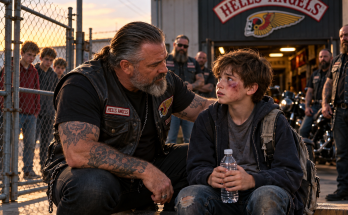
The next few afternoons settled into a pattern.
Helen brought Tommy over when her work allowed it.
Some days he arrived shortly after lunch.
Other days, he came later, when the sun had moved across the street and the shop floor had warmed beneath the open door.
We didn't make a schedule more complicated than it needed to be.
If Tommy could come, he came.
If he couldn't, the chair stayed where it was.
That was all.
The first afternoon after Helen and I talked, Tommy arrived carrying a small notebook.
He held it against his chest as he entered.
"What's that?" I asked.
"My book."
He sat in the old chair and opened it.
Inside were drawings, a few letters written in pencil, and several pages covered with lines that seemed to have no pattern.
He turned through them carefully.
"Mom gave me this."
I pulled up a stool.
"She did?"
He nodded.
"She said I could write things down."
He ran a finger over one of the pages.
"I used to write things I wanted to tell her."
I let that sit between us.
"Do you still write things?"
"Sometimes."
He turned to a blank page.
"Can I write about here?"
"Of course."
He leaned over the notebook.
For a while, I heard nothing but the scratch of his pencil.
Then he held the page toward me.
He had written three words in large, uneven letters.
BEAR FIXED CAR.
I smiled.
"That's right."
He looked pleased.
Then he added another line.
TANK HAS MOTORCYCLE.
Tank glanced over from his workbench.
"That's also right."
Tommy wrote a third sentence.
TINY FEEDS BUDDY.
Tiny looked up.
"That dog is getting a reputation."
Tommy giggled.
He wrote another line.
WHEELS IS FUNNY.
Wheels put a hand over his chest.
"Finally, somebody understands my gifts."
Tommy laughed harder.
I watched him write all four names.
He wasn't just recording what had happened.
He was putting his afternoon into words so he could carry it with him.
When he finished, he closed the notebook and tucked it into his backpack.
"Will you be here next time?"
I looked at him.
"Most likely."
"What if you're not?"
It was a fair question.
I couldn't promise I would never be sick, never have an appointment, or never need to leave the shop.
"I might have to go somewhere sometimes," I said. "But Tank, Tiny, or Wheels will usually be here."
He considered that.
"Will they let me sit in the chair?"
Tank answered before I could.
"That chair has your name on it, kid."
Tommy smiled.
The afternoon went on.
He helped Wheels arrange a few empty boxes in the storage room.
He watched Tiny clean the side of a motorcycle.
He asked Tank why a machine could make a noise that sounded different when something was wrong.
Tank explained that a good mechanic learned to listen.
Tommy thought about that.
"Can people make noises when something is wrong?"
Tank set down his wrench.
"Sometimes."
"How do you know?"
Tank glanced at me.
I stepped closer.
"You listen to what they say, and you pay attention to how they're acting."
Tommy nodded slowly.
"Like when someone is sad?"
"Exactly."
He looked down at his notebook.
Then he asked whether people could be sad without crying.
"Yes," I said.
"Can they be sad when they laugh?"
"Sometimes."
He didn't ask anything else.
But I wondered what he was trying to understand.
Perhaps he was learning that feelings weren't always easy to read.
Perhaps he was trying to make sense of his aunt.
Perhaps he was thinking about his mother.
I didn't know.
I had to remind myself that a child could ask a question without giving me permission to investigate every reason behind it.
I could answer him honestly and let him decide what he wanted to say next.
A few days later, Helen came into the shop while Tommy was drawing.
She carried a small paper bag.
"I brought him a snack," she said.
Tommy looked up.
"You came inside!"
Helen smiled faintly.
"I did."
She handed him the bag.
Inside was a banana and a small packet of crackers.
Tommy thanked her and set them on the chair beside him.
Then he turned back to his drawing.
Helen remained near the door.
I wondered whether she felt uncomfortable standing among a group of men who had become familiar to Tommy faster than she had expected.
I went over to her.
"Would you like some coffee?"
"No, thank you."
"You can sit if you want."
She glanced at the wooden chair, then at the stool beside the counter.
"I won't stay long."
"That's fine."
She took the stool anyway.
For several minutes, she watched Tommy draw.
He had started working on another picture of the shop.
This time, he had drawn the door open.
The chair stood near the bench.
The four bikers were inside.
He had even drawn the old fan above the work area.
The fan was much larger than it really was.
Helen smiled when she noticed it.
"He remembers everything," she said.
"He notices a lot."
"His mother used to say that."
She watched him color the fan.
"She said he noticed things other people missed."
I leaned against the counter.
"That can be a good thing."
"It can also make the world confusing."
I knew what she meant.
People often assumed that if a child had difficulty communicating something, he hadn't noticed it.
They mistook silence for a lack of understanding.
They mistook a slow response for an empty mind.
Tommy had already shown me how much he watched.
He noticed which tools belonged where.
He remembered who fed Buddy.
He remembered every promise about his drawings.
And he watched faces whenever adults spoke.
I suspected he understood more than people sometimes realized.
Helen seemed to be thinking along the same lines.
"Sometimes I forget how much he understands," she said.
I didn't criticize her.
Instead, I said, "I think we all forget that about people sometimes."
She nodded.
Tommy finished his drawing and brought it to us.
"Look."
Helen took it first.
She studied the picture.
"That's the shop."
Tommy nodded.
"And that's Bear."
He pointed to the bearded figure.
"That's me," he added, pointing to the small figure beside the chair.
Helen looked at the drawing again.
"You put yourself right in the middle."
Tommy considered that.
"I'm not in the middle."
He pointed to the figure near the chair.
"I'm sitting."
Helen's smile grew.
"You're right."
She handed the picture back to him.
Tommy held it against his chest.
"Can I put it with the others?"
I nodded.
He placed it beside the other drawings on the shelf.
Three pictures now rested on the cardboard.
The motorcycles.
The house beneath the yellow sun.
And the shop with the open door.
Helen stood up.
"I should go."
Tommy looked toward her.
"Are you coming back?"
"I'll come to get you later."
He nodded.
She started toward the door, then stopped beside me.
"He's been talking more at home."
"That's good."
"He tells me what he did here. He tells me what everybody said."
I smiled.
"That sounds like Tommy."
Helen looked toward the drawings.
"He hasn't talked this much about his day in a long time."
I didn't know whether to say that I was glad or that she deserved to hear those stories too.
Both felt true.
Instead, I said, "I'm glad he's sharing them with you."
She nodded and left.
Tommy watched her cross the street.
Then he turned back to the chair.
I noticed that he didn't ask whether she was angry.
He didn't ask whether he had done something wrong.
He simply returned to his drawing.
It was a small change.
Maybe it meant nothing more than that he had grown comfortable with the routine.
But I hoped it meant he was beginning to feel less afraid of ordinary things.
A week earlier, he had stood at the doorway and asked whether he could be with us.
Now he knew where to put his backpack.
He knew which shelf held his drawings.
He knew that Tiny fed Buddy, that Tank could explain a motorcycle, and that Wheels would turn almost anything into a joke.
He knew that if he asked for a pencil, somebody would find one.
He knew that if he needed help opening a container, he could ask.
And he knew that when it was time to go home, we would walk him to the door without pretending that leaving meant he wasn't welcome.
That was what we could offer.
Not a new family that replaced the one he had lost.
Not a solution to every difficulty waiting across the street.
Just a place where he could spend an afternoon being Tommy.
I had once thought kindness meant doing something big enough that everyone noticed.
Tommy was teaching me that the better kind often went unnoticed.
It looked like a chair kept in the same place.
A drawing protected from grease.
A snack set beside a backpack.
A grown man taking the time to answer the same question twice.
It looked like showing up again.
Click here to continue reading: PART 15: One Afternoon, Tommy Asked Whether We Would Still Want Him If He Couldn’t Help, and I Understood Why Our Small Promises Mattered
The Little Boy Behind the Window Had Lost His Mother, and None of Us Knew What He Was Waiting to Ask
Part 14 of 20