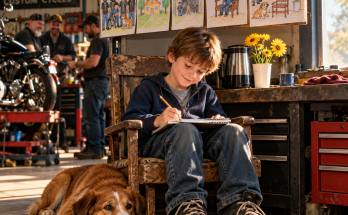
Tommy came back two days later.
I knew it was him before I looked up.
His footsteps were light, and he paused outside the doorway before entering.
I wiped my hands on a rag.
"Morning, Tommy."
"Morning, Bear."
He stepped inside and went to the chair.
The first thing he did was look at the shelf.
His drawing was still there.
He smiled, then sat down.
Tank was checking a motorcycle's electrical system.
Tiny was sweeping near the entrance.
Wheels was trying to fit a new handle onto an old toolbox.
Tommy watched each of them for a while.
Then he asked me if I had a piece of paper.
I found a clean sheet in the drawer and handed it over with a pencil.
He placed the paper across his knees.
For several minutes, he drew without speaking.
I didn't interrupt.
Children often needed quiet to get started.
Adults had a habit of filling every silence because we assumed silence meant something was wrong.
Sometimes it simply meant someone was thinking.
Tommy drew a house.
It had a front door, four windows, and a chimney that leaned to one side.
He added a path from the door to the street.
Then he drew two people beside the house.
One was small.
The other was taller.
He made the taller figure's hair longer than the smaller figure's.
When he finished, he looked at the picture for a long time.
I set down the tool I was holding.
"That's a nice house."
Tommy nodded.
"That's where I used to live with my mom."
I felt my chest tighten.
I had known his mother had died.
I had heard the words in the conversation with Helen.
But hearing Tommy speak about her made the loss feel different.
It was no longer a fact about a family across the street.
It was a little boy looking at a drawing of the home he had shared with someone who wasn't coming back.
"Would you like to tell me about her?" I asked.
He looked up.
"She liked yellow."
"Yellow?"
"Flowers. And cups. And my raincoat."
He touched the pencil to the taller figure's dress.
"She said yellow was a happy color."
I pulled the stool closer, leaving enough space between us that he wouldn't feel crowded.
"Sounds like she liked bright things."
Tommy nodded.
"She used to sing when she made breakfast."
"What did she sing?"
He thought about it.
"I don't remember all of it."
"That's okay."
"Sometimes I remember the song, but then it goes away."
I knew better than to tell him that he would always remember.
Memory didn't work that way.
Some things stayed sharp.
Others faded around the edges.
Sometimes a smell brought back a voice you hadn't heard in years.
Sometimes you tried to remember a face and found you could only recall the way a person smiled.
I had lost people myself.
I knew that trying to hold every detail could become another kind of pain.
"Even if you can't remember every word," I said, "you can still remember how it felt when she sang."
Tommy considered that.
"She made breakfast feel nice."
"Then that's something worth remembering."
He looked down at the drawing again.
"My aunt says I have to be brave."
I kept my hands still.
"What does brave mean to you?"
He shrugged.
"Not crying."
I shook my head gently.
"I don't think that's what brave means."
He looked at me.
"Then what?"
"I think being brave can mean telling somebody when you're sad. It can mean asking for help when something is hard."
He studied the pencil in his hand.
"What if you cry?"
"Then you cry."
He looked surprised.
"Even grown-ups?"
"Especially grown-ups."
That earned me a small smile.
Tank had stopped working.
He wasn't staring at Tommy.
He was looking down at the motorcycle, giving the boy the privacy of not being watched.
Tiny continued sweeping, but his movements had slowed.
Wheels quietly put the toolbox handle down.
None of them said anything.
Tommy drew a yellow circle above the house.
"That's the sun," he explained.
"It looks warm."
"Mom liked sunshine."
He pressed the pencil harder against the paper, coloring the circle until the yellow grew dark.
Then he asked a question that caught me completely unprepared.
"Do you think she can see me?"
I sat very still.
I had my own beliefs about death, but I wasn't going to put them into a child's heart as if they were facts he had to accept.
"I can't tell you for sure what happens after someone dies," I said. "But I do know the love your mom gave you is still part of your life."
Tommy stared at the drawing.
"How?"
"In the things she taught you. The songs you remember. The way you think about her. All the good things you carry from being her son."
He ran his thumb along the edge of the paper.
"I wish she could come here."
"So do I, buddy."
It was the first time I had said something like that without knowing whether it was the right thing to say.
But it was true.
I wished he could have brought his mother into the shop.
I wished she could have seen him sitting in that crooked chair, drawing motorcycles and asking questions.
I wished she could have known that a handful of old mechanics had started looking forward to seeing her boy.
Tommy leaned against the back of the chair.
For a while, neither of us spoke.
Then he folded the paper in half.
"Can I keep it here?"
"Of course."
He handed it to me.
I didn't put it on the shelf right away.
I asked whether he wanted me to keep it with his other drawing.
He nodded.
So I found another sheet of cardboard and placed the new picture beside the first one.
The drawing of the motorcycles sat on the left.
The house with the yellow sun sat on the right.
Tommy stood up and looked at them together.
"They're different," he said.
"They are."
"This one is here."
He pointed to the motorcycles.
"And this one is home."
He pointed to the house.
I nodded.
"That's right."
He looked between the two pictures.
"Can both stay?"
"They can both stay."
His shoulders relaxed.
He returned to the chair.
A little later, Tiny brought him a cup of water.
Tommy thanked him.
Tiny crouched beside the chair.
"Your mom sounds like she was a good woman."
Tommy nodded.
"She was."
Tiny's voice softened.
"I'm sorry you lost her, little man."
Tommy looked at him.
"Thank you."
Tiny rose slowly and went back to the workbench.
I watched him move away.
Tiny was a huge man with hands that could lift a motorcycle engine.
Yet when he spoke to Tommy, he never tried to make the boy feel small.
He gave him room to answer.
He let the silence last.
He didn't pretend there was a way to repair grief.
That afternoon, Tommy spent some time helping Wheels sort screws.
He seemed quieter than usual, but not unhappy.
Every so often, he glanced at the two drawings.
I wondered whether the picture of the house had helped him feel closer to his mother or whether drawing it had made him miss her more.
Maybe both things could be true.
When the afternoon grew late, I reminded him that Helen would probably be expecting him home.
He nodded and packed his things.
Before leaving, he stood in front of the shelf again.
"Don't let anybody throw those away."
"I won't."
"Promise?"
I looked him in the eye.
"I promise."
He seemed satisfied.
Then he turned toward the door.
Helen was already waiting across the street.
She had come to the corner and stood with her arms folded against the cool breeze.
Tommy saw her and walked toward the entrance.
I followed him outside.
"He talked about his mother today," I told Helen quietly.
Her face changed.
Only for a second, but I saw it.
"What did he say?"
"He drew their old house. He told me about the yellow things she liked."
Helen looked toward Tommy.
He was standing a few feet away, watching us.
"Did he cry?" she asked.
"A little."
She closed her eyes briefly.
"I keep telling him he has to be brave."
"He can be brave and still miss her."
Helen opened her eyes.
I wasn't sure whether she agreed.
"I don't always know what to say to him," she admitted.
The words came out so quietly that I almost thought I had misunderstood.
I looked at her more carefully.
For the first time, I saw something besides impatience in her expression.
I saw exhaustion.
I saw a woman trying to manage a life that had changed without asking her permission.
And I saw someone who might be afraid of doing the wrong thing.
"You don't have to know the perfect thing to say," I told her. "Sometimes listening is enough."
Helen looked at the shop behind me.
"He's different here."
"How?"
She hesitated.
"At home, he asks me questions all day. Sometimes I don't have the answers. Sometimes I just need to get through the next thing."
I understood that more than I wanted to.
"I don't think he expects you to have every answer."
"He expects me to be his mother."
She looked away as soon as she said it.
I didn't know what to tell her.
Tommy had lost his mother.
Helen had not become his mother simply by taking him into her home.
She was his aunt.
She was trying to care for a child who had lost the person he depended on most, and she was doing it while carrying her own responsibilities.
That didn't mean every choice she made was right.
It meant I needed to be careful about what I assumed.
"I think he knows you're his aunt," I said. "And I think he's still learning what that means now."
Helen pressed her lips together.
For a moment, neither of us spoke.
Then she called Tommy over.
He came immediately.
"Ready to go?" she asked.
He nodded.
He looked at me.
"Tomorrow?"
I glanced at Helen.
She seemed to be thinking.
"We'll see how the day goes," she said at last.
Tommy accepted the answer, though he didn't look completely satisfied.
I crouched so I could meet his eyes.
"Your pictures will be right here."
He smiled.
"Both of them?"
"Both of them."
He followed Helen across the street.
I watched them reach the house.
This time, I didn't feel only worried.
I felt something else, too.
Helen had listened.
She had admitted she didn't always know what to say.
It wasn't a solution.
It wasn't even a promise that things would become easier.
But it was a beginning.
I went back into the shop and stood in front of the shelf.
Two drawings rested on the cardboard.
One showed a little boy standing among four bikers.
The other showed a house beneath a yellow sun.
I straightened both sheets.
Then I turned off the light over the workbench and left the pictures where Tommy could find them when he came back.
Click here to continue reading: PART 13: Helen Finally Told Me Why She Struggled With Tommy, and I Realized We Had Been Seeing Different Sides of the Same Grief
The Little Boy Behind the Window Had Lost His Mother, and None of Us Knew What He Was Waiting to Ask
Part 12 of 20