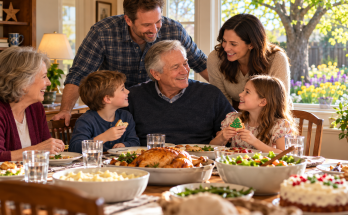
The house was quiet after everyone left.
I stood in the kitchen with my sleeves pushed up, looking at the plates stacked beside the sink and the little crumbs scattered across the table.
For once, the mess didn't bother me.
It meant people had been here.
People I loved had sat in my house, eaten my food, laughed at my stories, and left without making me feel as though I owed them something for the privilege.
I filled the sink with warm water and added a little dish soap.
The scent reminded me of Diane.
She always bought the same lemon-scented soap, even when I brought home a different bottle because it was on sale.
She used to say there were some things in a house that deserved to stay familiar.
I washed the serving dishes slowly.
The green bean casserole dish Margaret had brought was already clean, but I washed it again before placing it on the counter to dry.
I could almost hear her telling me I was fussing over nothing.
That thought made me smile.
When the last plate was in the rack, I wiped the table and noticed the wooden star still sitting a little crooked at the top of the Christmas tree.
I considered straightening it.
Then I decided to leave it alone.
Diane had never managed to make that star sit perfectly straight, either.
I dried my hands and walked into the living room.
The children had left a few small toys beneath the tree, along with a red ribbon that had come loose from one of their presents.
I picked up the ribbon and placed it on the mantel.
Their laughter still seemed to hang in the room.
I sat in my chair and looked at the book I'd received for myself.
The brown paper wrapping lay folded beside it.
For years, I had bought gifts for everyone else and told myself I didn't need anything.
Sometimes that had been true.
Other times, I had simply convinced myself that spending money on my own comfort was less important than making sure somebody else had what they wanted.
I opened the book and read the first few pages.
I didn't rush.
Nobody was waiting for me to finish.
Nobody needed me to solve a problem before bedtime.
For a little while, I allowed myself to enjoy the quiet without treating it as an empty space that needed to be filled.
My phone rang just after three.
It was Colin.
"Hey, Dad. You doing all right?"
"I'm fine. Just sitting down."
"Good. I wanted to check in."
I looked toward the kitchen.
"Everything went well today."
"It really did," he said. "The kids haven't stopped talking about the cookies."
"We haven't made them yet."
"They know that. Apparently, they're already planning what shapes they want."
"Then we'll have to make sure we have enough flour."
He laughed.
For a moment, we spoke about ordinary things.
The children had enjoyed their presents. Vanessa had taken several pictures. Margaret had told a story about Christmas when Colin was little, and he had been embarrassed enough to deny half of it.
Then his voice changed.
"Can I ask you something?"
"Of course."
"Did you feel uncomfortable when we came over today?"
I leaned back in my chair.
"No. Why would I?"
"I don't know. I've been thinking about everything that happened before Christmas."
I waited.
"I keep wondering whether you were only being nice because you didn't want to upset us."
I understood what he meant.
He was afraid that our peaceful dinner had been a performance, that beneath it I was still angry and waiting for an opportunity to remind him of everything he'd done wrong.
"I'm not pretending, Colin."
"Okay."
"But I need you to understand something."
He went quiet.
"I love having you here. I love seeing the children run through the house. I love hearing you tell the same stories you've told since you were ten years old."
"Those stories are good."
"Some of them are terrible."
He laughed again.
I smiled, but I kept going.
"What I don't love is feeling that I have to pay for every gathering, every extra guest, and every plan somebody makes without asking me."
"I know."
"I don't want you to stop coming because you're worried I'll think you're asking for something."
"That's not what I want, either."
"Then we need to keep doing what we did today. We make plans together, and we tell the truth about what we can afford."
He took a breath.
"I think I understand that better now."
"I hope so."
"I also wanted to tell you that Vanessa and I talked this afternoon."
I sat a little straighter.
"About what?"
"About the money. About how things got this way."
I didn't interrupt.
"We realized that we were treating your help like part of our income. We weren't thinking about it as money you were choosing to give us. We were counting on it before we even asked."
That was more honest than anything he'd said to me in a long time.
"What are you going to do differently?"
"We've already changed a few things. We're keeping the household bills in our own account, and we're setting up a separate amount for groceries. If we can't afford something, we won't buy it just because we thought you might cover it."
"That sounds sensible."
"It won't be easy every month."
"I know."
"But that's our problem to work out."
I looked at the budget sheet still sitting on the desk.
He had written the numbers in pencil, crossed out a few expenses, and circled the ones they couldn't change immediately.
It wasn't a perfect plan.
It was a beginning.
"Thank you for telling me," I said.
"Thanks for giving us the chance to figure it out."
After we hung up, I returned to my book.
I read another chapter before realizing I had been holding the same page open for several minutes.
My thoughts had wandered to the community room.
Thirty-one people had been expected to descend on my house because Vanessa had announced that they would.
For a while, I had imagined the whole thing ending in an argument, with Colin caught between his wife and his father.
Instead, we had found a different arrangement.
The larger gathering could happen somewhere built to hold that many people.
My home could remain my home.
And I could still welcome the people I loved.
I went into the kitchen to make tea.
Diane's blue mug sat on the shelf where I had placed it that morning.
I took down another mug for myself and poured the hot water slowly.
The steam rose between my hands.
I remembered the Christmases when Diane and I had invited more people than we could comfortably fit around the table.
She never minded moving chairs or borrowing another folding table from a neighbor.
But she had always asked me first.
That was the difference.
She understood that generosity meant more when it was freely offered.
I carried my tea into the living room and settled back into my chair.
Outside, the afternoon light was fading.
The maple tree stood bare against the winter sky, its branches moving gently in the wind.
I had spent so many years measuring my usefulness by what I could provide.
A paid bill.
A repaired car.
A full refrigerator.
A Christmas nobody had to worry about.
I had thought those things proved my love.
Perhaps they did, in part.
But love also meant being able to sit at a table without calculating the cost of every plate.
It meant telling the truth before resentment grew too large to hide.
And it meant allowing the people you loved to become responsible adults, even when you could make their lives easier by doing everything for them.
I took another sip of tea.
Then I turned a page.
For the first time in a long while, I wasn't waiting for the phone to ring.
*END PART 17**
Click here to continue reading: PART 18: THE PROMISE WE MADE IN THE KITCHEN
I Had Spent Years Calling It Family Help, Until One Christmas Request Made Me Question Who Really Owned My Home
Part 17 of 20