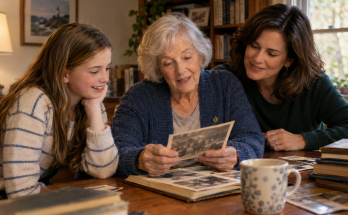
By the time Anna was seventy-eight, almost everyone who had lived through Saint Matthew was dead.
Sarah Mercer.
Leonard Pike.
Elaine.
Sophie.
Me.
Daniel’s generation remained mostly through children and recordings.
The old names continued appearing in family conversations, but their edges softened.
A younger relative once asked whether Robert Carter had been “the evil grandfather.”
Anna corrected him.
“No.”
The child looked confused.
“But he did bad things.”
“Yes.”
“Then why not?”
“Because calling him evil lets you stop asking how ordinary choices became harmful.”
The child disliked that answer.
Children preferred categories.
So did adults.
Anna had learned to distrust easy ones.
She lived in a smaller house now.
One floor.
A garden.
Too many books.
The family archive had moved again.
Not to her home.
That had been deliberate.
After Sophie’s death, Anna transferred the physical family collection to a regional historical repository under a restricted agreement.
Private letters remained closed for defined periods.
Medical information required family permission.
Research material related to Vale-Carter had separate access rules.
Nothing depended on whoever happened to have the largest closet.
The archive became institutional.
The family became freer.
Digital copies of selected materials existed in a shared folder.
Photographs.
Public letters.
Timelines.
The scanned rulebook.
No single person possessed the master version.
Nobody could burn it all.
Nobody could secretly alter it all.
Distributed truth.
Mom would have appreciated that phrase even while complaining it sounded technical.
One autumn afternoon, Anna received an email from a graduate student.
The student was researching historical failures in reproductive medicine consent.
She had found the Vale-Carter collection.
She wanted to interview a family descendant.
Anna almost deleted the message.
Then read it again.
The request was careful.
No sensational framing.
No interest in “the famous baby case.”
Specific questions about the effect of institutional secrecy on later family decision-making.
Anna agreed.
The student, Maya Chen, arrived carrying two notebooks and a recorder.
“Do you mind if I record?”
“Yes.”
Maya blinked.
“You do mind?”
“Yes.”
“Okay.”
Good start.
Maya put the recorder away.
They sat at Anna’s kitchen table.
The interview began with Marianne.
Then Daniel Mercer.
Then the nursery incident.
Anna interrupted often.
“No, that part was assumed for years and later corrected.”
“Paul Carter, not Robert.”
“The third baby was Emily. She wasn’t switched.”
“Sophie and Ruby were always Isabelle’s daughters.”
Maya took careful notes.
Eventually she asked, “What do you think was the central harm?”
Anna expected to answer secrecy.
Instead she paused.
“Ownership.”
Maya looked up.
“Of what?”
“Information. Children. Family narratives. Medical decisions. Reputation.”
She continued.
“Robert believed he owned outcomes because he had money and influence. Graham believed he could decide what his daughters should know. Hospitals believed records belonged to institutions instead of patients. Even people trying to protect children sometimes started acting as if protection gave them ownership.”
Maya wrote quickly.
“And the corrective?”
“Choice.”
“Individual choice?”
“Not only.”
Anna thought.
“Transparent choices. Accountable ones. Choices people can question.”
That sounded academic.
She disliked it.
So she added:
“And learning that loving someone doesn’t make their life yours.”
Maya stopped writing.
“That’s strong.”
“It’s old.”
“Where from?”
“A family rule.”
“Can I see it?”
Anna almost smiled.
“The original is gone.”
“What happened?”
“We burned it.”
Maya looked stunned.
“You burned a primary family artifact?”
“Yes.”
“Why?”
“Because it was becoming scripture.”
The graduate student looked physically pained.
Anna laughed.
“Archivists hate that story.”
“I’m not an archivist.”
“You made the face.”
“What face?”
“Our family has too many.”
Maya eventually asked about Isabelle.
Anna’s grandmother.
The person from whom much of the story had once been told.
“What was she like?”
Anna did not answer immediately.
How do you describe someone you knew as a child, adult, elder, and then memory patient?
“Difficult.”
Maya laughed.
“Is that your first word?”
“Yes.”
“What else?”
“Funny when she wasn’t trying. Suspicious of vague authority. Too willing to sacrifice herself sometimes. Controlling when scared. Better at admitting it as she aged.”
“Brave?”
Anna smiled.
“She specifically told us not to make her brave all the time after she died.”
Maya stopped.
“That sounds like a quote.”
“It is.”
“Can I use it?”
“No.”
Maya nodded immediately.
Good.
Anna continued.
“She was afraid a lot. That’s part of why what she did mattered.”
“What did she do?”
“She kept choosing to return.”
“To what?”
“Her daughters. Difficult conversations. Medical uncertainty. People she had reasons to avoid.”
Maya wrote that without asking permission to quote.
Better.
At the end of three hours, Maya closed her notebook.
“One last question.”
“Those are always dangerous.”
“If you could change one thing in the official archive, what would it be?”
Anna looked surprised.
“Nothing.”
“Nothing?”
“Correct errors if you find them. Add context. Don’t rewrite it toward a cleaner story.”
“What if new evidence appears?”
“Then add it.”
“Even if it contradicts family memory?”
“Especially then.”
Maya nodded.
“That’s unusual.”
“No. It should be normal.”
After the student left, Anna walked into the garden.
A patch of soil near the fence was darker where, decades earlier, the ashes of the rulebook had been scattered.
No marker identified it.
She knew anyway.
Elise arrived later with her granddaughter, June.
June was ten.
Exactly the age Sophie had been when leukemia brought Isabelle back into her daughters’ lives.
Anna noticed the age without saying so.
June carried a school tablet.
“Great-Grandma?”
“I’m not your great-grandma.”
“You basically are.”
Family terminology remained flexible.
“What do you want?”
“I have a history assignment.”
Anna groaned.
“No.”
June laughed.
“We have to interview someone old.”
“Leave.”
“You’re the oldest person I know.”
“Cruel.”
June sat at the table.
“I need a story from before I was born.”
Anna looked toward Elise.
“This is your fault.”
Elise smiled.
“Generational tradition.”
June opened the assignment.
“Something that changed your family.”
There were obvious answers.
The hospital.
The transplant.
The custody case.
The discovery of Emily.
But those events happened before Anna could remember much firsthand.
She refused to pretend inherited memory was personal memory.
“I’ll tell you about a fire.”
June brightened.
“A house fire?”
“No.”
“What burned?”
“A notebook.”
Disappointment.
“Why is that important?”
Anna explained the rulebook.
Not every rule.
Just what it represented.
The family had written down lessons after years of painful secrets.
They kept the notebook for decades.
Then Sophie asked them to destroy it.
“Why?”
“Because she thought we were treating the rules like answers instead of tools.”
June frowned.
“What’s wrong with rules?”
“Nothing, when they help you think.”
“And when they don’t?”
“They can stop you from thinking.”
June typed.
“So you burned them?”
“The pages.”
“Not the rules?”
“That’s the point.”
June stared.
“I don’t get it.”
Good.
She was ten.
She did not need to.
Anna continued.
“Sometimes adults keep things because they’re afraid forgetting them means the lesson disappears.”
“Does it?”
“Sometimes.”
“That sounds bad.”
“It can be.”
“Then why burn it?”
“Because if a lesson only survives because you preserve the exact object, maybe you haven’t really learned it.”
June considered that.
“Did you keep a picture?”
“Yes.”
“So you cheated.”
Anna laughed.
“Absolutely.”
The interview ended there.
June ran outside.
Elise stayed.
“You gave her the easy story.”
“No.”
“You left out most of the family.”
“She asked for something I remembered.”
Elise smiled.
“Grandma Isabelle would approve.”
“Or argue.”
“Same thing.”
They made tea.
On the counter sat no framed rules.
No family commandments.
Only photographs.
One of Anna with Sophie.
One with Emily.
One of the coastal weekend.
One of June missing both front teeth.
Ordinary evidence.
The official archive continued attracting occasional researchers.
A legal scholar wrote about custody evidence manipulation.
A medical ethicist studied Vale-Carter consent failures.
A historian wrote about informal child-protection networks when institutions failed.
Each paper emphasized something different.
None owned the whole story.
That pleased Anna.
Years later, after Anna died, Elise became the family contact for the archive.
She did not inherit control.
Only responsibility to respond when needed.
At the first family gathering after Anna’s funeral, June—now an adult—asked whether anyone remembered all six family rules.
Nobody did.
They laughed.
Someone looked them up on the scanned copy.
Rule Three still got the biggest reaction.
NO WEIRD RICH PEOPLE TRACKING BABIES.
June shook her head.
“Our family was insane.”
Elise corrected her.
“Our family had some insane circumstances.”
“That’s less fun.”
“It’s more accurate.”
There it was.
Still moving.
Accuracy without worship.
Truth without ownership.
Love without control.
The ideas had outlived the book.
Outside, children ran across the yard.
Someone burned the first batch of pancakes.
Someone else counted birds on the fence and got the number wrong.
No one corrected them immediately.
The archive sat miles away in climate-controlled storage.
The past remained accessible.
Not dominant.
That was the outcome Isabelle had fought toward without knowing its final shape.
She never saw this generation.
Never met June as an adult.
Never knew researchers would read parts of the family record.
Never knew the original rulebook would burn.
That was fine.
No one gets to supervise the future after death.
The living choose.
They make mistakes.
They revise.
They preserve some things.
Destroy others.
They tell stories badly.
Then better.
They leave gaps.
Someone else fills them.
And eventually the story belongs not to the person who suffered first, or the person who documented most carefully, or the person who lived longest.
It becomes shared memory.
Not perfectly accurate.
Not perfectly complete.
But open to correction.
That was enough.
At the end of June’s family gathering, her daughter asked a question while people were clearing plates.
“Why do we always talk about penguins?”
Nobody knew how to explain without taking twenty minutes.
June looked around the room.
Then smiled.
“Because somebody kept counting them wrong.”
“Who?”
“A lot of people.”
“How many penguins were there?”
June thought.
“Twenty-three.”
From across the kitchen, Elise shouted:
“Not always.”
Everyone laughed.
No one checked the archive.
No one needed to.
Some truths were exact.
Some were remembered.
Some became jokes.
The family had finally learned how to tell the difference.
And for the first time since a frightened mother drove through rain toward a sick daughter she had been kept from seeing, nobody in the family was waiting for one final hidden fact to make everything whole.
Nothing was whole.
Everything was real.
That was better.
The End
Read more original stories on Feel Every Story.