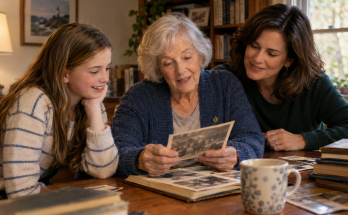
The last time our generation gathered completely, nobody knew it would be the last.
That mattered.
If we had known, we would have behaved badly.
Too many photographs.
Too many speeches.
Too much significance placed on ordinary moments.
Instead, we complained about parking.
It was Emily’s seventy-fifth birthday.
Marcus rented a house near the coast large enough for everyone.
Sophie and Noah arrived first.
I arrived second because I considered punctuality a moral virtue.
Anna came with Elise and two grandchildren.
Daniel brought his husband, Adrian, whose name still made family elders pause because of Adrian Vale.
Not his fault.
He found it funny.
Emily did not.
“Couldn’t you have been named something normal?”
“Like Daniel?”
“Exactly.”
Marcus laughed until Emily threatened divorce after fifty years of marriage.
The house overlooked gray water and a narrow beach.
Wind rattled the windows.
Someone had placed a bowl of shells on the dining table as decoration.
Within an hour, one great-grandchild had filled it with crackers.
No one corrected him.
Sophie found me unpacking.
“You brought files?”
“Emergency contacts.”
“That is a file.”
“I’m old.”
“So am I.”
“You’re younger.”
“Twin-adjacent logic.”
We had become the elders.
That realization remained offensive.
For decades, someone older had existed.
Mom.
Graham.
Elaine.
Sarah.
Emily’s adoptive family.
Then one by one those reference points vanished.
Now younger people looked at us when questions arose.
That weekend, they asked fewer questions than expected.
Good.
Maybe we had raised people who did not need family permission for everything.
Dinner the first night became chaotic.
Diet restrictions.
Medications.
Children refusing vegetables.
Someone burned garlic bread.
Noah claimed innocence.
Nobody believed him.
Emily stood to make a toast.
Everyone groaned.
“I’m seventy-five. I get a toast.”
“You get cake,” Daniel said.
“I paid for the house.”
“Toast approved.”
Emily held up her glass.
“I want to say one thing.”
Marcus whispered, “This will be twelve things.”
She ignored him.
“I spent most of my early life thinking family meant the people I already knew.”
The room quieted.
“Then Sophie needed bone marrow.”
Sophie raised her glass.
“Still dramatic.”
“You almost died.”
“I know.”
Emily continued.
“I gave something to a stranger. Then found out the stranger was family. Then found out my own family was larger, messier, and much more argumentative than expected.”
Ruby—me—raised my hand.
“Objection to argumentative.”
“Overruled.”
People laughed.
Emily looked around.
“I used to think the important part of our story was that we found one another.”
She paused.
“I don’t anymore.”
That surprised me.
“What’s the important part?” Anna asked.
“That we learned what to do after.”
The room stayed quiet.
Good line.
No plaque required.
Emily sat.
Marcus kissed her cheek.
Then immediately asked who wanted potatoes.
That was perfect.
The weekend continued without ceremony.
We walked on the beach.
Sophie collected stones because apparently that habit had passed from Anna Isabelle’s childhood into family tradition.
I refused.
“Rocks are heavy.”
“You’ve become practical.”
“I’ve always been practical.”
Sophie laughed so hard she had to stop walking.
“What?”
“Nothing.”
“Say it.”
“Mom once wrote that you considered emotion a procedural defect.”
“She exaggerated.”
“She was accurate.”
We continued along the water.
At low tide, children ran toward tide pools.
Anna shouted warnings about slippery rocks.
Elise told her to stop hovering.
Anna immediately stopped.
I noticed.
Family habits changed through tiny corrections.
Not declarations.
Later, Daniel asked whether we wanted to record a formal oral history.
Everyone reacted differently.
I said maybe.
Sophie said no.
Emily said only if she could approve edits.
Anna wanted copies.
Marcus asked whether dinner would be delayed.
Noah left the room.
Daniel sighed.
“You people donated half your lives to archives but won’t sit for one recording.”
Sophie said, “Documents don’t ask follow-up questions.”
“You’ve been interviewed before.”
“Exactly.”
He looked at me.
“You?”
I thought.
“What would you ask?”
“How the family changed after Isabelle died.”
Mom.
Even hearing her name decades later shifted something.
“I’d answer that.”
Sophie stared.
“Traitor.”
“Only that.”
Daniel set up one camera the next afternoon.
No lights.
No staging.
We sat outside beneath a covered porch.
Wind filled parts of the audio.
Good.
No polished documentary.
He asked the first question.
“What changed after Isabelle died?”
I answered.
“Less than I expected.”
Daniel waited.
“What does that mean?”
“She had already changed the family before she died.”
Sophie nodded.
“The rules stayed.”
“Some.”
“What else?”
I thought.
“We stopped needing one person to be the keeper.”
Daniel asked, “Keeper of what?”
“The truth.”
That felt right.
When Mom was alive, especially before dementia, we often looked to her as the central witness.
The one who connected custody, hospital records, Saint Matthew, Emily, Graham, and everything after.
Once she died, no one replaced her.
We did not need replacement.
The story became distributed.
Sophie remembered her illness.
I remembered court years differently.
Emily carried Marianne and Anna Mercer.
Anna carried the next generation’s questions.
Documents filled gaps.
No one owned the whole.
Daniel asked Sophie what she believed was the biggest change.
“Boundaries became normal.”
“Explain.”
“When I was little, boundaries were treated like rejection. If Mom wanted information, she pushed. If Dad wanted forgiveness, he waited for signs. Everyone interpreted distance emotionally.”
“And now?”
“If Anna says she needs space, I assume she needs space.”
Anna called from behind the camera, “Mostly.”
Sophie laughed.
“Mostly.”
Emily’s answer was different.
“We stopped rewarding secrecy.”
Daniel asked what she meant.
“People used to reveal things at crisis points. Hidden documents. Hidden family connections. Hidden motives. The person with the secret had power.”
“And now?”
“If someone says, ‘I have something important but I can’t tell you yet,’ everybody gets annoyed.”
Marcus shouted from inside, “Accurate.”
The interview lasted forty minutes.
We forgot the camera after ten.
That made the recording useful.
Not polished.
Real.
At one point Sophie and I argued about whether Mom voluntarily entered memory care before or after the second navigation incident.
We checked later.
Sophie was right.
I hated that.
The correction remained in the transcript.
Accuracy mattered more than my dignity.
That evening, a storm came in.
Power went out for twenty minutes.
Children screamed happily.
Adults reached for phones.
Emergency lights flickered on.
We gathered candles.
Someone joked that this was how family mysteries started.
Anna said, “If anybody discovers a hidden baby tonight, I’m leaving.”
The lights returned before dinner.
No secret baby.
Good.
The birthday cake arrived from a bakery in town.
Someone had misspelled Emily’s name as Emilly.
She loved it.
“Finally, a new identity.”
Daniel threatened to update the family tree.
We took photographs.
Too many.
In one, Sophie had her eyes closed.
In another, I was talking.
In another, Marcus held a plate directly in front of Emily’s dress.
The final photograph was not perfect.
It became everyone’s favorite.
The next morning, before people began leaving, Anna brought out the old family rulebook.
I groaned.
“Why is that here?”
“Historical artifact.”
“This is a vacation.”
Emily said, “Read Rule Three.”
Anna did.
NO WEIRD RICH PEOPLE TRACKING BABIES.
The younger generation laughed.
Several had heard the story but not the original wording.
A great-grandchild asked, “Did that really happen?”
“Yes,” ten adults answered at once.
The child looked delighted.
“Cool.”
“No,” Sophie said. “Not cool.”
“Kind of cool.”
“No.”
That was how history changed.
Trauma became story.
Story became family joke.
The joke did not erase harm.
It changed its ownership.
Anna turned pages.
Rule Four.
Rule Five.
Rule Six.
Then the blank pages.
“Still no Rule Seven,” she said.
“Correct,” Sophie answered.
Daniel protested.
“We need one.”
“No.”
“Why?”
Sophie looked toward the ocean.
“Because eventually people should make their own.”
That ended the debate.
Before leaving, we walked to the beach one last time.
The wind had calmed.
Water stretched flat and gray beneath the morning sky.
Emily stood between Marcus and Daniel.
Sophie beside Noah.
Anna with Elise.
I walked slightly behind.
Not because of age.
Because I wanted to see everyone at once.
For most of my childhood, our family story had been about what adults did to us.
What was hidden.
Who controlled access.
Who believed whom.
Then for years it became about recovery.
Reunion.
Illness.
Accountability.
Boundaries.
Eventually something changed so gradually none of us noticed.
The story stopped being about survival.
It became about birthdays.
Medical appointments that ended normally.
Careers.
Marriages.
Divorces.
Children.
Bad dinners.
Aging.
Funerals.
Ordinary conflict.
That was not anticlimax.
It was victory.
Sophie slowed until I caught up.
“What are you thinking?”
“That this is boring.”
She smiled.
“Good boring?”
“The best.”
She took my arm.
We walked.
Ahead of us, one of the children shouted because a wave reached his shoes.
Everyone laughed.
No one photographed it.
No one documented the exact time.
No one preserved the wet socks.
Some moments were allowed to disappear.
That was freedom too.
A year later Marcus died.
Two years after that, Emily.
No conspiracy.
No hidden confession.
Age.
Illness.
Ordinary endings.
The coastal weekend became the last photograph with all of us alive.
For years it sat on Sophie’s mantel.
Not because we knew it was final when we took it.
Because later, we learned it was.
That distinction mattered.
Life did not announce which ordinary afternoon would become evidence of an era.
Sometimes the most valuable record was simply proof that, for one weekend, everyone came.
And nothing terrible happened.