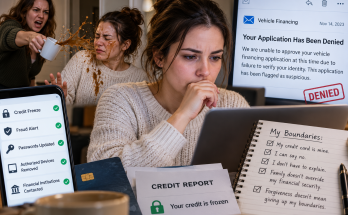
The next morning, I woke with the list of questions already in my mind.
For once, I didn't reach for my phone before getting out of bed.
I washed my face, changed clothes, and went downstairs.
My father was making breakfast.
The folder was still on the desk in the spare room, exactly where I had left it.
I felt a small sense of relief knowing I wouldn't have to search for anything.
After breakfast, I brought it to the kitchen table.
I placed the question sheet on top and read it once more.
The wording was plain.
I had removed the questions that asked the bank to explain things it couldn't reasonably know.
I had kept the ones that concerned my accounts, the attempted authorizations, and the steps I could take to protect myself.
My father sat across from me.
"Ready?"
"As ready as I'm going to be."
He nodded toward my phone.
I called the bank.
After completing the security checks, I explained that I had received three declined authorization alerts and had already taken steps to secure the affected cards.
I gave the representative the dates and amounts.
She reviewed the information available to her.
I took notes as she spoke.
First, I asked whether the three requests had been completed.
She confirmed that the requests we had discussed were declined.
I wrote the answer beside the first question.
Then I asked whether there was any additional action I needed to take on the accounts.
She reviewed the existing security measures and explained the available options.
I followed the instructions that applied to my situation.
When something wasn't clear, I asked her to repeat it.
I didn't pretend to understand simply because the explanation sounded technical.
That was a small change, but it mattered to me.
For years, I had sometimes nodded along when someone explained a financial detail I didn't fully understand.
I had worried that asking another question would make me seem incapable.
Now I was more worried about leaving a conversation without knowing what I needed to know.
The representative explained how I could report further suspicious activity and where to find the bank's guidance on account security.
I wrote down the relevant details.
Then I asked about the earlier transactions I had marked for clarification.
She explained what information she could review and what additional details might be needed.
Some of the entries could be identified from their descriptions.
Others required further review.
She did not tell me that they were connected to the three attempted authorizations.
She did not identify a person responsible for the large requests.
I wrote those limits down, too.
When the call ended, I looked at my notes.
I had not received the answer I wanted.
But I had obtained specific information about the accounts, confirmed which protections were in place, and learned what to do if another alert arrived.
I placed the pen on the table.
My father waited.
"Well?"
"The accounts are protected as far as the bank can confirm right now. The earlier entries still need clarification. They haven't established who initiated the attempts."
He nodded.
"That's useful information."
"It doesn't feel useful."
"It tells you what to do next."
I looked at the list.
He was right.
The answers had narrowed the practical questions, even if they had not solved the larger mystery.
I wrote the date and time of the call at the top of the notes.
Then I checked that I had saved the information in the folder.
I did not add anything about my former husband.
The bank had not connected him to the attempted authorizations.
I wasn't going to use the blank space in my knowledge as a reason to put his name there.
After organizing the notes, I turned to the earlier transactions.
I chose one entry and read its description carefully.
I compared it with the corresponding statement.
The amount matched.
The date matched.
The description provided some information about the type of transaction, but it did not answer every question I had about why it had occurred.
I marked it for follow-up.
Then I moved to the next entry.
I did not rush.
I did not assume that unfamiliar meant unauthorized.
I also did not dismiss an entry simply because it appeared on an account I had once shared with my former husband.
I needed to understand the account arrangements before deciding what each transaction meant.
When I reached the end of the list, I had fewer questions than before.
The ones that remained were more precise.
That was progress, even if it didn't feel like the kind I had imagined.
I leaned back and rubbed my eyes.
My father poured water into my glass.
"Take a break."
"I just took a break."
"You spent the whole break staring at the page."
I laughed quietly.
He smiled, and for a moment, the kitchen felt almost normal.
I stood and walked to the window.
The street was bright with late-morning sunlight.
A neighbor was loading bags into a car.
Someone across the road was sweeping leaves from a front step.
I watched them for a moment, then returned to the table.
I had wanted the bank to tell me that everything was fine.
Instead, it had told me which things were confirmed, which things required further review, and which questions it couldn't answer yet.
I could work with that.
I opened the folder and checked the order of the papers.
The original alerts came first.
The bank notes followed.
The earlier transactions remained in a separate section.
The security checklist came last.
I made sure each page had a date or a clear heading.
Then I closed the folder.
I felt no sudden relief.
I was still afraid that more alerts might appear.
I was still worried about the possibility that someone had accessed information they shouldn't have had.
But I was no longer waiting for the bank to explain my entire life in a single phone call.
That was not its job.
My job was to keep asking reasonable questions, protect what I could, and resist the temptation to turn uncertainty into a verdict.
I picked up my phone and checked the time.
No new alerts had arrived.
I set it down again.
This time, I didn't refresh the account page.
I had already completed the steps I intended to complete that morning.
The next step could wait until I had something new to work with.
Click here to continue reading: PART 18: I Finally Decided What I Needed From a Conversation With My Former Husband, Even Though I Still Feared What His Answer Might Be
My Marriage Was Over, but My Father Was Watching Something I Could Not See Yet
Part 17 of 20