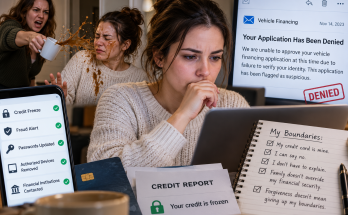
By early afternoon, I had stopped checking my phone every few minutes.
I still kept it nearby.
I simply stopped treating every vibration as a warning.
My father went to the front room to take a call of his own.
I remained at the kitchen table with the folder open in front of me.
The three amounts were on the first page.
The earlier unfamiliar transactions were listed separately.
The bank's answers were written beneath them.
I turned to a blank page and wrote my former husband's name.
I stared at it.
Then I drew a line beneath it.
I wanted to call him.
I wanted to ask whether he knew anything about the attempts.
I wanted to ask why anyone would try to authorize such enormous amounts against accounts connected to my life.
I wanted him to sound surprised.
I wanted him to sound concerned.
Most of all, I wanted his answer to tell me whether I had spent years living beside someone I had never really known.
But I couldn't decide what I would do with any answer he gave me.
If he denied knowing anything, would I believe him?
If he sounded angry, would I interpret that as guilt?
If he sounded worried, would I mistake his concern for proof of innocence?
I knew how easily my feelings could shape what I heard.
I had done that before.
I had heard an apology and treated it as a promise.
I had heard reassurance and treated it as evidence.
I had heard someone say that everything was fine and used those words to silence the part of me that disagreed.
I didn't want to do that again.
I put the pen down.
When my father returned, he noticed the name on the page.
"You want to call him."
It wasn't a question.
"Yes."
"Have you decided what you would ask?"
"I'd ask if he knows anything."
"And if he says no?"
I pressed my lips together.
"I don't know."
"If he says yes?"
"I don't know that either."
My father pulled out the chair opposite me.
"Then perhaps you don't need to make that call today."
I felt irritation rise in me.
It wasn't really directed at him.
I was tired of being told to wait.
I was tired of careful steps and incomplete answers.
I was tired of having to think about consequences when I wanted to act.
"I can't just sit here forever."
"No," he said. "You can't."
He didn't raise his voice.
"But you don't have to decide everything this afternoon."
I looked at the page again.
The name seemed too large for the space I had given it.
"What if he really doesn't know anything?"
"Then the facts will still be the facts."
"And what if he does?"
"Then you'll have to decide what to do with what you can establish."
I rubbed my forehead.
"I wish you would tell me what you think."
"I think you are hurt, frightened, and trying to find something solid to stand on."
I looked at him.
He continued.
"I think you deserve answers. I also think you deserve to get them without putting yourself in a position where somebody can pressure you into accepting an explanation before you're ready."
I sat back.
That was not the dramatic answer I had wanted.
It was more useful than one.
My father wasn't telling me never to speak to my former husband.
He was reminding me that I could choose when and how to speak.
I crossed out the name on the page, not because I wanted to erase it, but because I didn't want the page to look like a decision had already been made.
Beside it, I wrote: POSSIBLE CONTACT. NOT DECIDED.
Then I closed the folder.
For a while, neither of us spoke.
I could hear a clock ticking in the next room.
It sounded louder than it had that morning.
I thought about the years I had spent making plans with another person.
We had discussed bills, holidays, repairs, and the ordinary expenses that made up a shared life.
I had assumed that the way we handled money reflected the way we trusted each other.
Now I wondered whether I had confused access with trust.
I had given him access to parts of my life because I believed that was what marriage meant.
Some access had been necessary.
Some had been convenient.
Some had been granted without my fully understanding what it involved.
That did not prove he had done anything wrong.
It did mean I needed to understand what access still existed and what I could control myself.
I opened the folder again and added a separate section for account access.
I wrote down which cards had been replaced, which accounts had been secured, and which institutions I still needed to contact.
I left space beside each item for the date and the result.
My father glanced at the page.
"That's sensible."
"I don't feel sensible."
"You don't have to feel sensible to do something sensible."
I almost smiled.
It was the first time all day that I had nearly laughed without feeling that I was betraying the seriousness of what had happened.
I checked the time.
The afternoon was moving on.
There were practical things I still needed to do, but there was no reason to call my former husband simply because I couldn't tolerate the silence.
I took my phone and reviewed the contacts I had already secured.
I didn't delete his number.
I didn't block it in a moment of anger.
I didn't send a message demanding an explanation.
I left the choice open until I could make it deliberately.
That felt strange.
For years, I had thought that a decision was only real if I made it quickly enough to prove I meant it.
Now I was learning that restraint could be a decision, too.
My father stood to get the mail.
When he came back, he placed the envelopes on the counter without sorting them.
There was nothing important in the stack.
A bill.
An advertisement.
A plain envelope addressed to him.
The sight of ordinary mail reminded me that life would continue presenting ordinary tasks while I dealt with something I didn't understand.
I couldn't stop the world until I felt ready.
I could, however, stop demanding that I solve everything before the end of the day.
I wrote one more note in the folder.
DO NOT CONTACT HIM UNTIL I KNOW WHAT I NEED TO ASK AND WHAT I NEED TO KEEP.
I read it twice.
Then I closed the folder and set it beside my phone.
I still wanted to hear my former husband's voice.
I still wanted him to explain the numbers.
But wanting an explanation was not the same as being ready to accept one.
For that afternoon, I let the question remain unanswered.
Click here to continue reading: PART 12: The Quiet After the Bank Calls Gave Me Room to Notice How Much of My Life I Had Handed Over Without Asking Enough Questions
My Marriage Was Over, but My Father Was Watching Something I Could Not See Yet
Part 11 of 20