I used to think the end of a mystery would feel like relief.
You found the answer.
You understood the clues.
You could finally put the questions away.
I had imagined that moment more than once.
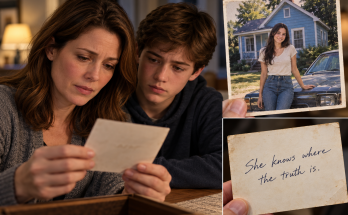
I pictured myself holding the photograph and understanding why David had kept it.
I pictured Ethan looking at the woman and recognizing the connection.
I imagined the sentence on the back becoming clear at last.
But none of those things had happened.
The photograph remained unexplained.
The woman remained unknown to us.
And the connection between the picture and 3025 remained something we could not establish.
I had to accept that our lives were not moving toward a conclusion simply because I wanted one.
That was difficult.
I had spent so much time thinking about what the photograph might reveal that I had not fully considered what it meant to live without knowing.
I was beginning to understand that the question could remain open for a long time.
Perhaps longer than I wanted.
Perhaps longer than Ethan wanted.
We could not control that.
What we could control was how we treated each other while we waited.
One afternoon, Ethan asked whether I thought we had done enough to understand the photograph.
I looked at him.
"What do you mean?"
He glanced toward the place where we had stored it.
"We've looked at it. We've talked about it. But we still don't know anything."
I understood his frustration.
We had examined the picture from every angle we could think of.
We had read David's sentence again and again.
We had tried to remember whether he had ever mentioned the woman or the blue house.
Nothing had produced an answer.
I did not want to pretend that our efforts had solved anything.
But I also did not think they had been wasted.
"We've learned what we can from what we have," I said.
Ethan looked disappointed.
"That's not much."
"No," I admitted. "It isn't."
He sat down.
I could tell that he wanted a next step.
I wanted one, too.
But I did not have a reliable answer to offer.
I could have suggested another theory.
I could have told him that the woman must have known David.
I could have claimed that the sentence proved he wanted us to find something.
Those explanations would have given us something to discuss.
They would not have given us the truth.
I had learned to be suspicious of answers that appeared only because we were tired of waiting.
Instead, I told Ethan what I honestly believed.
"I don't think we should pretend we've solved it. But I don't think we need to keep asking the same questions when we have nothing new to help us answer them."
He considered that.
"So we wait?"
"We stay open to learning more."
He nodded slowly.
It was not the answer either of us wanted.
But it was the only one I could give without pretending to know more than I did.
We sat together for a while.
I thought about David.
I wondered whether he had expected someone to find the photograph and understand the message immediately.
I wondered whether he had believed the woman would be recognizable.
I wondered whether he had intended the picture to reach Ethan at all.
Those questions were still there.
But I no longer felt the need to choose an answer for each one.
I had begun to see how much harm an invented explanation could do.
It could make us believe something about David that was not true.
It could make us judge the woman without knowing her story.
It could make Ethan feel responsible for a mystery he had not created.
And it could turn a family question into a source of suspicion that never needed to exist.
I did not want that.
I wanted the truth, whatever it was.
If it eventually became clear, I wanted us to be able to recognize it without having to defend all the guesses we had made along the way.
That meant keeping our minds open.
It also meant accepting that we might not get the answer we wanted.
Ethan looked toward the table.
"Do you think Dad would be upset that we don't understand?"
The question made me pause.
I had wondered whether David expected someone to understand the message.
But I had no way to know how he would feel about our confusion.
"I don't know," I said.
Then I added something I had not thought to say before.
"But I don't think we should blame ourselves for not knowing something he never explained to us."
Ethan looked at me.
I could see that the thought mattered to him.
He had been carrying the number 3025 and the photograph without knowing how they fit together.
I did not want him to turn that uncertainty into a personal failure.
Neither of us had chosen the situation.
Neither of us had enough information to solve it.
We had done what we could.
That had to count for something.
I reached for the photograph and held it carefully.
I looked at the woman one last time before turning it over.
David's sentence seemed no less important than before.
But it no longer felt like a demand that we discover everything immediately.
It was a message whose meaning we did not yet understand.
That was the honest description.
I placed the picture back in its safe place.
Ethan watched me.
"Are we going to leave it there?"
"For now."
He nodded.
I could tell that part of him wanted to keep searching.
Part of me did, too.
But leaving the photograph alone did not mean forgetting it.
It meant allowing the next step to come from something real rather than from our impatience.
I had finally learned that there was a difference.
Later, I sat by myself and thought about everything the photograph had changed.
I had become more careful about the way I listened to Ethan.
I had become less certain that I understood every part of David's life.
I had learned that a familiar handwriting could bring back memories without explaining the person who had written it.
And I had learned that love did not guarantee complete knowledge.
Those lessons had come at a cost.
I had spent days worrying.
Ethan had spent time trying to explain feelings he could not always put into words.
We had both been frustrated by questions that seemed to lead nowhere.
But we had also learned to talk more honestly.
We had learned to admit when we did not know.
We had learned to stop treating uncertainty as an accusation.
I did not know whether that was the outcome David had intended.
I could not connect our new understanding to the message he had written.
It was simply what had happened to us.
I could not claim that the photograph had been resolved.
It had not.
I could only say that we had stopped allowing its unanswered meaning to decide how we treated each other.
For now, that was enough.
Click here to continue reading: PART 20: I Never Found the Answer I Wanted in David’s Handwriting, but I Finally Understood What His Unfinished Message Had Taught Me About Love and Trust
I Thought My Son Was Hiding Something Small Until One Question Made Me Wonder What He Had Been Carrying Alone
Part 19 of 20