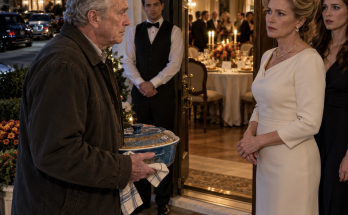
One year later, I was driving a blue van.
Not because Matthew had finally bullied a corporation into changing its fleet.
He had tried.
Repeatedly.
The blue van belonged to Serrano Group’s worker-support outreach team.
I was borrowing it for one afternoon.
Marcus hated this fact.
“Traitor.”
“It’s one delivery.”
“In a blue van.”
“Matthew will never let me hear the end of it.”
“He shouldn’t.”
I had taken the route-lead promotion.
Not immediately.
I waited a week.
Read the responsibilities.
Asked questions.
Talked to Matthew.
Then accepted.
The extra money helped.
So did the schedule.
But the part I liked most was training new drivers.
On their first morning, I showed them the inspection sheet.
Brakes.
Tires.
Lights.
Fluid.
Cargo restraints.
“If something is wrong, report it.”
One new driver once asked, “What if the delivery is late?”
“Then it’s late.”
He laughed because he thought I was joking.
I did not.
“Cargo can wait. People don’t get replacement bodies.”
Marcus heard me from the office.
Later he said, “Bit dramatic.”
“I know a guy.”
Oscar would have approved.
He was managing a kitchen now.
Still limped.
Still complained.
Still went to therapy.
He and Marisol had started taking Sunday walks because his specialist wanted consistent low-impact movement.
Oscar called this medical harassment.
Marisol called it marriage.
Lupita had been promoted to shift supervisor at the hotel.
Her first act was apparently creating a written overtime sign-off procedure.
I teased her.
She threatened to make me wash pans.
Mario had rebuilt his savings.
Naomi remained private.
Sofia visited once.
She brought Teresa’s photograph.
Not the old employee badge picture.
A family photograph.
Teresa laughing beside a lake.
I placed it inside the notebook.
That was how I preferred to remember her.
Not only frightened.
Not only guilty.
A whole person.
The restitution process had reached hundreds of workers across several old vendor programs.
Some claims were large.
Some tiny.
A few workers received amounts so small they laughed when contacted.
Then accepted anyway.
Because it was theirs.
Isabel’s trust funded part.
Serrano Group funded more.
Insurance and recovered assets contributed.
Ramiro’s hidden reserve account was emptied into restitution under court orders.
I liked that part.
Not revenge.
Arithmetic.
Money moved back toward the people whose names had been used to take it.
The independent audit changed Serrano Group too.
Not perfectly.
Companies did not become moral beings because they rewrote policies.
People still made mistakes.
Managers still complained about cost.
Vendors still tried to cut corners.
But workers received direct payment confirmations.
Compliance reported outside procurement.
Anonymous complaints could bypass management.
Vendor safety failures triggered independent review.
And every quarter, a random group of workers was contacted directly.
Not supervisors.
Workers.
Valerie called it Isabel’s rule.
If your name is in the record, you get to see the record.
Simple.
Powerful.
Annoyingly obvious.
Andrew Vale no longer worked in corporate consulting.
Martin Cole no longer controlled anybody’s vendor contract.
Pike had completed the cooperation required under his case.
Evelyn disappeared from public attention after her legal proceedings.
I never contacted her.
I did not hate her.
I did not need a relationship with her either.
Both could be true.
Ramiro remained incarcerated when the anniversary arrived.
He sent one letter.
I did not open it.
My lawyer did.
Nothing in it required a response.
So I gave none.
That was another lesson.
Closure did not require consuming every word somebody wanted to give you.
Sometimes the door was already closed.
Matthew was taller.
Not dramatically.
He insisted dramatically.
His health had been stable.
The new insurance covered his regular care.
We kept emergency savings.
Real emergency savings.
The first time the account reached an amount larger than one month’s rent, I stared at it for a long time.
Then closed the banking app.
I had finally learned that money could exist without demanding an immediate decision.
Mrs. Petra remained Mrs. Petra.
I offered to help her move somewhere nicer.
She became offended.
“My apartment is nice.”
“The ceiling leaked.”
“It stopped.”
“Because the landlord repaired it.”
“Then what is problem?”
I gave up.
Instead, I replaced her ancient microwave after it began sparking.
She accused me of extravagance.
Matthew pointed out that fire prevention was technically an emergency expense.
I had created a monster.
The bracelet remained with Valerie.
I knew because she wore it once.
Only once that I saw.
At the opening of the Isabel Serrano Worker Protection Office.
No gala.
No champagne towers.
Just workers, compliance staff, trustees, journalists and a wall displaying the new reporting process in three languages.
Valerie stood at the front.
The bracelet caught the light when she lifted a folder.
For a second, I was back in her driveway.
Paper bag in my hand.
Prescription in my pocket.
Gold bracelet where it had no business being.
Then the moment passed.
Valerie did not tell the audience the bracelet story.
I respected her for that.
She talked about her mother.
Not as a saint.
As a woman who noticed a weakness, investigated it, made mistakes and tried to build a better system before time ran out.
Then Valerie talked about institutional responsibility.
“Trust is necessary,” she said, “but trust without verification gives dishonest people somewhere to hide.”
I looked at Daniel.
He whispered, “That line took legal three days.”
I nearly laughed during the speech.
Afterward, Valerie found me near the exit.
“You’re leaving?”
“I have work.”
“This is work.”
“Not mine.”
She looked at my uniform.
“Route lead.”
“Very prestigious.”
“I heard.”
“From who?”
“Matthew.”
I stared.
“You talk to my son?”
“He emailed our general office asking when the fleet would become blue.”
I closed my eyes.
“Of course he did.”
“He included design concepts.”
“I’m changing his internet password.”
Valerie smiled.
Then touched the bracelet.
I noticed.
She noticed me noticing.
“I almost never wear it.”
“I wondered.”
“For a while, I couldn’t.”
“Because of what happened?”
“Because it felt like evidence.”
I understood.
“And now?”
She looked at the gold around her wrist.
“Now it feels like my mother’s again.”
That was probably the best ending the bracelet could have received.
Not symbol.
Not evidence.
Not bait.
A daughter’s bracelet from her mother.
Ordinary enough to wear.
The anniversary itself fell on a Friday.
I knew the date without checking.
How could I not?
I did not plan anything.
Neither did Valerie.
Then, around noon, Marcus told me one of our drivers had called out sick and a time-sensitive package needed delivery.
“To where?”
He handed me the route slip.
Serrano residence.
I stared.
“No.”
He grinned.
“You believe in fate?”
“No.”
“Good. It’s scheduling.”
That I believed.
The package was not food.
Legal documents for the family trust.
Nothing valuable-looking.
Nothing mysterious.
Just a sealed courier envelope.
Our usual van was in maintenance.
Serrano’s outreach team had dropped off the blue vehicle that morning after a joint training session.
So there I was.
One year later.
Driving a blue van to the house where everything changed.
I called Matthew from the parking lot.
“You are not going to believe this.”
“What?”
“Blue van.”
He screamed.
I moved the phone away.
“I told you.”
“You told me nothing.”
“Send picture.”
“After.”
“Before.”
“I’m working.”
“Bad service.”
I hung up on him.
The drive felt shorter than I remembered.
Maybe because I was not racing a prescription clock.
Maybe because my fuel gauge did not represent grocery money.
Maybe because the package beside me was only a package.
At Valerie’s gate, security recognized my name.
That was embarrassing.
I parked near the same side entrance.
For a moment, I stayed in the van.
Not because I was tempted by anything.
Because memory had geography.
That curb.
That gate.
That path.
I could still see myself sitting there with the bracelet in my palm.
Thirty-eight dollars short.
Trying to decide what kind of man desperation allowed me to become.
I wanted to tell that version of myself something.
Not that everything would be fine.
It would not.
The next weeks would be terrifying.
People would be arrested.
Secrets would surface.
I would learn how thoroughly strangers had studied my weaknesses.
I would discover that years of financial instability were not entirely my own failure.
I would also learn that some people I trusted had failed me.
Others had helped quietly.
Nothing would become simple.
So what would I tell him?
Maybe only this.
Go back to the door.
One honest step.
Then another.
That was enough.
I picked up the envelope.
The side door opened before I knocked.
Valerie stood there.
She looked at the van.
“No.”
I pointed at her.
“Do not encourage him.”
“Matthew?”
“Yes.”
“Too late.”
I handed her the package.
“Signature.”
She took the scanner.
“Very professional.”
“I’ve improved.”
She signed.
I checked the screen.
“Thank you.”
Neither of us moved.
Finally she said, “Do you remember what you told me that night?”
“Which part?”
“When I asked why you came back.”
I did.
I had said something clumsy about not wanting my son’s medicine bought with something that belonged to somebody else.
I nodded.
“I remember.”
“I thought about that for months.”
“Why?”
“Because I kept wondering what I would have done.”
I leaned against the doorframe.
“With the bracelet?”
“If I were you.”
“You weren’t.”
“I know.”
“That’s the problem with everybody asking.”
She raised an eyebrow.
“What?”
“People ask whether they would have returned it.”
“Yes.”
“But they imagine being themselves with my problem.”
Valerie became quiet.
“They don’t imagine being me.”
“No.”
Being poor was not a costume.
Neither was fear.
You could not subtract security from your life for five imaginary minutes and know what desperation felt like.
“I almost kept it,” I said.
“I know.”
“Daniel told you?”
“You told me eventually.”
“Right.”
She looked at the driveway.
“I’m glad you did.”
“So am I.”
“Does it bother you that people call you honest because of one decision?”
“Yes.”
“Why?”
“Because honesty isn’t something you finish.”
She smiled slightly.
“That sounds like something my mother would have said.”
“I charge consulting fees now.”
“Absolutely not.”
I laughed.
Then she became serious.
“Julian.”
“What?”
“Thank you.”
I knew what she meant.
Not only the bracelet.
Everything after.
I shook my head.
“You asked questions too.”
“Eventually.”
“Eventually counts.”
I thought of Teresa.
Mateo.
Oscar.
All the people who eventually did something.
Sometimes too late to prevent harm.
Not too late to matter.
Valerie glanced at the package.
“Trust documents.”
“Apparently.”
“Nothing planted inside?”
“Please don’t joke.”
“Sorry.”
She was not sorry.
I looked at my scanner.
“I have three more stops.”
“Then go.”
I started toward the van.
“Julian.”
I turned.
She held up her wrist.
The bracelet.
“I was going to put this away today.”
“Why?”
“Anniversary.”
I waited.
“But I think I’ll wear it.”
“Good.”
“Good?”
“It’s jewelry.”
She smiled.
“Yes.”
“That’s all it should have been.”
I got into the van.
Before leaving, I took a photograph of the dashboard for Matthew.
He replied before I reached the gate.
FINALLY.
Then:
KEEP IT.
I wrote:
NOT OUR VAN.
He answered:
EVERYONE BENDS.
I nearly drove into a hedge.
I called him immediately.
“Where did you hear that?”
“What?”
“That sentence.”
“You told me.”
“When?”
“Like months ago.”
“Do not use it.”
“Why?”
“Bad history.”
He thought.
“Okay.”
Then:
EVERYONE CAN CHANGE?
I smiled.
“Better.”
“Can we put it on the van?”
“No slogans on vans.”
“You hate ideas.”
“I love you.”
“Same.”
He hung up.
I drove away.
The city moved around me.
Traffic.
Buses.
People carrying groceries.
Motorcycles squeezing through gaps that did not exist.
Delivery riders balancing bags behind them.
I noticed every one.
Maybe I always would.
At a red light, a food courier stopped beside me.
Old scooter.
Worn helmet.
Insulated bag faded from sun.
For one second, I saw myself.
Then the light changed.
He accelerated.
So did I.
My life had not become perfect.
I still checked prices.
Still worried about bills more than Valerie probably ever would.
Still had mornings when old fear returned before I remembered the bank balance.
Oscar still hurt.
Teresa was still dead.
Mateo was still gone.
No investigation could return lost years.
No restitution payment could make exploitation harmless.
Justice had limits.
So did forgiveness.
So did money.
But truth had changed practical things.
Workers got paid.
Medical treatment happened.
Dangerous equipment could be reported without losing a job.
False records were corrected.
Money came back.
People responsible faced consequences.
A system built on nobody checking had been replaced by one built around asking.
Not perfect.
Better.
At my last delivery, the customer signed and said, “Long day?”
“Not bad.”
I meant it.
I returned the blue van to the fleet center just before sunset.
Matthew and Petra were waiting.
I had no idea why.
Then I saw the phone in Matthew’s hand.
“You came to photograph the van.”
“Yes.”
“Unbelievable.”
“Stand there.”
“No.”
“Dad.”
Petra pushed me toward the van.
“Do it.”
I stood beside it.
Matthew took six pictures.
“Why six?”
“You blink.”
“I blink because I’m human.”
He inspected the screen.
“Good.”
“Can we go home?”
“Pizza.”
“Why?”
“Anniversary.”
I looked at him.
He knew.
Not every detail.
Enough.
“Pizza,” I agreed.
We walked.
No delivery.
That had become our joke.
At home, after Matthew went to bed, I opened the small envelope in my desk.
Valerie’s old business card.
The prescription.
The original restitution notice.
I added one more thing.
A printed photograph of the blue van.
Then I closed the envelope.
Not a shrine.
Not evidence.
Just a record.
I understood Teresa better now.
Sometimes you kept records because memory could be manipulated.
Sometimes because shame lied.
Sometimes because powerful people depended on everyone forgetting the details.
And sometimes you kept them because you wanted proof that your life had changed.
The next morning, I woke before the alarm.
Made coffee.
Checked the savings account.
Then laughed at myself and closed it.
Matthew wandered into the kitchen.
“Work?”
“Yeah.”
“Blue van?”
“No.”
He groaned.
“White van.”
“Boring.”
“Reliable.”
“Still boring.”
I handed him breakfast.
My phone buzzed.
Route assignment.
Nothing unusual.
No mysterious message.
No investigator.
No lawyer.
No emergency.
Just work.
I put on my jacket.
At the door, Matthew called after me.
“Dad.”
“What?”
“You forgot this.”
He tossed me the van key.
I caught it.
A year earlier, I had walked toward a stranger’s house carrying food and wondering how I would buy medicine.
That night, somebody had expected desperation to make my choice for me.
They were almost right about the desperation.
They were wrong about the choice.
But the lesson I carried afterward was not that good people never bend.
We do.
We hesitate.
We get frightened.
We compromise.
We fail one another.
Sometimes we accept money we wish we had refused.
Sometimes we stay silent too long.
Sometimes we sit on a curb with something valuable in our hand and seriously consider becoming the person somebody already expects us to be.
Character was not the absence of that moment.
It was what happened next.
I slipped the key into my pocket.
“Thanks.”
Matthew returned to breakfast.
I opened the door.
Outside, morning traffic had already begun.
Drivers were loading vans.
Restaurants were receiving produce.
Parents were walking children to school.
Somewhere, somebody was probably checking a payroll statement and asking why the numbers did not match.
Now there was somewhere for that question to go.
That mattered.
I walked to work.
Not because everything had been repaired.
Because enough had changed that work was only work again.
And after everything that had happened, ordinary life did not feel small.
It felt like something worth protecting.
The End
Read more original stories on Feel Every Story.
The Bracelet in the Discarded Bag Was Worth More Than Everything I Owned, and My Son Needed Medicine Before Morning
Part 27 of 27