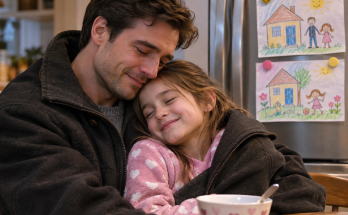
Recovery didn't happen all at once.
There wasn't a particular morning when everything suddenly became normal.
My daughter's physical injuries improved with treatment and follow-up care.
Her fear took longer.
Some days were easier than others.
Sometimes an unexpected sound made her nervous.
Sometimes she apologized for things that didn't require an apology.
I tried not to make those moments into complicated conversations.
I reassured her.
I listened when she wanted to speak.
I made sure she received appropriate professional support.
And I learned to be patient.
The legal process continued.
The neighbor's recording remained an important piece of evidence.
The medical findings supported the seriousness of what had happened.
My wife could dispute my reasons for ending our marriage.
She couldn't explain away everything that had been independently documented.
Eventually, our divorce was finalized.
My daughter remained in my care under the custody arrangements established through the legal process.
Any future contact with her mother would be governed by the applicable safety requirements.
I didn't celebrate those arrangements as a victory over my wife.
There was nothing victorious about a child needing protection from her own parent.
I was grateful that my daughter had a safer place to live.
That was enough.
I kept thinking about how different things might have been without the neighbor's decision to send that recording.
Someone had noticed.
Someone had acted.
My daughter benefited because another person hadn't dismissed what was happening as a private household disagreement.
I wished I had recognized the seriousness of the situation sooner.
I knew that regret would remain with me.
But regret couldn't be the only thing I offered my daughter.
She needed a father who was present.
A father who listened.
A father who didn't treat her fear as an inconvenience.
I worked on becoming that person.
One evening, several months later, we were eating together.
Nothing special was happening.
There was no important appointment the following morning.
No detective waiting to speak with us.
No hospital equipment.
Just dinner.
My daughter was telling me something when she accidentally knocked over her drink.
It spread across the table.
Some of it reached the floor.
I reached for a towel.
“Oops,” she said.
I looked at her.
She wasn't crying.
She wasn't apologizing repeatedly.
She wasn't watching my face for a sign of anger.
She reached for another towel.
“I'll help.”
We cleaned it together.
Then she continued telling me what she had been saying before the drink spilled.
I listened.
I answered her question.
We finished eating.
The whole thing took less than a minute.
Later that evening, I thought about it again.
I remembered the hospital room.
Her fingers clutching the front of my coat.
The way she had looked toward the doorway before speaking to the detective.
I remembered her asking whether she was in trouble for spilling food.
And I thought about the little girl who had just knocked over a drink and continued talking.
Something had changed.
Not everything.
But something important.
She was beginning to trust that an accident could remain an accident.
That was a freedom I had never properly understood until I saw what happened when a child was denied it.
My coat was still hanging near the door.
I wore it when the weather was cold.
Sometimes my daughter borrowed it when she wanted to feel warm.
I never minded.
One evening, she pulled it around her shoulders while sitting beside me.
“Daddy?”
“Yes?”
“Do we have to move again?”
“Not because of anything you've done.”
She considered that.
“Can we stay here?”
“Yes.”
She rested against me.
I thought about the question she had asked during those terrible first hours.
Whether I would let her mother take her.
Back then, I had been terrified.
I hadn't known what the police would discover.
I hadn't known what the doctors would find.
I hadn't known how the divorce would affect the investigation.
I had only known that my daughter was hurt and needed me.
Now I understood that protecting her involved more than taking her out of the cold.
It meant believing her.
It meant allowing other people to help.
It meant admitting that I had overlooked things I should have confronted.
And it meant refusing to let my own embarrassment become another reason for silence.
I couldn't change the father I had been before that night.
I could change the father I was afterward.
My daughter didn't need me to spend the rest of my life explaining how ashamed I felt.
She needed breakfast in the morning.
Help when something hurt.
Someone to listen when she was frightened.
Someone who would keep showing up.
Those were ordinary responsibilities.
I had learned never to underestimate their importance again.
The divorce papers had ended my marriage.
The recording had challenged my wife's account.
The doctors had treated my daughter's injuries.
But the work of making our home feel safe belonged to every day that followed.
That evening, my daughter fell asleep beside me beneath my old coat.
I carefully moved it so she would remain comfortable.
Then I sat there for a little while.
There was no crying outside.
No open door letting freezing air into the house.
No angry voice explaining why a frightened child deserved punishment.
There was only the quiet sound of my daughter's breathing.
For the first time in a long time, I understood what that quiet meant.
She wasn't silent because she was afraid.
She was sleeping because she felt safe.
Click here to continue reading: PART 9: I Thought the Hardest Days Were Behind Us Until My Daughter Asked Whether Loving Her Mother Meant She Had Done Something Wrong
I Sat Beside My Daughter’s Hospital Bed and Began to Understand How Little I Knew About Her Life at Home
Part 8 of 10