The following morning, my daughter woke before I did.
I found her standing beside the kitchen table, trying to decide which bowl she wanted for breakfast.
She pointed toward the cupboard.
“Can I have that one?”
I handed her the bowl she had chosen.
She carried it carefully to the table.
There had been a time when I would have thought nothing of watching my daughter prepare for breakfast.
Now I noticed everything.
The way she moved without holding her injured side.
The way she opened the cupboard without asking whether she was allowed.
The way she pulled out her chair without worrying about the noise it made.
She was becoming comfortable in her own home.
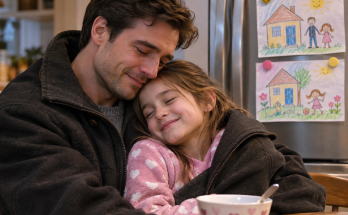
That morning, she asked me to sit beside her instead of across the table.
I moved my chair.
She ate several spoonfuls before speaking again.
“Daddy, do you think Mommy misses me?”
I put down my coffee.
I had known that questions about her mother would eventually become more difficult.
Knowing that hadn't prepared me for hearing them.
“She might,” I answered.
My daughter pushed a piece of cereal around her bowl.
“Sometimes I miss her.”
There was something apologetic about the way she said it.
As though she expected me to be disappointed.
I wasn't.
“You're allowed to miss her.”
She looked up.
“Even after what happened?”
“Yes.”
I took a moment before continuing.
“You can love somebody and still need to be protected from them.”
She considered that while looking into her bowl.
“Are you mad at me?”
“No.”
She went back to eating.
I picked up my coffee, although I no longer wanted it.
That conversation stayed with me throughout the day.
My daughter had been trying to understand whether her feelings were acceptable.
I didn't want her to believe that loving me required her to stop loving her mother.
She hadn't chosen what happened to our family.
She shouldn't have been responsible for choosing which parent deserved her affection.
The adults had already made enough decisions that had complicated her life.
I didn't intend to give her another burden.
At her next appointment with the professional helping her recover, I mentioned our breakfast conversation.
I explained what she had asked.
I also explained how I had answered.
We discussed the importance of allowing her to express complicated feelings without believing she was betraying either parent.
That made sense to me.
My feelings about my former wife belonged to me.
They weren't something my daughter needed to carry.
I had to remember that even when my anger returned.
And it did return.
Sometimes unexpectedly.
I would open a drawer and see a hospital document.
I would find an old message on my phone.
I would remember the sound of my daughter's teeth clicking together when I carried her inside.
For a few moments, everything would feel immediate again.
I couldn't always control when those memories appeared.
I could control what I did with them.
My daughter deserved to live in a home where another person's anger didn't determine how the rest of the evening unfolded.
That included mine.
One afternoon, I returned from work feeling exhausted.
There had been problems that day.
Nothing unusual.
Just the sort of things adults complained about when they came home.
My daughter was sitting at the table with some paper.
She had been drawing.
Several colored pencils were scattered around her.
I put down my work bag and discovered that one of the pencils had rolled beneath my chair.
I stepped on it.
It broke.
I sighed.
My daughter immediately stopped drawing.
“Sorry, Daddy.”
I looked at her.
Her shoulders had stiffened.
She was watching me.
I realized how quickly my ordinary frustration had become something frightening to her.
I bent down and picked up the broken pencil.
“I had a difficult day at work. That wasn't because of you.”
She looked uncertain.
“Are you sure?”
“I'm sure.”
I placed the pencil beside the others.
“We can sharpen that one later.”
She returned to her drawing.
I went into the kitchen and washed my hands.
For a while, I stood beside the sink thinking about what had just happened.
My daughter had become good at noticing changes in an adult's mood.
Too good.
She had learned to search another person's face for information about her own safety.
That habit wouldn't disappear simply because we lived somewhere else.
It would take many ordinary days before she stopped expecting the worst.
I had to give her those days.
Not just when I was rested.
Not just when everything was going well.
Especially when I was tired.
That evening, I apologized for making her think I was angry with her.
She seemed surprised.
“You didn't do anything.”
“I know. But I wanted you to understand that.”
She smiled slightly.
Then she asked whether we could sharpen the broken pencil.
We did.
It was shorter than the others afterward.
Still perfectly useful.
She put it back among the colored pencils and continued drawing.
A few days later, I received another communication concerning the arrangements involving her mother.
I read it carefully.
Then I discussed it with my attorney.
I didn't make promises to my daughter about decisions that weren't mine alone to make.
I didn't tell her that everything concerning her mother had been settled forever.
I simply maintained the protections that were already in place.
Her safety remained the priority.
That wasn't negotiable.
But I was learning that protecting her didn't require me to speak cruelly about her mother.
There was a difference between acknowledging what someone had done and making hatred part of a child's daily life.
I wanted my daughter to understand the first without growing up surrounded by the second.
One evening, she brought me a drawing.
There were two figures standing beside a small house.
One was taller.
The other had an enormous smile.
“That's us,” she explained.
I examined the picture.
The house had several windows.
There was a yellow shape above the roof.
The front door was painted blue, even though our actual door wasn't.
“I like the door.”
She grinned.
“I made it my favorite color.”
I asked whether she wanted to put the drawing somewhere.
She chose the refrigerator.
I found a magnet and attached it where she could see it.
She stood back to admire her work.
Then she asked a question I hadn't expected.
“Can Mommy have a picture, too?”
I looked at her.
“If you want to make one for her, you can.”
“Will she see it?”
“We'll ask the people helping us whether there's a safe way to arrange that.”
She accepted the answer.
I was careful not to turn a simple drawing into a promise about contact.
There were legal arrangements for a reason.
There were professionals involved for a reason.
I wasn't going to disregard those protections because a particular moment felt emotional.
Later, my daughter made another picture.
She folded it herself.
She asked me to keep it somewhere safe.
I placed it in a drawer.
I didn't examine it without her permission.
It belonged to her.
Her feelings belonged to her, too.
That was something I was beginning to appreciate.
Weeks earlier, I had believed my greatest responsibility was making sure her mother couldn't hurt her again.
That responsibility hadn't changed.
But there was another one I hadn't fully considered.
My daughter needed the freedom to become someone whose life wasn't entirely defined by what her mother had done.
She needed to draw pictures.
Choose her breakfast bowl.
Get annoyed when something didn't go her way.
Laugh at things I didn't find funny.
Have opinions that differed from mine.
She needed to be a child.
One Saturday morning, she asked whether we could make pancakes together.
I gathered the ingredients.
She insisted on helping.
I gave her a bowl and let her stir.
Some flour landed on the counter.
She glanced toward it.
Then she continued stirring.
I pretended not to notice how important that moment was to me.
We finished preparing breakfast.
The pancakes weren't particularly attractive.
One was almost round.
Another had a strange shape that made my daughter laugh.
She told me it looked like a shoe.
I put it on her plate.
She laughed harder.
For several minutes, the kitchen was filled with a sound I had missed more than I realized.
My daughter's laughter.
Not nervous laughter.
Not an attempt to please somebody.
Just laughter because breakfast had turned out funny.
When we finished eating, we cleaned the counter together.
She wiped the flour away.
I washed the bowl.
There was no tension between us.
Nobody needed to explain why the mess had happened.
Before leaving the kitchen, she picked up the drawing she had made for her mother.
“Can you keep this until it's okay?”
I took it gently.
“Yes.”
She went back to playing.
I returned the drawing to the drawer.
I didn't know exactly what her relationship with her mother would become.
I couldn't predict whether her mother would eventually accept responsibility.
Those questions belonged to a future I couldn't control.
What I could control was the way my daughter was treated that morning.
And the morning after that.
I looked at the drawing on the refrigerator.
Two figures.
A small house.
A blue door.
It wasn't a picture of a perfect family.
It was a picture of the place where my daughter believed she belonged.
For the first time, I understood that building a new life for her didn't mean asking her to erase the old one.
It meant making room for her feelings without allowing those feelings to place her in danger.
I could live with that responsibility.
More importantly, I was finally prepared to honor it.
Click here to continue reading: PART 10: When the Weather Turned Cold Again, I Finally Understood What My Daughter Had Been Asking Me Since That Night in the Hospital
I Sat Beside My Daughter’s Hospital Bed and Began to Understand How Little I Knew About Her Life at Home
Part 9 of 10