The weather turned cold again.
I noticed it one morning when I stepped outside and immediately went back for my coat.
The same coat.
It was older now.
One pocket had begun to come apart along the seam.
The cuffs showed signs of wear.
I had considered replacing it several times.
Somehow, I never did.
My daughter noticed me putting it on.
“That's your good coat.”
I looked down at it.
“It's getting pretty old.”
“I like it.”
I smiled.
“So do I.”
She returned to what she was doing.
I stood near the door for a moment longer than necessary.
Cold weather still brought back memories I would have preferred to leave behind.
The open back door.
The freezing air entering our old kitchen.
The frightened sound I had heard before I understood what was happening.
I no longer thought about those things every day.
But they hadn't disappeared.
Neither had the responsibility that came with remembering them.
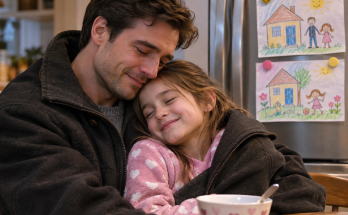
That morning, my daughter wanted to help me prepare breakfast.
She opened the refrigerator while I found the plates.
We moved around each other in the kitchen.
She complained that I was standing in her way.
I moved.
She complained that I had given her the smaller spoon.
I exchanged it.
Then she announced that she didn't want the larger one after all.
I laughed.
She laughed, too.
It was an ordinary morning.
I treasured it for exactly that reason.
A year earlier, I wouldn't have understood how much it mattered for a child to disagree with an adult without becoming frightened.
Now I understood.
My daughter was becoming more comfortable expressing what she wanted.
Sometimes that meant listening to complaints about spoons.
I didn't mind.
Later that week, I organized some documents that had accumulated since our separation.
I found copies of the original divorce papers.
The signatures were there.
The date was there.
I remembered signing those documents at work.
I remembered believing that the difficult part would be telling my wife.
I had been wrong.
The difficult part had been accepting what had happened to my daughter while I was still trying to decide how to leave.
Beneath those documents were papers connected to her hospital treatment.
I looked through them slowly.
There were details I remembered.
Others I had forgotten.
The medical language was precise and unemotional.
It didn't describe the feeling of standing beside a hospital bed while your daughter slept beneath unfamiliar blankets.
It didn't describe how helpless I had felt.
It didn't need to.
Those documents existed to record what had happened.
I placed them back inside their folder.
I kept everything organized.
The legal arrangements concerning my daughter's care remained in place.
I continued following them.
I had no intention of treating her improvement as evidence that those protections were no longer necessary.
Healing didn't erase the reason protection had been required.
That afternoon, my daughter returned to the table where I was working.
“What's all that?”
“Some grown-up paperwork.”
“Boring?”
“Very.”
She laughed.
Then she brought me a book and asked whether we could read together.
I closed the folder.
The paperwork could wait.
We sat together and read several pages.
She interrupted frequently.
She wanted to know why characters had made certain decisions.
She wanted to guess what would happen next.
Sometimes her guesses were better than mine.
I enjoyed listening to them.
When we finished reading, she went to get another book.
I put the folder away.
There was a time when I had believed being a good father meant working hard enough to provide everything my daughter needed.
I still believed providing for her mattered.
But my definition of providing had changed.
Money could pay for food.
It could pay for clothes.
It could help establish a comfortable place to live.
It couldn't replace being present.
It couldn't tell my daughter that her feelings mattered.
It couldn't notice when she was afraid.
Those responsibilities required something more personal from me.
They required attention.
A few weeks later, my daughter had another difficult day.
Nothing serious had happened.
She had simply become upset and struggled to explain why.
I sat beside her.
She didn't want to talk immediately.
So I waited.
After several minutes, she leaned against my arm.
“Sometimes I remember things.”
I nodded.
“Do you want to tell me?”
“Not now.”
“All right.”
I didn't ask again.
We stayed together until she decided she wanted something to eat.
I prepared a snack.
She carried it to the table.
The moment passed without any dramatic conversation.
But I thought about it afterward.
I was grateful she had felt comfortable telling me even that much.
I was grateful she had felt equally comfortable saying that she didn't want to tell me more.
She hadn't always possessed that kind of freedom.
I wanted her to keep it.
At a later appointment, I discussed the importance of continuing her support even when she appeared to be doing well.
I understood that recovery wasn't a straight road.
Good days didn't guarantee that difficult memories would never return.
Difficult days didn't mean she had lost the progress she had made.
I tried to remember that whenever I became impatient with myself.
I wanted her to feel better.
Sometimes I wanted it so badly that I had to remind myself not to make my wishes another expectation placed upon her.
She didn't owe me a perfect recovery.
She didn't owe me constant happiness.
She certainly didn't owe me reassurance that I had finally become a good father.
She was entitled to grow at her own pace.
My job was to support her while she did.
One evening, I was preparing dinner when she walked into the kitchen carrying the old drawing from the refrigerator.
The paper had curled slightly at the corners.
“Can I make another one?”
“Of course.”
She sat at the table with her colored pencils.
I continued cooking.
Every so often, she asked me to look at something.
When she finished, she brought the new drawing over.
There was another house.
Another blue door.
This time, there were flowers beside the entrance.
She had drawn herself outside, holding something that looked like a ball.
I asked what she was doing.
“Playing.”
I looked at the picture again.
There was nothing particularly unusual about it.
A child playing outside her home.
But I thought about the little girl I had once found outside in the freezing cold.
I thought about the father who had carried her through an open doorway, desperately trying to warm her.
Then I looked at the picture of a child who had drawn herself outside because she wanted to be there.
The difference mattered.
“Where should we put this one?”
“Next to the old one.”
I attached it to the refrigerator.
She stood beside me.
“Now there's two.”
“There are.”
She returned to the table.
I finished preparing dinner.
We ate together.
She told me about several things that had happened during her day.
I listened.
When she reached for her drink, she accidentally knocked her spoon onto the floor.
She picked it up.
“Can I get another?”
“Sure.”
She went to the drawer herself.
I kept eating.
There was no sudden silence.
No frightened apology.
No need to reassure her repeatedly.
She simply replaced the spoon.
I wondered whether she would ever understand how much those little moments meant to me.
Perhaps she wouldn't.
Perhaps that was better.
I didn't want her ordinary childhood experiences to become a collection of reminders about something terrible.
I wanted them to remain ordinary.
After dinner, we washed the dishes.
She dried a plastic cup.
I put the plates away.
She asked whether we could go outside the following afternoon if the weather was nice.
I told her we could.
“Even if it's cold?”
“We'll wear warm clothes.”
She seemed satisfied.
Before bedtime, she noticed my coat hanging near the entrance.
She took it down.
It was much too large for her.
She wrapped it around herself and walked toward me.
“Look.”
I smiled.
“You're going to disappear inside that thing.”
She lifted the collar.
“It's warm.”
I helped her arrange it around her shoulders.
Then we sat together.
She talked for a while about the plans she had made for the following day.
Eventually, her voice became quieter.
She rested her head against me.
“Daddy?”
“Yes?”
“Do you know what I like about our house?”
“What?”
She thought about it.
“Nobody gets really mad when I do something wrong.”
I felt my throat tighten.
She wasn't looking at me.
She was playing with the edge of the coat.
I remembered being in the hospital when she had struggled to explain what her mother did whenever she became angry.
I remembered how carefully the detective had chosen his questions.
I remembered the social worker asking me what I had witnessed before.
For a long time, I had believed the most important question was whether I could keep my daughter away from what had hurt her.
Now I understood there had always been another question underneath it.
Could she trust the people who were supposed to love her?
Could she make a mistake without becoming afraid?
Could she tell someone she was hurting and expect that person to listen?
Those were questions every child deserved to have answered through the way they were treated.
Not just through promises.
I looked at my daughter.
“Everybody makes mistakes,” I told her.
She nodded.
“Even grown-ups.”
“Yes. Even grown-ups.”
She smiled.
Then she asked whether I had ever made a really big mistake.
I considered my answer.
“I have.”
“What did you do?”
“I didn't always notice when somebody needed my help.”
She looked at me.
“Did you help them later?”
“Yes.”
“That's good.”
I held her a little closer.
I knew the situation was more complicated than those few words suggested.
I knew that helping someone later couldn't erase what had happened before.
But I didn't need to explain all of that to her.
She had enough years ahead of her to understand that adults were imperfect.
For now, she needed to know that I was there.
That she mattered.
That she was safe.
When she became sleepy, I helped her get ready for bed.
She asked me to leave her bedroom door slightly open.
I did.
She asked for a glass of water.
I brought it.
Then she asked whether I would be there when she woke up.
“Of course.”
She settled beneath her blankets.
“Good night, Daddy.”
“Good night, sweetheart.”
I remained near the doorway until she became comfortable.
Then I returned to the living room.
My old coat was lying across the chair.
I picked it up.
For months, I had associated that coat with the most frightening evening of my life.
I had remembered wrapping it around my daughter because I didn't know what else to do.
I had remembered her holding it while strangers examined her injuries.
I had remembered her refusing to let go.
But the coat belonged to other memories now.
Quiet evenings.
Conversations.
Laughter.
A little girl pretending it was a blanket.
I hung it beside the front door.
Then I checked that the house was secure and turned off the kitchen light.
Before going to bed, I looked at the two drawings on the refrigerator.
The first showed us standing beside a house.
The second showed my daughter playing outside.
I was proud of both.
Not because they proved that everything had been repaired.
They didn't.
There were things my daughter would always remember.
There were things I would always regret.
There were questions concerning her mother that couldn't be answered simply.
But there was also a life beyond those questions.
My daughter was living it.
And I was fortunate enough to be there with her.
The following afternoon, we went outside together.
The air was cold.
I wore my old coat.
My daughter wore hers.
She ran a little ahead of me before turning around.
“Come on, Daddy!”
I followed.
She laughed when I pretended I couldn't keep up.
Then she stopped to show me something she had noticed.
I bent down beside her.
I listened while she explained why it was interesting.
We stayed outside until she decided she wanted to go home.
When we returned, I opened the front door.
Warm air met us.
She stepped inside, removed her coat, and hurried toward the kitchen.
“Can we have something to eat?”
“Absolutely.”
I hung our coats beside each other.
Then I followed her.
There were no frightening voices waiting for us.
No explanations about why a child deserved to suffer.
No need for her to measure every movement against an adult's temper.
There was only a kitchen where we could prepare something to eat.
My daughter chose a plate.
I found the food.
She spilled a few crumbs.
Neither of us gave it much thought.
And that was the ending I had once been too frightened to imagine.
Not revenge.
Not victory.
Not a perfect family.
Just a little girl who could finally come home without being afraid.
The End
Read more original stories on Feel Every Story.
I Sat Beside My Daughter’s Hospital Bed and Began to Understand How Little I Knew About Her Life at Home
Part 10 of 10