The tape resisted when I tried pulling it away.
I tugged harder.
A thin layer of cardboard came off with it.
Hank remained seated across from me.
He didn't offer to help.
I appreciated that.
Whatever Dad had left inside the box, I wanted to be the person who opened it.
There were several overlapping strips of tape.
I removed the first.
Then the second.
My hands had begun shaking.
I found that embarrassing.
It was only a cardboard box.
I had opened hundreds of boxes while working at the store.
But none of those boxes had been left behind by someone I could never speak to again.
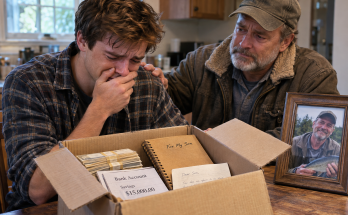
When the final strip came loose, I folded the flaps outward.
There was a collection of envelopes inside.
Some looked older than others.
A few had creases near the edges.
Beneath them were folded papers and a small notebook.
I stared.
I had expected something more immediately recognizable.
Perhaps a personal possession.
Perhaps photographs.
Instead, I was looking at ordinary stationery.
I reached for the envelope closest to me.
There was handwriting on the front.
Dad's handwriting.
I recognized it instantly.
It was the same plain, slightly uneven writing I remembered from school forms and the note he had given me on my eighteenth birthday.
Written in the corner was a date.
The first day of a month.
Underneath it was a number.
250\.
I felt my stomach tighten.
For a moment, I thought my bitter remark had been correct.
He had left behind a collection of rent records.
I looked at Hank.
"Is this what I think it is?"
He motioned toward the envelope.
"Keep looking."
I opened it.
There was a deposit receipt inside.
I studied the printed information.
Two hundred and fifty dollars had been deposited into a bank account.
The transaction date was shortly after the date written on the envelope.
I looked for the account holder's name.
Then I examined the next envelope.
Another date.
Another deposit receipt.
Another two hundred and fifty dollars.
I began taking envelopes out of the box.
One after another.
The dates continued in order.
The amounts remained identical.
My breathing changed.
I didn't yet understand what I was seeing, but I knew there was a pattern.
A pattern that matched the payments I had made.
I reached for the notebook.
The cover was plain.
There was nothing written on the outside.
When I opened it, I saw columns of dates and amounts.
Dad had recorded the payments carefully.
Beside each entry was a second notation.
It referred to the corresponding bank deposit.
I turned the page.
More dates.
More payments.
More deposits.
I couldn't remember Dad ever mentioning a savings account connected to my rent.
He had collected the money and put it away.
I had assumed it disappeared into his ordinary expenses.
The beer.
The fishing equipment.
The things he brought home while I struggled to save.
I looked toward Hank.
"What account is this?"
He folded his hands on the table.
"Your father opened it for the money you gave him."
I stared at him.
"What do you mean?"
"He put the payments into savings."
I looked back down.
I could hear my own breathing.
"All of them?"
Hank nodded.
"Every one."
I didn't believe him.
Not because I thought Hank was lying.
Because the explanation seemed incompatible with the father I had known.
I reached into the box and began searching through the papers more quickly.
There were bank statements.
I unfolded one.
I looked at the transactions.
The deposits appeared regularly.
Two hundred and fifty dollars.
Month after month.
I saw no ordinary purchases.
No withdrawals for beer.
No payments for fishing equipment.
The money had remained there.
I found a more recent statement and stared at the balance.
Fifteen thousand dollars in contributions.
Additional interest.
I read the figure again.
Then I looked at the name connected with the account.
I had difficulty concentrating on the words.
My fingers were trembling so badly that the paper moved.
"Why?"
It was the only thing I could say.
Hank didn't immediately answer.
I looked at him.
"Why would he do that?"
Hank drew a breath.
"He wanted you to have something when you were ready to start your own life."
I stared at the statement.
"But that's what I was trying to do."
"I know."
"I was trying to save enough to leave."
Hank nodded.
I felt anger rising alongside my confusion.
"He knew how hard it was."
I pointed toward the envelopes.
"He knew what I was paying him."
Hank didn't argue.
I looked at the box.
All those months.
All those payments.
All the evenings I had sat upstairs trying to work out how long it would take to escape the house.
The money hadn't been spent.
It had been saved.
I should have felt happy.
Part of me did.
But the revelation didn't erase the years that had led to it.
It made them more complicated.
I remembered repairing my work shoes.
I remembered the reduced shifts.
I remembered the car repairs.
I remembered believing that my father cared more about collecting rent than about whether I could manage.
I suddenly wanted to ask him a hundred questions.
Why hadn't he told me?
Why had he watched me struggle?
Why had he allowed me to believe something so painful?
Why had he waited until he was dead?
Hank reached toward the remaining papers.
"There's something else."
He lifted a large envelope from beneath the notebook.
My name was written across the front.
Nothing else.
I took it from him.
The envelope wasn't sealed with the same determination as the box.
I opened it easily.
Inside was a handwritten letter.
I looked at the opening line.
For several seconds, I couldn't continue.
My father had addressed me directly.
Not as a tenant.
Not as someone who owed him money.
As his child.
I sat down in the chair nearest me.
It was Dad's chair.
I hadn't intended to sit there.
When I realized where I was, I nearly stood again.
Then I looked at the letter.
I began reading.
Dad had written that the money belonged to me.
He explained that Hank knew where the account was held and had agreed to help me understand the arrangements.
He had included the records so I would know that none of my payments had been used for his personal expenses.
I stopped at that sentence.
None.
I remembered the beer.
I remembered watching him examine the new fishing equipment.
I remembered silently accusing him of spending the money I had earned.
I pressed my fingers against my forehead.
There were things I had misunderstood.
But there were also things he had allowed me to misunderstand.
I continued reading.
Dad wrote that after Mom died, he had worried constantly about my future.
He had feared that something might happen to him before I was capable of supporting myself.
He wanted me to learn how to manage regular expenses.
He wanted me to develop the habit of putting money aside.
And he wanted me to have savings that unexpected expenses couldn't immediately consume.
His solution had been the rent.
He had apparently believed that by requiring the payment, he could protect part of my earnings until the time came for me to use them.
I lowered the letter.
My eyes were beginning to burn.
The idea wasn't entirely unreasonable.
I could understand what he had been trying to accomplish.
But I couldn't understand why he had chosen to accomplish it without speaking honestly to me.
I looked at Hank.
"Did you know about this the whole time?"
Hank shook his head.
"Not from the beginning."
"When did he tell you?"
"Later on. When he started putting these papers together."
I looked down again.
The letter continued.
Dad admitted that he wasn't good at discussing feelings.
He wrote that after losing Mom, he had often concentrated on practical matters because those were the things he knew how to handle.
Bills could be paid.
Groceries could be bought.
Work could be completed.
Grief was different.
He had never figured out what to do with it.
I swallowed.
For the first time, I considered that the silence in our house might have been more than rejection.
Perhaps some of it had been fear.
Perhaps he had been protecting himself from conversations that reminded him of what we had lost.
But he had protected himself at my expense.
I had been nine years old when Mom died.
I needed someone to talk to.
I needed somebody to tell me that missing her was normal.
Dad had needed those things too.
Neither of us had received them from the other.
I turned the page.
Near the bottom, Dad had written a sentence that made me stop breathing normally.
He admitted that he had confused providing for me with being close to me.
I read that sentence several times.
I had wanted him to understand that distinction for years.
And apparently, somewhere inside himself, he had eventually understood it.
He just hadn't told me.
There were more words underneath.
He wrote that he was proud of the way I worked.
He had noticed that I continued meeting my obligations even when my hours were reduced.
He had noticed that I tried repairing things instead of immediately replacing them.
He had noticed more than I had believed.
That should have comforted me.
Instead, it broke something open.
I thought about all the evenings when I had come home tired and wanted somebody to recognize what I was doing.
All the times I had hoped for a simple expression of pride.
He had possessed those words.
He had written them down.
And he had never spoken them while I could hear his voice.
My vision blurred.
I put the letter on the table.
I didn't want my tears damaging the paper.
Hank stood.
I tried saying something, but nothing came out properly.
My chest tightened.
I began crying harder than I had cried at the funeral.
I felt Hank's hand on my shoulder.
Then his arms around me.
I leaned forward.
There was no dignity in the way I cried.
I wasn't thinking about the money anymore.
I wasn't thinking about an apartment.
I was thinking about a father who had known how to save fifteen thousand dollars for me but hadn't known how to tell me he loved me.
And I was thinking about the child who had spent years believing otherwise.
When I could finally breathe more comfortably, I reached for the letter again.
There was still another page folded underneath it.
I looked at Hank.
He sat beside me.
I wanted to understand everything Dad had intended.
But I also knew that understanding his intentions wouldn't make every decision he had made right.
The money could help me build a future.
It couldn't give me back my childhood.
It couldn't restore the conversations we had never had.
And it couldn't bring my father through the front door to put on those old work boots again.
I unfolded the remaining page.
This time, I wasn't looking for another financial surprise.
I was looking for my father.
Click here to continue reading: PART 5: The Last Page of My Father’s Letter Explained His Greatest Fear, but It Also Revealed the Mistake He Could Never Undo
My Father Never Asked Whether I Was Happy, but on My Eighteenth Birthday, He Finally Told Me What He Expected
Part 4 of 10