My father died before I ever managed to move out.
I was twenty-three.
Five years had passed since he sat me down at the kitchen table and told me what my bedroom would cost.
Sixty months.
Fifteen thousand dollars.
I had worked out the total before.
Sometimes I calculated it when I was particularly angry.
Other times, I deliberately avoided doing the mathematics because it made me feel worse.
Fifteen thousand dollars could have changed my circumstances.
At least, that was what I believed.
It represented deposits, furniture, emergency expenses, and months when my wages weren't enough.
Instead, I had handed it over a little at a time.
I had never imagined that the payments would end because Dad's life had ended.
His death was unexpected.
There was no long period during which I prepared myself for it.
No gradual adjustment to the possibility that he might not be around much longer.
One day, my father was part of the world I knew.
Then he wasn't.
I struggled to understand how someone could disappear so completely while everything associated with them remained.
His chair was still in the kitchen.
His clothes were still in the house.
His fishing equipment hadn't gone anywhere.
Nothing looked different enough to explain what had happened.
I kept expecting ordinary sounds.
A cupboard opening.
The television coming on.
His footsteps downstairs.
They never came.
During those first days, I discovered how many things I knew about Dad without knowing much about him.
I knew where he usually left his work boots.
I knew which chair he preferred.
I knew how he sounded when he was tired.
I knew how he counted money.
But I couldn't have confidently explained what frightened him.
I didn't know what he dreamed about.
I didn't know whether he was lonely.
And I had no idea what he thought of me.
Those questions became more painful after his death.
When someone is alive, you can pretend there will always be another opportunity to ask.
You can postpone an uncomfortable conversation indefinitely.
There will be another weekend.
Another evening.
Another ordinary day when perhaps the right words will finally come.
Death removes that excuse.
It leaves the questions exactly where they were.
Only now, there is nobody to answer them.
I had spent years imagining the relief of living without Dad.
I was ashamed to admit that, even privately.
But it was true.
There had been mornings when I walked downstairs and wished I could enter a kitchen where nobody made me uncomfortable.
There had been evenings when I wanted to come home without calculating whether the rent was ready.
I wanted freedom from his silence.
Freedom from feeling like an obligation.
Freedom from having to earn the right to stay.
Now the house was quiet.
There was no payment waiting to be made to him.
There was nobody counting the days until the first of the month.
And I wasn't relieved.
Not in the way I had imagined.
I felt something heavier.
It wasn't simply sadness.
It was grief tangled with anger and regret.
Part of me still resented him.
Another part desperately wanted him back.
I didn't know those feelings could exist together until I experienced them.
During the funeral, I listened to people talk about Dad.
They described a man who worked hard.
A dependable man.
Someone who could be counted on.
I recognized parts of that description.
Dad had certainly been hardworking.
But I kept wondering whether anyone knew what he was like inside our house.
Whether anyone understood how little we had spoken.
Whether anyone knew that his child had spent five years dreaming about leaving.
I didn't say any of those things.
A funeral wasn't the place to settle old grievances.
And I wasn't certain what I would have accomplished by sharing them.
The people around me were mourning someone they had known differently.
Their grief was genuine.
So was mine.
Hank was there.
I remembered how often I had heard the two of them talking.
Now Hank looked like a man who had lost someone important.
I realized that whatever distance had existed between Dad and me hadn't existed in exactly the same way between Dad and his friend.
Hank had known a version of my father that I had never fully encountered.
That thought made me jealous.
Then I felt ashamed.
Hank was grieving.
He hadn't taken anything from me.
Whatever Dad had chosen to share with his friend instead of his child was not Hank's fault.
After the funeral, I returned home.
I stood just inside the entrance.
Dad's work boots were there.
They looked ordinary.
Worn.
Familiar.
I had passed them countless times without giving them any special attention.
Now I couldn't look away.
I knew he would never put them on again.
Something about that simple fact made his death feel more real than everything that had happened earlier.
I considered moving them.
The house would eventually need to be organized.
His belongings couldn't remain untouched forever.
I bent slightly.
Then I straightened.
I couldn't do it.
Moving those boots felt like accepting something I wasn't ready to accept.
So I left them where they were.
I went into the kitchen.
Dad's chair was empty.
I sat in my usual place, opposite it.
For years, that table had been associated with money.
It was where he had given me the note.
Where I had made my first payment.
Where he had counted every bill.
But it had existed before those payments.
Mom had been there.
I remembered meals from childhood.
I remembered being small enough that the table seemed enormous.
And I remembered how everything had changed after she died.
I stared at the empty chair and wondered whether Dad had ever sat there thinking about her.
Perhaps he had.
Perhaps those long evenings I interpreted as indifference had contained thoughts he couldn't express.
I didn't know.
I hated not knowing.
When I was younger, I had believed adulthood would bring explanations.
I thought I would eventually become old enough to understand why people behaved as they did.
Instead, I was discovering that some explanations disappeared with the people who possessed them.
I had questions about the rent.
I had questions about my childhood.
I had questions about the shoes.
Mostly, I wanted to know whether Dad had ever been proud of me.
It was such a small question.
Yet after his death, it seemed enormous.
I would have been willing to endure one more uncomfortable conversation to ask it.
I would have accepted an awkward answer.
Even a disappointing one.
At least it would have been an answer.
That evening, I remained in the house.
The quiet felt different from the silence we had shared while Dad was alive.
Before, I knew someone else was nearby.
Now there was only me.
I looked around the kitchen without knowing what to do next.
Then somebody knocked on the front door.
The sound startled me.
I hadn't been expecting anyone.
When I opened the door, Hank was standing outside.
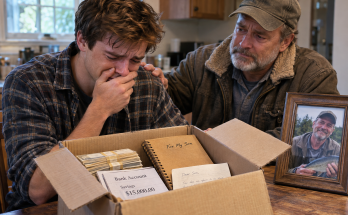
He was carrying a cardboard box.
It wasn't particularly large.
There was packing tape across the top.
Several strips, placed carefully enough that opening it would require some effort.
Hank looked tired.
I stepped back to let him enter.
He carried the box into the house without immediately explaining why he had brought it.
We walked toward the kitchen.
He set it on the table.
I looked at the box.
Then I looked at him.
"What's that?"
Hank rested one hand on the cardboard.
"Something your father wanted you to have."
I didn't understand.
Dad had never mentioned leaving anything with Hank.
"What kind of thing?"
Hank glanced down.
"He asked me to hold on to it."
There was something careful about the way he spoke.
I got the impression he had been thinking about this conversation for some time.
"Why didn't he give it to me himself?"
Hank pulled out a chair.
He didn't sit immediately.
"He wanted you to receive it after he was gone."
I looked at the box again.
After he was gone.
The words felt strange.
It suggested Dad had considered a future in which he wouldn't be there.
A future that included me.
I wasn't accustomed to thinking about him making plans for my benefit.
I touched the edge of the cardboard.
"When did he tell you that?"
"He was very particular about what he wanted me to do."
Hank seemed unwilling to explain everything before I opened it.
That made me uncomfortable.
I had already spent enough years trying to understand my father's decisions.
Now he had left another one behind.
For some reason, I thought immediately about the rent.
Perhaps it was because we were standing beside the same kitchen table.
Perhaps the box simply looked like somewhere a person might keep receipts.
Whatever the reason, bitterness arrived before curiosity.
I let out a short laugh.
It wasn't a pleasant sound.
"Don't tell me he left you a record of everything I paid him."
Hank didn't laugh.
I continued anyway.
"Maybe he wanted to make sure I didn't forget."
Hank looked at me for several seconds.
Then he spoke quietly.
"You ought to see what's in there first."
Something in his expression made me stop.
He wasn't defending Dad.
He wasn't accusing me of being unfair.
He simply wanted me to open the box.
I looked at the tape.
My father had apparently arranged for this object to reach me only when he could no longer explain it himself.
I didn't understand why.
And I was angry that even now, after his death, I was being asked to accept another decision without an explanation.
But curiosity was stronger.
I pulled the box toward me.
The cardboard scraped against the table.
Hank sat down.
I slipped a fingernail underneath the corner of the packing tape.
For the first time since my father's death, I felt that one of my questions might have an answer.
Click here to continue reading: PART 4: Hank Watched Me Open the Box My Father Had Left Behind, and the First Envelope Made Me Forget Every Argument
My Father Never Asked Whether I Was Happy, but on My Eighteenth Birthday, He Finally Told Me What He Expected
Part 3 of 10