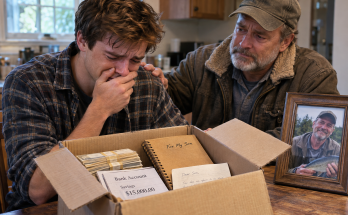
The remaining page had been folded differently from the others.
There was a crease down the middle, and the corners had become soft from being handled.
I wondered how many times Dad had opened it before deciding that he was finished.
His handwriting was smaller here.
Several words had been crossed out.
I could see where he had started one sentence, stopped, and tried again underneath.
That was strangely comforting.
For once, I was looking at something my father hadn't been entirely certain about.
I began reading.
He wrote about the months following Mom's death.
He admitted that he had been frightened by the responsibility of raising me alone.
There had been mornings when he didn't know how he would get through the day.
But he had gone to work anyway.
He had believed that keeping our household functioning was the most important thing he could do.
I understood that part.
What I hadn't understood was how much of himself he had apparently shut away while doing it.
He wrote that he had avoided talking about Mom because mentioning her made him feel helpless.
When I asked questions about her, he often changed the subject.
He remembered doing that.
He admitted that it had been wrong.
I stopped reading.
There was something painful about discovering that he remembered moments I had assumed meant nothing to him.
I looked at Hank.
"Did he ever talk to you about Mom?"
Hank nodded slowly.
"Sometimes."
"What did he say?"
"Mostly that he missed her."
I looked toward the empty chair across the table.
That was all I had ever wanted him to tell me.
Just that he missed her too.
I could have understood those words when I was nine.
I could have understood them when I was eighteen.
I could have understood them last month.
Instead, we had spent years living with the same sadness while behaving as though it belonged to only one of us.
I returned to the letter.
Dad wrote that charging me rent had originally seemed like a sensible decision.
He had watched other young people struggle when they first began supporting themselves.
He worried that I would experience the same difficulties.
He wanted me to become accustomed to regular financial responsibilities.
The savings account had been his way of making sure those responsibilities produced something permanent.
But there was another reason he hadn't told me about the arrangement.
He believed that if I knew the money was being saved for me, I might eventually stop treating the payments seriously.
He wanted the obligation to feel real.
I put the letter down.
"It was real."
Hank looked at me.
"I know."
"No, Hank. It was real every single month."
My voice had become louder.
I wasn't shouting at him, but I couldn't seem to control the strength of my words.
"I didn't have another account full of money somewhere. I didn't know there was anything waiting for me."
Hank remained quiet.
"When my car needed repairs, I thought I was starting over. When my hours got cut, I thought I might never get out of here."
He lowered his eyes.
I rubbed my face.
"I wish he'd trusted me enough to tell me."
Hank nodded.
"So do I."
That surprised me.
I had expected him to defend Dad.
Instead, he seemed as troubled by the arrangement as I was.
I picked up the page again.
Near the bottom, Dad had written something about my childhood shoes.
I had to read the passage twice before I understood it.
He remembered the afternoon I showed him the damaged soles.
He remembered telling me to wear extra socks.
He admitted that he should have taken me to buy another pair.
He had even remembered how quietly I walked away afterward.
I stared at those words.
For fourteen years, I had carried that little memory around with me.
It had become proof of something I believed about myself.
That my needs were inconvenient.
That asking for help was embarrassing.
That disappointment was easier to endure when nobody else knew about it.
And here was my father admitting that he remembered the moment too.
I wondered why he had never apologized.
There had been thousands of opportunities.
A thousand breakfasts.
A thousand evenings.
A thousand ordinary moments when he could have said that he was sorry.
I would have listened.
I would have remembered.
I probably would have forgiven him before he finished speaking.
The final paragraphs were harder to read.
Dad admitted that he had allowed too much time to pass between us.
He had become accustomed to our silence.
Whenever he considered starting a difficult conversation, he postponed it.
There was always another day.
Another opportunity.
Another excuse.
I recognized that habit.
I had inherited it.
How many times had I wanted to tell him how much his behavior hurt me?
How many times had I decided there was no point?
We had both been waiting for the other person to do something different.
Neither of us had.
His letter ended with an apology.
Not a particularly graceful one.
There were no grand declarations.
He simply acknowledged that he should have been a warmer father and that he regretted not showing me what I meant to him.
He hoped the savings would help me establish a life of my own.
Then, underneath everything else, he had written that he loved me.
I pressed my lips together.
There it was.
Three ordinary words.
Words that other children heard while being dropped off at school or before going to sleep.
Words I had waited years to hear.
I touched the paper with the tips of my fingers.
I wanted to believe those words completely.
Part of me already did.
Another part was still the child standing in the kitchen holding a damaged shoe.
That child had questions.
I couldn't silence those questions just because Dad was dead.
Hank moved his chair closer.
"He wasn't good at any of this."
I gave a small, exhausted laugh.
"That's putting it mildly."
Hank almost smiled.
Then his expression changed.
"He used to tell me you were a hard worker."
I looked at him.
"He talked about my job?"
"Quite often."
"What did he say?"
"That you never seemed to give up."
I looked at the notebook beside the box.
"I thought he didn't even notice."
"He noticed."
I swallowed.
Hank told me about conversations they had shared over the years.
Nothing especially dramatic.
Dad mentioning that I had taken another shift.
Dad talking about the repairs to my car.
Dad saying that I was careful with money.
These weren't things Hank had considered particularly important at the time.
They mattered enormously to me.
I discovered that my father had spoken about me with more warmth when I wasn't there than he had ever managed while standing beside me.
It hurt.
I wished I could have overheard some of those conversations.
Even once.
I gathered the envelopes into a small pile.
Hank reached for the notebook and opened it near the beginning.
He showed me how Dad had arranged the entries.
There was a date for every payment I had made.
The first entry belonged to the month of my eighteenth birthday.
I recognized the period immediately.
I remembered carrying those bills downstairs and watching Dad count them.
He had seemed so indifferent.
Now I was looking at what he had done afterward.
There were no missing months.
The numbers continued across the pages in his familiar handwriting.
I ran my finger along one of the columns.
It was almost unsettling how much of my adult life could be represented by those entries.
The month my car broke down was there.
So was the period when my hours at work were reduced.
Every difficult first day of the month had left a mark.
I had never expected those marks to lead back to me.
"Did he ever think about giving it to me earlier?"
Hank leaned back.
"He talked about it."
I waited.
"He thought there would be a right time."
I looked at him.
"And when was that supposed to be?"
Hank shook his head.
"I don't think he ever settled on one."
I closed the notebook.
That answer sounded exactly like Dad.
He had made the decision to collect the money without hesitation.
But making the decision to explain himself had apparently been much more difficult.
I wondered whether he had feared my reaction.
Perhaps he knew I would be angry about the secrecy.
Perhaps he had become embarrassed by how long he had allowed it to continue.
There was no way to know for certain.
I didn't want to start replacing every unanswered question with a comforting explanation.
I had done enough guessing about my father already.
Hank pointed toward the remaining documents.
"We'll need to speak to the bank about the account."
I nodded.
Dad had included the relevant information with his papers.
There were practical matters that would need attention before I could access everything.
I understood that.
For the moment, though, I didn't care how quickly the money became available.
I was still trying to understand the person who had put it there.
Hank asked whether I wanted him to stay for a while.
I said yes.
I surprised myself by saying it.
For years, I had avoided admitting when I needed company.
That evening, I couldn't bear the thought of sitting alone with the letter.
Hank made coffee.
He knew where Dad kept the cups.
Watching him move around the kitchen made me realize how familiar this house was to him.
He returned with two cups and sat across from me.
We talked about Mom.
At first, I mostly listened.
He remembered her laughing at Dad when he took fishing too seriously.
He remembered the way she could interrupt an argument by making an ordinary observation that reminded everyone how ridiculous they were being.
I remembered that too.
There were little things about her that I had nearly forgotten.
The sound of her singing.
The way she sometimes laughed before finishing a sentence.
Hank brought some of those memories back.
For a little while, the kitchen felt less empty.
Then our conversation returned to Dad.
I asked whether he had changed after Mom died.
Hank rubbed his hands together.
"He became quieter."
I nodded.
"Much quieter," he added.
I looked at the letter again.
"Did you ever tell him he should talk to me?"
"Yes."
"What did he say?"
"Usually that things were fine."
I almost laughed.
Things were fine.
That sounded like something Dad would say even if the roof were leaking and half the house was underwater.
Hank told me he wished he had pushed harder.
I shook my head.
"You weren't responsible for us."
He didn't answer immediately.
Then he reached across the table and rested his hand beside mine.
"I cared about both of you."
For some reason, that was difficult to hear.
I wasn't accustomed to people telling me such things directly.
I nodded instead of speaking.
Later, Hank helped me arrange the papers so that nothing would be misplaced.
The receipts went back into their envelopes.
The statements were stacked together.
The notebook rested underneath them.
But I kept Dad's letter outside the box.
I wasn't ready to put it away.
When Hank finally prepared to leave, I walked him to the door.
Dad's work boots were still sitting near the entrance.
Hank stopped when he saw them.
He stared for a moment.
Then he looked at me.
"Leave them there as long as you need."
I nodded.
After he left, I returned to the kitchen.
I unfolded the letter once more.
I read the apology.
I read the final words.
Then I sat quietly until the coffee beside me became cold.
For the first time, I knew that my father had loved me.
But knowing that didn't mean I suddenly knew how to forgive him.
I would have to find my own way toward that.
Click here to continue reading: PART 6: When I Finally Saw the Money My Father Had Protected for Me, I Had to Decide What His Sacrifice Really Meant
My Father Never Asked Whether I Was Happy, but on My Eighteenth Birthday, He Finally Told Me What He Expected
Part 5 of 10