
The first Christmas Sophie spent living with Emily, I arrived carrying more presents than I should have purchased.
Emily opened the door and stared at the bags.
“Lucas, she's one child.”
“I know.”
“Not an entire classroom.”
“I might have overdone it.”
She laughed and helped me carry everything inside.
Sophie was sitting on the living room floor, wearing purple pajamas and attempting to put a tiny paper hat on Mr. Pickles.
The rabbit still had only one ear.
She looked up when she heard my voice.
“Lucas!”
She ran toward me.
I put down the bags just before she reached my legs.
She hugged me tightly.
Then she immediately asked whether I had brought pancakes.
I had.
They had become something of a tradition.
Not just on Saturdays.
Birthdays.
Holidays.
Occasional Sunday mornings when my schedule allowed.
Emily had eventually learned to make them without burning the edges.
Sophie considered that an improvement, although she still maintained that Alicia's burned pancakes had been the best.
I never argued.
Some opinions weren't supposed to change.
That Christmas morning, Emily placed a photograph of Alicia beside the television.
A small candle stood nearby.
Nobody made a formal announcement about it.
Nobody needed to.
Alicia belonged in the room.
When Sophie opened her presents, she occasionally looked toward the photograph.
She received books, clothes, art supplies, and several small pieces of furniture for her dollhouse.
One of my gifts was a miniature purple sofa.
Sophie held it up proudly.
“Alicia would've wanted this.”
Emily smiled.
“She probably would have.”
Sophie carried the sofa into her bedroom and placed it beside the miniature kitchen.
Then she returned to open another present.
I watched her.
Months earlier, I had met a frightened little girl who worried that people might become sick because they had done something wrong.
Now she was laughing because she couldn't untie a ribbon.
She wasn't finished grieving.
Neither were we.
But grief no longer occupied every available space in her life.
There was room for excitement.
Disappointment.
Homework.
Messy bedrooms.
Ordinary happiness.
I had come to appreciate how valuable ordinary happiness could be.
After breakfast, Emily handed me a small package.
“I found something while sorting through the last of Alicia's clothes.”
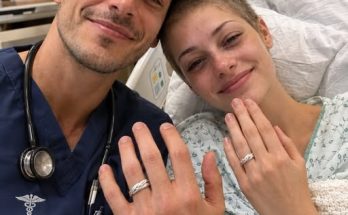
Inside was the white scarf Alicia had worn during our wedding.
It had been carefully folded.
I lifted it.
For several seconds, I couldn't say anything.
Emily sat beside me.
“I thought you should decide what happens to it.”
I ran my fingers across the soft fabric.
The hospital room returned to me.
Alicia laughing.
The nurse standing near the doorway.
Emily adjusting the scarf before the photograph was taken.
I folded it again.
“Would you keep it with the things we're preserving for Sophie?”
Emily nodded.
“Of course.”
I didn't need to possess everything Alicia had touched.
I had my memories.
I had our photographs.
And I still had the little bandage ring.
The scarf might someday help Sophie understand something about her sister that no photograph could fully explain.
I wanted her to have that opportunity.
As the months passed, our lives settled into routines.
Emily worked.
Sophie attended school.
I continued practicing medicine.
There were still appointments concerning Sophie's placement and wellbeing.
Emily took them seriously.
She kept records, asked questions, and made adjustments whenever Sophie needed additional support.
Some weeks were difficult.
Sophie occasionally became anxious when plans changed unexpectedly.
She worried when Emily caught a cold.
Once, when I had to cancel a Saturday visit because of an urgent hospital responsibility, Sophie became unusually quiet.
Emily called me that evening.
“She thinks you might not come back.”
I felt terrible.
But I remembered what Sarah had taught us about the importance of predictable communication.
I spoke to Sophie on the telephone.
I explained why I hadn't been able to come.
We agreed on another appropriate time.
Then I showed up when I said I would.
I didn't promise never to miss another visit.
That would have been impossible.
Instead, I made sure she understood that an unexpected change didn't mean somebody had stopped caring about her.
Over time, she began believing it.
Richard's involvement developed slowly too.
He continued working with the people responsible for arranging his contact with Sophie.
There were periods when he followed through.
There were others when his old habits returned.
Emily didn't hide her disappointment from me.
But she also understood that Sophie's relationship with her father wasn't something we should manipulate through anger.
When contact was appropriate, it was arranged.
When difficulties arose, they were addressed through the proper channels.
Richard gradually learned more about Sophie's medical needs and daily routines.
He remembered her ninth birthday.
He brought her a purple backpack.
She liked it.
Emily told me afterward that Richard had arrived on time.
That mattered more to her than the present.
For years, punctuality had represented something he couldn't seem to offer his daughters.
Now he was learning that an ordinary commitment could mean more than an extravagant promise.
He wasn't suddenly perfect.
He never became the father Alicia had needed during her childhood.
Nothing could change those years.
But he began making some better choices.
I hoped he would continue.
Not for his sake alone.
For Sophie's.
One afternoon, nearly two years after Alicia died, Richard asked whether we could talk.
We met at the same coffee shop where Emily and I had first spoken to him.
He looked healthier.
He told me he had found more stable employment and was trying to address several longstanding problems in his life.
Then he removed a familiar envelope from his jacket.
Alicia's letter.
The corners were worn.
“I carry this sometimes.”
I looked at it.
“Why?”
“Because I forget things I shouldn't forget.”
He opened the envelope.
He didn't ask me to read it.
Instead, he told me about one sentence Alicia had written.
She had reminded him that children remembered who appeared when they needed someone, even if they eventually stopped asking.
Richard folded the letter.
“I thought she'd always forgive me.”
I remained quiet.
“She usually did.”
He looked toward the window.
“I kept thinking I'd make everything right later.”
His eyes filled.
“Then there wasn't a later.”
I understood the pain in those words.
I had believed there would be another opportunity for Alicia to tell me about Sophie.
There hadn't been.
But my regret was different from his.
I wouldn't pretend otherwise.
Richard asked whether Emily still hated him.
I told him that was something he needed to discuss with Emily.
He nodded.
Then he asked whether Sophie seemed happy.
“She has good days. She has difficult ones. She's doing well.”
He appeared relieved.
“I don't want to ruin that.”
“Then keep putting her needs first.”
He slipped Alicia's letter back into his pocket.
Before leaving, he shook my hand.
I didn't forgive him on behalf of his daughters.
That wasn't mine to offer.
But I was glad he had finally begun understanding that becoming a dependable parent required more than regretting the past.
The years continued moving.
Sophie's ninth birthday arrived.
Then her tenth.
Each year, Emily brought out another envelope Alicia had prepared.
Sometimes the letters made us laugh.
Sometimes we cried.
Occasionally, Sophie asked to read them privately.
We respected that.
They belonged to her.
On her tenth birthday, she opened a letter in which Alicia encouraged her to try something she had previously believed she couldn't do.
Sophie decided this meant she needed to learn how to ride a bicycle without assistance.
Emily purchased a secondhand bicycle.
I helped check that everything was working properly.
Sophie chose a purple helmet.
The first afternoon we practiced, she became frustrated.
“I can't do it.”
I stood beside her.
“You're learning.”
“I'm bad at learning.”
“No, you're not.”
She frowned.
Then she tried again.
By the end of the afternoon, she could ride a short distance independently.
She turned toward us with an enormous smile.
“Did you see?”
Emily clapped.
I laughed.
We had seen.
That evening, Sophie wrote about the experience in a notebook Emily had given her.
She included a drawing of the bicycle.
At the bottom of the page, she wrote something that Emily later showed me with Sophie's permission.
I wish Alicia could see me, but I think she would be proud.
I sat quietly after reading it.
For years, I had wanted to fulfill Alicia's final requests.
Now I realized that Sophie was beginning to understand her sister's love without needing an adult to explain it every time.
She carried it herself.
When Sophie was eleven, Emily and the professionals supporting her agreed that she was ready to explore some of Alicia's recorded messages.
Emily retrieved the digital voice recorder from the carefully preserved carton.
We sat together in her living room.
Sophie held the recorder.
She looked nervous.
“What if I forgot her voice?”
Emily gently squeezed her shoulder.
“Then you'll get to hear it again.”
Sophie pressed the button.
There was a brief rustling sound.
Then Alicia's voice filled the room.
“Hey, Soph.”
I froze.
I hadn't heard her voice in years.
Photographs had preserved her face.
Letters had preserved her words.
But nothing had prepared me for the sound of her speaking again.
She sounded tired.
There was a slight weakness in her breathing.
Yet the familiar warmth was there.
So was her humor.
She began by complaining that making recordings was much more difficult than people imagined.
Sophie laughed through her tears.
Emily covered her mouth.
I looked toward the window.
For a moment, I couldn't bear to see anyone else's expression.
Alicia spoke about their childhood memories.
Mr. Pickles.
The dollhouse.
The pancakes.
The time Sophie had attempted to repair a broken toy using strawberry jam.
Sophie laughed again.
Then Alicia told her something she had repeated throughout her letters.
She hoped Sophie would grow into a person who understood that she deserved to be loved.
She encouraged her to trust dependable people.
To ask for help.
To remember that being brave didn't mean pretending not to be frightened.
The recording ended quietly.
Sophie stared at the device.
Then she pressed it against her chest.
“I remember her now.”
Emily put an arm around her.
“You never really forgot.”
Sophie nodded.
We remained together for a while.
Nobody rushed to play another recording.
One was enough for that afternoon.
Later, while Sophie was doing homework, Emily brought me Alicia's green notebook.
She had found the page I had added after Sophie moved into her apartment.
“I want to show her this someday.”
I smiled.
“Whenever she's ready.”
Emily opened the notebook to the original list.
A bedroom.
A good school.
Medical appointments.
A birthday party.
She touched the unchecked squares.
“Alicia thought these were impossible.”
I shook my head.
“I think she was afraid they might be.”
Emily closed the notebook.
“She should've had somebody doing those things for her.”
I agreed.
Alicia had carried responsibilities that should never have rested entirely on her shoulders.
Her courage didn't make that fair.
Her generosity didn't excuse the adults who had failed her.
I wanted Sophie to understand both things as she grew older.
She could admire Alicia's love without believing that she needed to sacrifice her own wellbeing to prove hers.
That became another quiet lesson we carried into our lives.
One spring afternoon, several years after the funeral, Sophie asked whether we could visit Alicia's grave together.
Emily arranged it.
We brought white flowers.
Sophie carried a drawing inside a purple folder.
The cemetery was quiet when we arrived.
I stood beside the headstone, remembering the day Emily had approached me with the cardboard box.
I had been frightened to open it.
I had believed that whatever Alicia had left behind might destroy the few peaceful memories I possessed.
Instead, it had introduced me to an entire part of her life.
Sophie knelt beside the flowers.
She removed the drawing from her folder.
It showed a house with purple curtains.
There was a bicycle beside the front door.
Mr. Pickles sat in one of the windows.
Several people stood outside.
Emily.
Richard.
Me.
Margaret and Daniel.
And Alicia.
Sophie had drawn a small yellow circle above her sister's head, just as she had years earlier.
She placed the drawing beside the flowers while we stood with her.
Then she began speaking quietly.
She told Alicia about school.
About her bicycle.
About the birthday letters.
About the fact that Emily's pancakes were finally getting better.
Emily laughed through her tears.
Sophie continued talking for another minute.
Then she stood.
She looked at me.
“Are you going to say something?”
I nodded.
But I didn't speak immediately.
There were too many things I wanted to tell Alicia.
Eventually, I said the simplest one.
“Sophie has her own room now.”
Emily began crying.
Sophie took her hand.
I looked at the flowers.
“And she's doing really well.”
That was enough.
After we left the cemetery, we stopped for lunch.
Sophie ordered pancakes even though it was the middle of the afternoon.
Emily pretended to disapprove.
Then she ordered them too.
I did the same.
We laughed when Sophie's arrived with slightly burned edges.
She examined them.
“Just like Alicia's.”
I smiled.
Life had continued.
Not because we had forgotten her.
Because she had taught us something worth carrying forward.
That evening, I returned to my apartment and took the original cardboard box from a cabinet.
My name was still written across its lid.
The handwriting hadn't changed.
Inside were the photograph of seven-year-old Sophie, the old hospital bracelet, and the small silver key.
The key no longer opened anything useful to us.
The storage unit had been emptied years earlier.
Still, I kept it.
I picked up the hospital bracelet.
SOPHIE MORGAN.
I remembered how frightened I had been when I first read those letters.
I had imagined betrayal.
A secret life.
Something that might make me question the woman I had married.
Looking back, I regretted how quickly suspicion had entered my mind.
Alicia hadn't left me evidence of some terrible deception.
She had left me the truth about someone she loved.
She had been afraid of burdening me.
Afraid of being misunderstood.
Afraid that the little girl she couldn't protect would be forgotten.
I unfolded her original letter.
I read the final page slowly.
Alicia had written that I owed her nothing.
She had meant it.
She hadn't tried to bind me to a responsibility through guilt.
That was precisely why helping had become something I wanted to do.
I placed the letter beside the photograph.
Then I retrieved the little bandage ring.
It had become fragile over the years.
I kept it in a protective container now.
There was no gold in it.
No precious stone.
Nothing that would interest a jeweler.
Yet it represented the most unusual and meaningful promise I had ever made.
I had married Alicia knowing our time together would be terribly short.
I had believed the marriage would end when she died.
Legally, it had.
But its influence on my life hadn't.
I had learned to call my parents more often.
To listen differently to my patients.
To recognize the responsibilities hidden behind someone's smile.
And to understand that helping a person didn't always require an extraordinary act.
Sometimes it required showing up on Saturday with pancakes.
Sometimes it meant preserving a broken dollhouse.
Sometimes it meant allowing a grieving child to laugh without making her feel guilty.
My telephone rang.
It was Sophie.
She wanted to know whether I could help her with a school assignment the following weekend.
I asked what subject it was.
“Science.”
“Anything difficult?”
“Probably.”
I laughed.
She told me Emily was making dinner.
Then she mentioned that Richard had called earlier and remembered something important about her school schedule.
She sounded pleased.
I was glad.
Before hanging up, she asked another question.
“Lucas?”
“Yes?”
“Can you bring pancakes on Saturday?”
“Of course.”
“Don't forget.”
“I won't.”
She said goodbye.
I placed my telephone beside Alicia's photograph.
Then I looked at the calendar.
Saturday was already marked.
It had become an ordinary part of my life.
And that was exactly what made it precious.
Alicia had asked me to make sure Sophie knew she had been loved.
Years later, I could see that the little girl understood.
She had a home.
She had people she could call.
She had memories she could revisit whenever she wanted.
She had a future that belonged to her.
And I had learned that the three days I spent married to Alicia weren't the end of our story.
They were the beginning of everything she had quietly hoped would come afterward.
I still wished we had been given more time.
I probably always would.
But I no longer measured our marriage only by the days we had shared.
I measured it in the birthday candles Sophie had blown out.
The purple curtains Emily opened every morning.
The letters we had protected.
The laughter that had returned to rooms once filled with grief.
I measured it in the promises we had kept.
Before closing Alicia's box, I looked at the photograph from our wedding one more time.
There she was.
Eighteen years old.
Wearing a white scarf.
Holding my hand.
Smiling at a future she knew she wouldn't live to see.
I touched the edge of the photograph.
“She's safe, Alicia.”
Then I closed the lid.
On Saturday morning, I woke early, walked into my kitchen, and began making pancakes.
One came out slightly burned.
I smiled and placed it in the container anyway.
Sophie would know exactly why.
The End
Read more original stories on Feel Every Story.
I Had Spent My Entire Adult Life Learning How to Save People, Until One Young Woman Asked Me for Something Medicine Could Not Give Her
Part 10 of 10

One Comment on “PART 10 – Years After Our Three Day Marriage, I Opened Alicia’s Box Again and Discovered That the Greatest Promise I Had Made Was Never Spoken at Our Wedding”