Alicia died two days after our wedding.
The room was quiet.
Emily sat on one side of her bed.
I sat on the other.
There were no dramatic final speeches.
No miraculous improvement.
Just a young woman whose body had endured more than it could continue carrying.
I held her hand.
Emily brushed her fingers across her sister's forehead.
When it was over, I remained in my chair.
I knew what death looked like.
I had seen it many times.
But knowledge didn't prepare me for the emptiness of that room.
Alicia wasn't going to make another joke.
She wasn't going to complain about pudding.
She wasn't going to tell me that I needed to smile.
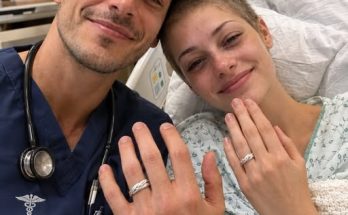
The little bandage ring remained on her finger.
Emily noticed me looking at it.
“She wouldn't let anyone take it off.”
I nodded.
My throat hurt.
I couldn't answer.
Eventually, Emily asked whether I wanted a few minutes alone.
I did.
After she left, I looked at Alicia and tried to find something to say.
Thank you seemed inadequate.
Goodbye seemed impossible.
So I sat there.
I remembered the crossword puzzle.
The ridiculous conversations.
The way she had asked about my father.
And the photograph from our wedding.
I had known her for only a small portion of my life.
Yet the person I had been before meeting her already felt unfamiliar.
The hospital arranged time away from work.
I went home and stood in my kitchen without turning on the lights.
My apartment looked exactly as I had left it.
A coffee mug beside the sink.
A jacket over a chair.
Unopened mail on the counter.
Nothing had changed.
Everything had changed.
I removed my tie and placed it on the kitchen table.
Beside it, I laid the small ring made from braided bandage.
I didn't sleep much that night.
Every time I closed my eyes, I remembered something Alicia had said.
Especially her unfinished confession.
I haven't told you everything about myself.
I wondered what she had wanted to explain.
Then I felt ashamed for wondering.
She had been dying.
Whatever she hadn't told me belonged to her.
I had no right to demand answers.
Emily contacted me the following morning about the funeral arrangements.
Her voice sounded different.
Flat.
Exhausted.
I offered to help.
She accepted.
Over the next few days, we dealt with the small practical tasks that followed an enormous loss.
There were forms.
Telephone calls.
Flowers.
Photographs.
Questions about dates and names.
Emily handled most of it.
Occasionally, she would stop speaking in the middle of a sentence and look at nothing.
I recognized that expression.
I had been doing the same thing.
On the morning of the funeral, I put on the tie I had worn at our wedding.
I almost changed it.
Then I decided Alicia would have appreciated the familiarity.
The gathering was modest.
Several hospital employees attended.
There were relatives I hadn't met.
People who had known Alicia when she was younger.
They told stories about her stubbornness, her humor, and her tendency to defend people who couldn't defend themselves.
Emily spoke briefly.
She couldn't finish everything she had written.
Nobody expected her to.
When my turn came, I looked at the faces in front of me.
I told them Alicia had reminded me that a person's life was more than their diagnosis.
I told them she had made difficult days easier for people who were supposed to be making hers easier.
And I told them I was grateful she had chosen me to share something important with her.
My voice broke.
I stopped.
That was all I could manage.
Afterward, people approached me quietly.
Some shook my hand.
Others offered condolences.
One nurse hugged me without saying anything.
I thanked everyone.
Then I walked toward my car.
The air was cool.
I could hear tires moving across the parking lot.
I remember taking my keys from my pocket and staring at them.
I had nowhere important to go.
No hospital appointment.
No wedding arrangement.
No reason to hurry.
“Lucas!”
I turned.
Emily was walking quickly toward me.
She was holding a small box against her chest.
I recognized it.
The same cardboard box she had brought into Alicia's hospital room.
She stopped in front of me.
For a moment, she didn't speak.
Then she held it out.
“Alicia wanted you to have this.”
I took it carefully.
My name was written across the lid.
The handwriting was uneven.
Some of the letters leaned sideways.
But I recognized Alicia's writing immediately.
“When did she do this?”
“Before the wedding.”
I looked at Emily.
“Why didn't she give it to me herself?”
Emily pressed her lips together.
“She made me promise to wait until she was gone.”
I ran my thumb across the handwritten letters.
I didn't want to open it.
Opening the box felt like accepting that there would never be another conversation with the person who had written my name.
Emily waited.
Eventually, I lifted the lid.
A photograph rested on top.
It showed a little girl beside a hospital bed.
She looked about seven years old.
She had long, dark brown hair and was holding a stuffed rabbit against her chest.
One of the rabbit's ears was missing.
I examined the picture.
There was something familiar about the girl's eyes.
I couldn't explain it.
Then I noticed the handwriting beneath the photograph.
Alicia had written a short message addressed to me.
She wanted me to understand, before discovering anything else, that causing me pain had never been her intention.
My fingers began trembling.
I looked at Emily.
“Who's the child?”
Her expression tightened.
“Read what Alicia wrote.”
“Emily, who is she?”
She looked toward the ground.
“She wanted you to learn about her properly.”
I looked inside the box again.
Underneath the picture was a folded letter.
There was also a small silver key.
Beside it lay a hospital identification bracelet.
I lifted the bracelet.
The printed letters were slightly faded.
But the name remained readable.
SOPHIE MORGAN.
Morgan.
Alicia's surname.
I turned the bracelet over.
Then I looked at the photograph again.
My thoughts began moving too quickly.
I tried to remember everything Alicia had told me about her family.
Nothing explained the child.
“Was Alicia keeping something from me?”
Emily began crying.
“She wanted to tell you.”
“Tell me what?”
“She was afraid.”
I stared at the box.
The photograph.
The bracelet.
The little silver key.
Three ordinary objects that suddenly seemed to contain an entire part of my wife's life I had never known.
Emily touched my arm.
“Please read the letter before you decide what any of it means.”
I unfolded the paper.
Alicia had begun by addressing me with affection.
She acknowledged that if I was reading her words, the recovery she had hoped for hadn't happened.
Then she wrote about our brief marriage.
She said those three days had given her a happiness she hadn't expected to experience.
For a little while, she hadn't felt defined by her illness.
She had felt like a bride.
I stopped reading.
My eyes were burning.
Emily handed me a tissue.
I wiped my face and continued.
The next paragraph began with the name written on the hospital bracelet.
Sophie.
Click here to continue reading: PART 4: The Little Girl in Alicia’s Photograph Had Been Carrying a Secret for Years, and Her Name Changed Everything I Thought I Knew About My Wife
I Had Spent My Entire Adult Life Learning How to Save People, Until One Young Woman Asked Me for Something Medicine Could Not Give Her
Part 3 of 10