I didn't agree to marry Alicia immediately.
There were professional responsibilities I couldn't ignore.
She was vulnerable, seriously ill, and under medical care.
I needed to make certain that whatever happened was genuinely her decision and that her remaining treatment would never depend on my answer.
I explained that to her.
She listened patiently.
Then she tilted her head.
“That's a very long way of saying you're nervous.”
I laughed despite myself.
“I am nervous.”
“Good. That makes two of us.”
She looked toward the ceiling.
“I know what I'm asking.”
I believed she understood.
But believing wasn't enough.
I arranged for another physician to take responsibility for her care.
I spoke openly with the hospital's appropriate staff.
I wanted Alicia to have independent support, time to consider her request, and the freedom to change her mind.
There would be no pressure.
No promises of medical miracles.
No confusion about what marriage could or couldn't change.
When Emily learned what her sister had asked, she stared at me.
“She actually said that?”
“Yes.”
Emily lowered herself into a chair.
Then she began laughing and crying at the same time.
“That sounds exactly like her.”
I asked whether Alicia had ever mentioned the idea before.
Emily shook her head.
“She talked about getting married someday. But not like this.”
She wiped her cheeks.
Then she looked directly at me.
“Don't agree because you feel sorry for her.”
I appreciated her saying it.
“I won't.”
“She deserves more than pity.”
“I know.”
Emily glanced toward her sister's room.
“She always has.”
I remembered that sentence.
The following morning, Alicia brought up the subject again.
She had spent the evening talking with Emily and the members of her care team.
Her decision hadn't changed.
Neither had the medical prognosis.
“Any chance you've reconsidered?” she asked.
I pulled a chair beside her bed.
“I have something to ask you first.”
She nodded.
“Why me?”
For once, Alicia didn't have a clever answer ready.
She looked at the blanket.
“Because you never made me feel embarrassed about being sick.”
I waited.
“And because when everybody else was scared to talk to me, you still did.”
Her fingers moved against the edge of the sheet.
“Because you listened.”
I hadn't realized how much those ordinary conversations had meant to her.
She continued.
“I don't expect you to spend the rest of your life missing me.”
I looked away.
“I'm not asking for that.”
Then she smiled.
“I just don't want every important thing in my life to happen because I'm sick.”
Something inside me changed.
I reached for her hand.
“All right.”
She blinked.
“All right, what?”
“I'll marry you.”
Her mouth fell open.
Then she laughed so loudly that a nurse appeared in the doorway.
“What happened?”
Alicia pointed at me.
“He finally made a good decision.”
The nurse looked confused.
I was smiling.
Alicia was crying.
Emily arrived twenty minutes later.
When she heard the news, she covered her face with both hands.
Her sister called across the room.
“Apparently, you're organizing a wedding.”
Emily shook her head.
“You are absolutely impossible.”
“I know.”
There wasn't much time.
The hospital staff helped us arrange a small ceremony, with the necessary formalities handled as quickly as circumstances permitted.
Nobody pretended it was an ordinary wedding.
There was medical equipment beside the bed.
There were medications on a table.
Alicia needed help sitting upright.
But she insisted on making choices about everything she could.
White flowers.
A white scarf.
No gloomy music.
And absolutely no hospital pudding at the reception.
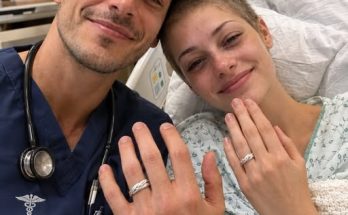
One of the nurses found clean strips of unused bandage and carefully braided them into two little rings for the ceremony.
Alicia examined them.
“These are perfect.”
I offered to arrange something more traditional.
She shook her head.
“No. These belong to our story.”
I wore a dark tie.
It had been months since I'd worn one.
When I entered her room, Alicia looked at me for a long moment.
“You look different without your stethoscope.”
“Good different?”
“Very good different.”
Emily had placed white flowers near the window.
Alicia wore a soft scarf over her head, arranged so that it fell gently behind her shoulders.
She had asked for a mirror earlier that morning.
When Emily handed it to her, Alicia had reportedly looked at herself and said she finally resembled someone going somewhere other than a medical appointment.
I wanted to remember that smile forever.
The ceremony was quiet.
A few nurses stood near the door.
Emily remained beside her sister.
Alicia's voice was weak, but every word mattered to her.
When we exchanged the handmade rings, she held my hand carefully.
Her fingers felt cold.
I wanted to warm them.
I wanted to fix everything.
Instead, I listened.
I smiled.
I stood beside her.
For once, those things were enough.
After the ceremony, Alicia asked for photographs.
She insisted on taking one with every nurse who had helped her.
Then she asked Emily to photograph the two of us.
“Closer,” Emily said.
Alicia rested her head against my shoulder.
The camera clicked.
I would look at that photograph hundreds of times afterward.
Not because we looked like a traditional bride and groom.
We didn't.
But because Alicia looked happy.
Completely happy.
That evening, after the visitors had gone, I sat beside her bed.
She turned her hand and examined the little white ring.
“Mrs. Doctor,” she whispered.
I smiled.
“That's not how it works.”
“Too late.”
She closed her eyes.
For several minutes, I thought she had fallen asleep.
Then she spoke again.
“Lucas?”
“I'm here.”
“If I tell you something difficult, will you promise not to hate me?”
I leaned forward.
“Why would I hate you?”
She opened her eyes.
There were tears gathering in them.
“I haven't told you everything about myself.”
I waited for her to continue.
But she turned toward the window.
“Not tonight.”
I could have asked more questions.
I didn't.
She was exhausted.
I believed there would be another conversation.
Another quiet hour.
Another chance.
The following morning, Emily arrived with her brown handbag and a small cardboard box.
I noticed Alicia look at it.
Then she looked at her sister.
Something passed between them.
I couldn't explain it.
Emily placed the box inside the bedside cabinet.
Alicia reached for her hand.
“Remember what we talked about.”
Emily nodded.
I assumed they were discussing family arrangements.
Alicia asked me to sit with her again.
She was weaker than the previous day.
Talking required more effort.
We spent much of the afternoon holding hands.
Sometimes she slept.
Sometimes she woke and smiled when she noticed I was still there.
Late that evening, she asked me whether I believed people could remain part of someone's life after they died.
I told her I believed memories could.
She considered that.
“Good.”
Then she closed her eyes.
Before falling asleep, she whispered something I almost missed.
“Please remember that I tried.”
I didn't understand what she meant.
I thought she was talking about surviving.
I didn't know she was thinking about a little girl, a silver key, and a letter she hadn't found the courage to give me herself.
Click here to continue reading: PART 3: Two Days After Our Small Hospital Wedding, I Lost Alicia and Received the One Thing She Had Deliberately Kept Hidden From Me
I Had Spent My Entire Adult Life Learning How to Save People, Until One Young Woman Asked Me for Something Medicine Could Not Give Her
Part 2 of 10