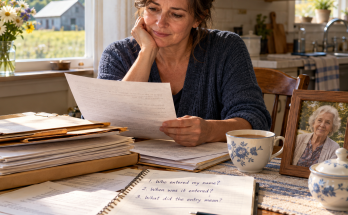
The next morning, I woke up knowing that I could not keep working through the folder without finding a way to check the records.
I had reached the limit of what I could learn by reading the same pages over and over.
The documents gave me dates, names, amounts, and references.
They did not give me the missing context.
I needed help understanding the business records and determining whether the surviving documents could be compared with anything else.
I began looking for someone who could examine them without being personally involved in my family's history.
I did not want another person telling me what to believe.
I wanted someone who could explain what the documents showed, what they did not show, and what additional records might be needed.
That distinction seemed simple.
In practice, it was the most important decision I had made since leaving the factory.
I started by making a clean inventory of the papers.
I listed each document separately.
I recorded its date, if one appeared.
I noted the names it contained and whether it referred to money, property, or a meeting.
When I could not read a word clearly, I marked it as uncertain instead of guessing.
I also recorded where each page had been placed in the folder.
I did not want to rearrange the papers again and accidentally lose a connection that might matter later.
The inventory took most of the morning.
By the time I finished, I had a clearer picture of what I possessed.
I did not have a complete set of business records.
I did not have a document that established who was responsible for my grandfather's death.
I did have several records that appeared to concern the same business transactions, a handwritten note referring to a meeting, and entries involving people who had not fully explained their roles.
That was enough to justify further examination.
It was not enough to justify an accusation.
I wrote those two sentences at the top of a fresh page.
I wanted to see them every time I opened the folder.
Later that day, Raymond came by.
He looked tired.
I offered him coffee, and he accepted.
We sat at the kitchen table with the folder between us.
“I've been organizing the records,” I told him.
He looked at the notebook.
“You've done a lot.”
“I've made a list of what we have and what is missing.”
“That's a good idea.”
“I also want someone independent to examine them.”
Raymond nodded.
“I think that's wise.”
“I don't want someone who already believes you're innocent.”
“Neither do I.”
“I want someone who can tell me whether the records support what you think happened.”
He rested his hands on the table.
“That is what I should have looked for earlier.”
I studied him.
“Why didn't you?”
He considered the question.
“When I first got out, I wanted someone to understand what had happened to me. I wanted them to see how much of the case hadn't been explained.”
“And when they didn't?”
“I became angry. Sometimes I stopped listening when people questioned parts of my account.”
He looked down.
“I thought that if they doubted one thing I said, they were dismissing everything.”
I had not expected him to admit that.
It made me think about how easily people could become trapped by their own need to be believed.
I had done something similar with my father.
When I was younger, I had treated his certainty as a substitute for evidence.
Raymond had sometimes treated other people's doubts as proof that they refused to listen.
Neither response helped establish the truth.
“I'm sorry,” I said.
He looked up.
“For what?”
“For assuming I already knew what kind of person you were.”
Raymond was quiet.
“I made it easy for people to believe what they were told,” he said. “I kept my distance. I didn't explain myself to you. I let years pass.”
“You had reasons.”
“Reasons aren't the same as doing the right thing.”
I thought about that sentence.
It was one I needed to remember.
I had spent years using my father's explanations to avoid difficult questions.
Raymond had spent years trying to recover from a conviction he believed was unjust.
Both of us had allowed time and fear to shape the distance between us.
That did not make our choices equal.
But it made them worth examining honestly.
I opened the notebook and showed him the inventory.
We went through it together.
He recognized some of the entries.
Others were unfamiliar.
When he could not explain a document, I marked it for further examination.
When he remembered something that might help identify a record, I wrote it down as his recollection rather than as an established fact.
We disagreed about one date.
Raymond believed it referred to a particular business meeting.
I thought the entry might concern a transaction recorded later.
Neither of us could prove the other wrong.
So I wrote both possibilities in the margin.
It felt strange to leave the question unresolved.
I had been raised to think that uncertainty meant someone had failed.
Now I was beginning to understand that recording uncertainty honestly was better than pretending to know.
When we finished, Raymond closed the notebook.
“You're approaching this differently than I did.”
“Is that good?”
“I think so.”
He looked at the folder.
“You're not trying to make the papers say something. You're trying to find out what they say.”
I nodded.
“That has to be the point.”
He sat back.
For a moment, we listened to the quiet sounds of the house.
Then I asked him the question I had avoided since the factory.
“If the records never prove who was responsible for Grandpa's death, what will that mean for you?”
Raymond looked at the table.
“It will mean I still have to live with what happened.”
“And if they don't clear your name?”
“I will still know what I did and didn't do.”
I waited.
“But I won't ask you to accept my word instead of evidence,” he continued. “I want you to understand why I believe the case was wrong. I want someone to examine it properly. Beyond that, I can't promise you an answer.”
His words hurt.
They also made me trust him more than a confident promise would have.
He was not telling me that the folder would solve everything.
He was telling me that he wanted the questions examined, even if the answers were incomplete.
That was something I could respect.
I looked at the folder.
“I'm going to keep it safe,” I said.
“I know.”
“And I'm going to continue checking the records.”
“You should.”
“If my father asks for them again, I'm not handing them over just to make the argument stop.”
Raymond gave a small nod.
“That's your decision.”
I smiled faintly.
“You always say that.”
“Because it is.”
For years, I had thought family loyalty meant standing with someone regardless of what I knew.
Now I understood that loyalty could also mean refusing to help someone hide from a question that needed answering.
I did not know whether my father had done anything wrong.
I did not know whether Frank was withholding information or simply unable to remember everything.
I did not know whether the surviving papers would establish anything about the circumstances of my grandfather's death.
But I knew I could not return to the old version of the story.
I could no longer hear Raymond's name and automatically think of guilt.
I could no longer hear my father's certainty and assume that certainty came from knowledge.
And I could no longer treat Frank's vague answers as a substitute for the records he claimed to understand.
The next steps would take time.
I would need to identify the transactions, look for original documents, and find someone qualified to examine the business records.
If the papers supported further questions about the old case, I would need to learn what options existed for having those questions reviewed.
I would have to accept that some details might remain uncertain.
None of that would be easy.
But it was possible.
After Raymond left, I placed the inventory and notebook in the drawer beside the folder.
I checked that the papers were arranged as we had agreed.
Then I closed the drawer.
I did not feel victorious.
I did not feel that the mystery had been solved.
I felt responsible for what I did next.
That was different from fear.
Fear had made me want to choose the person who sounded most certain.
Responsibility required me to look at the evidence, ask difficult questions, and admit when I did not know enough.
I thought about my father standing in the factory.
I remembered the way he had demanded the folder without explaining why.
I remembered Frank's hesitation when I asked about the day my grandfather died.
I remembered Raymond's willingness to admit that he could not answer every question.
Those memories remained unresolved.
I could not make them fit together simply because I wanted a clean ending.
For the first time, I was willing to let the truth take whatever shape the evidence supported.
I turned off the kitchen light and went to bed.
The folder remained locked away.
Tomorrow, I would continue the work.
I would not promise Raymond that it would clear his name.
I would not promise my father that I would stop asking questions.
And I would not promise myself that the answers would be comforting.
I had spent years waiting for someone else to tell me what had happened.
Now I understood that I had a responsibility to examine what they said.
I could not change the past.
I could not recover the years Raymond had lost.
I could not undo the silence that had shaped my family.
But I could refuse to let that silence decide what I believed next.
That was where I stood when I finally closed my eyes.
Not certain.
Not free of doubt.
But no longer willing to mistake someone else's certainty for the truth.
The End
Read more original stories on Feel Every Story.
I Thought My Father Was Just Another Man With a Temper Until I Saw the Gun in His Hand and Realized What My Uncle Had Been Protecting
Part 20 of 20