By the time we reached my place, the night had grown colder.
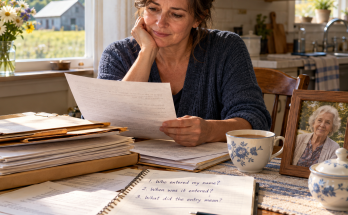
I carried the folder inside and set it on the table.
Raymond remained near the door.
He looked as though he wanted to say something but wasn't sure how to begin.
I turned on the kitchen light.
The yellow folder looked different beneath it.
Under the factory's flashlight, it had seemed like something dangerous.
Here, it looked like an ordinary collection of old papers.
That almost made the situation harder to understand.
Nothing about the documents explained why my father had brought a pistol.
Nothing about the figures explained why Frank had followed him.
The papers themselves could not tell me what those men feared.
I pulled out a chair.
“Sit down,” I said.
Raymond hesitated before taking the seat opposite me.
I placed the folder between us.
For a while, neither of us touched it.
I could hear the refrigerator humming.
A pipe clicked somewhere behind the wall.
The ordinary sounds of the house made the night at the factory feel distant, but I knew it wasn't over.
My father would not simply forget what had happened.
Frank would not suddenly begin answering questions because I had asked them politely.
And Raymond had no reason to believe that the next person who examined the records would be any more willing to listen than the people who had handled his case.
I opened the folder again.
“Let's start at the beginning,” I said.
Raymond nodded.
We arranged the papers in small groups.
I kept the property records together.
The notes and handwritten entries went into another pile.
The documents containing dates and amounts remained separate until we could work out how they related to the others.
We did not discover anything dramatic.
There was no single page that explained the whole story.
Instead, there were names that appeared repeatedly, dates that seemed significant, and references that required information we did not have.
It was slow work.
I had expected that.
I hadn't expected how frustrating it would feel to know that an answer might be hidden somewhere in the records while remaining just beyond my understanding.
At one point, I pushed a page away.
“I can't tell what this means.”
“Neither can I,” Raymond said.
I looked at him.
“You don't have to pretend you understand everything.”
“I'm not pretending.”
He drew the page closer.
“I remember why I kept this one. I thought it might connect to another entry. But I never found the document I needed.”
“Which document?”
“An earlier record of the same transaction.”
I searched the stack.
There was nothing that clearly matched it.
“Could it be missing?”
“Yes.”
“Could you have overlooked it?”
“That's possible, too.”
I nodded.
I liked that he was willing to admit it.
The admission did not make him look weak.
It made the work feel more honest.
I wrote a small note on a separate sheet of paper, listing the date and the missing reference.
Then I placed it beside the relevant document.
We continued.
After a while, Raymond leaned back in his chair.
“You don't have to do all this tonight.”
“I know.”
“You've had a long evening.”
“So have you.”
He looked at the folder.
“I've had a long time.”
I stopped writing.
There was no anger in his voice.
That made the words more painful.
I thought about the years he had spent in prison.
I had never visited him there.
I had never written him a letter.
I had accepted my father's account and allowed the distance between us to become permanent.
I had told myself there was no reason to get involved in a matter I couldn't understand.
Now I wondered how much of that decision had been fear disguised as common sense.
“Why didn't you contact me after you got out?” I asked.
Raymond looked at his hands.
“I thought about it.”
“But you didn't.”
“No.”
“Why?”
“Because I didn't know what you had been told.”
“You could have asked.”
“I could have.”
He paused.
“I was ashamed of how things had turned out, even though I knew I hadn't done what they accused me of. I didn't want you to look at me and see only the man everyone said I was.”
I felt something tighten in my chest.
“I might have listened.”
“Maybe.”
“You don't believe that?”
“I didn't know.”
He looked directly at me.
“And I didn't want to force you into a fight with your father before you were ready to have it.”
I thought about that for a moment.
“You still brought me to the factory.”
“Yes.”
“Knowing he might be there.”
“I thought he might find out eventually. I didn't expect him to arrive like that.”
I looked at the folder.
“You could have told me more before we went.”
“Yes,” Raymond said. “I should have explained what I knew and what I didn't know.”
His willingness to admit that surprised me.
I had expected an argument.
Instead, he seemed to be trying to understand his own mistakes as carefully as he wanted me to examine everyone else's.
I took a breath.
“I don't know if I can trust you yet.”
“I understand.”
“I don't know if I can trust Dad, either.”
Raymond didn't answer immediately.
“You don't have to decide tonight.”
I looked at him.
“What if I never find out everything?”
“Then you'll have to decide what the evidence supports. Nobody gets to know everything about the past.”
He glanced at the documents.
“But not knowing everything doesn't mean you should stop asking questions.”
I returned to the papers.
We spent another hour reading.
I made a list of names that appeared more than once.
Frank Malone.
My father.
My grandfather.
Several company names.
I added a question mark beside each entry that I couldn't explain.
The page began to fill with small marks.
It looked unimpressive.
There was no sudden discovery.
No confession.
No clear account of what had happened the night my grandfather died.
There were only the beginnings of an order that might help us understand the records.
When I finished, I placed the list beside the folder.
“We need someone who can examine these properly,” I said.
Raymond nodded.
“Yes.”
“Someone who understands the business records.”
“Yes.”
“And someone who can look at the case without assuming you're guilty.”
“That might be harder.”
I looked at him.
“Why?”
“Because people often decide what a person is before they decide what the evidence means.”
I thought about my father.
I thought about the way he had spoken of Raymond throughout my childhood.
He had never needed to explain the case in detail.
He had only needed to repeat the conclusion.
Over time, I had learned to hear Raymond's name as a warning.
I had never asked what evidence supported that warning.
Now I knew I had to.
I closed the folder carefully.
The papers were still incomplete.
The questions remained.
But I had a clearer idea of what to do next.
I needed to preserve the records, keep track of what they actually said, and avoid turning suspicion into certainty.
I also needed to remember that the men involved had their own memories, interests, and fears.
None of them could be allowed to replace the evidence.
Raymond stood and walked toward the window.
He looked outside for a moment, then returned to the table.
“There's one thing I want you to understand,” he said.
I waited.
“I didn't give you those papers because I expected you to take my side.”
“Then why?”
“Because I wanted someone in the family to be able to look at them without being told what conclusion to reach first.”
I looked down at the folder.
For years, I had believed that trust meant accepting the account of someone I loved.
If my father told me Raymond was guilty, questioning that claim had felt like betraying him.
I had never considered that refusing to question it might be a different kind of betrayal.
I looked at Raymond.
“I should have asked you sooner.”
“Yes,” he said quietly.
He didn't soften the answer.
He didn't tell me it didn't matter.
I appreciated that, too.
“I can't give you back the years you lost,” I said.
“No.”
“I can't promise that these papers will clear your name.”
“I know.”
“But I can read them. I can ask questions. And I can stop repeating things I can't prove.”
Raymond looked at me for a long moment.
Then he nodded.
“That would be a start.”
I slid the documents back into the folder.
This time, I took care to preserve the order in which we had arranged them.
I placed my list of questions on top.
Then I closed the cover.
The folder was still just a folder.
It had not transformed the past into something simple.
It had not made my father answer for his behavior.
It had not proved that Raymond was innocent of every accusation, although I had begun to understand why he insisted that the original case deserved another look.
What it had done was give me a reason to stop accepting conclusions without examining the facts behind them.
Raymond reached for his coat.
“Keep it somewhere safe,” he said.
“I will.”
“And don't assume that every person who wants to see it has the same reason.”
I remembered my father's hand around the pistol.
I remembered Frank looking at him before answering even the simplest questions.
“I won't.”
Raymond paused beside the door.
“I know this has changed the way you see your father.”
I looked toward the folder.
“It has changed the way I see what I don't know about him.”
Raymond nodded slowly.
“That may be more useful.”
He opened the door.
Before he left, I asked him one last question.
“If you had to do everything again, would you still keep these papers?”
He considered it.
“Yes.”
“Even knowing what happened?”
“Especially knowing what happened.”
Then he stepped outside.
I watched until he reached his vehicle.
When his headlights disappeared, I locked the door and returned to the table.
I placed the folder in a drawer and checked that it was closed.
Then I stood there for a moment with my hand on the handle.
I was still afraid of what the papers might reveal.
I was afraid of what they might fail to reveal.
And I was afraid that the truth, whatever it turned out to be, would leave me with no easy way to return to the life I had known before.
But I no longer believed that uncertainty was a reason to stop.
I turned off the kitchen light.
The folder remained in the drawer, holding its incomplete records and unanswered questions.
For once, I wasn't asking it to tell me whom to love.
I was asking it to help me understand what had happened.
That was the only honest place I knew to begin.
Click here to continue reading: PART 17: The Morning After the Factory, I Began Checking the Records Instead of Trusting Anyone Who Claimed to Know What Happened
I Thought My Father Was Just Another Man With a Temper Until I Saw the Gun in His Hand and Realized What My Uncle Had Been Protecting
Part 16 of 20