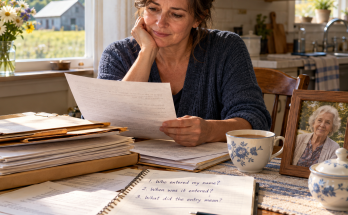
The request for the remaining records took longer than I expected.
I called the courthouse once to check the status.
The clerk told me that some of the older files were stored separately and that the office was still waiting for one of them.
I thanked her and made a note of the call.
I did not call again the next day.
I had learned that checking too often did not make a record appear any faster.
During that wait, Rosella's older son called me.
He asked whether I would be willing to come to the farmhouse and look through a few papers that had been found among his mother's belongings.
I was surprised by the invitation.
"Are you sure you want me there?" I asked.
"We found some things we don't understand," he said. "You worked with Mother for years. You might recognize the way she kept her papers."
I considered his request.
I did not want to go to the house and accidentally disturb something that belonged to the family.
I also did not want to miss a chance to learn whether the papers were connected to the records I had found.
"I can come if we agree that I'm only there to look at the papers," I said.
"That's fine."
"And I won't take anything away without your permission."
"I understand."
We arranged a time for the following afternoon.
I called Rosella's friend and told her about the invitation.
She offered to come with me.
I was grateful.
I did not need her to speak for me, but I wanted another person present while we looked through the papers.
The next afternoon, I drove along the old road toward the farmhouse.
I had not turned into that driveway since I had slowed down across from it several weeks earlier.
The pecan grove looked thinner now, with more bare branches showing against the sky.
The gravel drive crunched beneath my tires.
For twenty-six years, that sound had meant I was arriving for work.
This time, I was not carrying my cleaning bag.
I had my handbag and a notebook.
The difference made me feel as if I had crossed some quiet line.
Rosella's son met us at the front door.
He looked tired.
"Thank you for coming," he said.
"Thank you for asking."
He led us into the kitchen.
The room was familiar enough that I noticed every small change.
The curtains had been taken down.
A stack of unopened mail sat near the telephone.
The sugar bowl was gone from its usual place.
I stopped looking at the counter when I realized what I was doing.
I had no right to expect the house to remain untouched after Rosella's death.
Her family had been handling the property and sorting through her belongings.
Things would naturally be moved.
Still, seeing the kitchen without its familiar objects made me feel the loss again.
Rosella's son noticed my expression.
"We've been trying to sort through everything," he said. "Mother kept a lot of papers."
"She liked to keep records."
"She certainly did."
He took us to the dining room, where several boxes had been placed against the wall.
Some were labeled with dates.
Others had only short descriptions written on their lids.
There were envelopes, old bills, tax statements, and folders tied with string.
The papers had not been thrown together carelessly.
But they had accumulated over many years, and some of the labels were faded.
His brother was not there that afternoon.
Rosella's older son explained that they had divided the work of sorting through the house and that he had gathered the boxes from a desk and a cabinet.
"We found a folder with some property references," he said. "I thought you might recognize the way she labeled things."
He opened one of the boxes.
Inside were several manila folders.
I did not touch them until he invited me to look.
The first folder contained old insurance papers.
The second held receipts and correspondence about repairs to the farmhouse.
The third had a faded label that read "Land."
My heart began to beat faster.
I kept my expression calm.
"May I open this one?"
"That's why I asked you here."
I lifted the flap.
Inside were copies of surveys, tax notices, and several sheets of handwritten notes.
Some of the papers were older than others.
I recognized Rosella's handwriting on a note about the fence near the creek.
She had written the measurements in the same neat, narrow script she used for shopping lists.
I remembered her standing in the kitchen with a pencil tucked behind her ear, checking the measurements before calling someone to make a repair.
The memory came so clearly that I almost expected her to walk in and ask what we were doing.
I set the note down carefully.
"I remember her writing measurements like this," I said.
Her son leaned over to look.
"Do you know what the numbers mean?"
"Not from this page alone. She may have been keeping track of the fence or the boundary. We would need to compare it with the other records."
He nodded.
I moved to the next sheet.
It contained a list of dates and document references.
Several numbers matched the references I had copied from the courthouse records.
I pointed them out.
"These are connected to the documents I requested."
His son took a closer look.
"Are you sure?"
"I'm sure the numbers match. I don't know what every reference means yet."
He sat down at the table.
For a moment, neither of us spoke.
Rosella's friend stood near the doorway, watching us quietly.
"Mother didn't tell me about these," he said.
I kept my eyes on the papers.
"She may have expected you to find them when the time came."
"Or she may have forgotten they were here."
"That's possible too."
He rubbed his forehead.
"I don't know what to think anymore."
I understood that feeling.
I had been living with it for weeks.
I wanted to tell him that the records might have an explanation that would settle everything.
But I did not know that.
So I said nothing.
We continued looking through the folder.
There were no plain statements explaining why my name had appeared in the deed book.
There was no letter addressed to me.
There was no signed note saying that Rosella intended to leave me the farmhouse or the land.
I did not find the answer I had hoped might be waiting in the box.
But I did find something useful.
One of the handwritten sheets listed a document date that was not included in the two records I had already obtained.
I copied the date into my notebook.
Then I showed it to Rosella's son.
"Have you seen this one before?"
He shook his head.
"No."
"It may be another reference we need to check."
He studied the page.
"Can you tell what it is?"
"Not yet."
I placed the sheet back in its folder.
I did not remove it or make a copy without asking.
Instead, I asked whether he would allow me to photograph the reference so I could give the date to Mr. Harris.
He agreed.
I took one clear photograph and checked that the numbers were readable.
Then I put my phone away.
The rest of the folder contained ordinary papers.
A repair estimate.
A tax notice.
A note about a tree that needed trimming.
Those small details reminded me that Rosella had not spent her life thinking only about inheritance or legal arrangements.
She had worried about gutters, fences, bills, and the same daily problems everyone faced.
She had been a person before she became a mystery to me.
I wanted to remember that.
After we finished with the folder, her son closed the box.
"Did you recognize anything important?" he asked.
"I recognized some of the references. I found one date we should look into. But I didn't find an explanation for my name."
He nodded slowly.
"I suppose we shouldn't expect everything to be in one place."
"No."
He looked toward the kitchen.
"Mother always said she would explain things when she had time."
I turned to him.
"Did she say that about this property?"
"I can't remember exactly. She said it about several things. Whenever I asked about papers she kept separate from the rest, she'd say she would explain them later."
I felt a small ache in my chest.
"Did she ever get around to explaining them?"
"Not to me."
He looked down at the closed box.
"Maybe she thought there would be more time."
I did not know what to say.
There were things I had wanted to ask Rosella myself.
I had never asked them because I thought I had no reason to.
Now she was gone, and the questions had become part of the work she left behind.
I thanked her son for letting me look through the papers.
He thanked me for helping identify the references.
The conversation was not friendly in the way it had been when Rosella was alive, but it was no longer openly defensive.
We had a shared problem, and for a little while we had worked on it together.
Before leaving, I stood in the kitchen doorway.
The room was quiet.
I remembered washing dishes at the sink while Rosella sat at the table sorting mail.
I remembered the sugar bowl beside her hand.
I remembered how she sometimes stopped reading and watched the fields through the window.
I had thought those moments were ordinary pauses in an ordinary day.
Perhaps they had been.
Perhaps I was only seeing them differently because I knew what I knew now.
I would not turn a memory into evidence.
But I would not throw it away either.
Outside, the air had grown colder.
Rosella's friend walked with me to the car.
"You handled that well," she said.
"I hope so."
"You didn't try to claim anything."
"No."
"And you found a useful reference."
I looked back at the farmhouse.
"I did."
On the drive home, I thought about the box labeled "Land."
The folder had not answered my questions.
It had shown me that Rosella had kept records connected to the property, and that at least one of those references had not yet been examined.
That was enough for now.
When I reached home, I called Mr. Harris's office and left a message with the new date and reference.
Then I wrote the same information in my notebook.
I placed the photograph in a separate folder on my phone and made sure it was saved.
I did not know whether the reference would lead to the answer.
I only knew it was another piece of the record Rosella had left behind.
I put the notebook away.
Then I went into the kitchen and made dinner.
For the first time in weeks, I felt that I had not simply been waiting for the truth to arrive.
I had found another place to look.
Click here to continue reading: PART 17: The Date in Rosella’s Handwriting Led Us to Another Filing, and I Finally Understood Why One Missing Piece Had Mattered So Much
I Spent Twenty-Six Years Cleaning a Wealthy Woman’s Home Without Knowing Why She Never Let Me Leave It Behind
Part 16 of 20