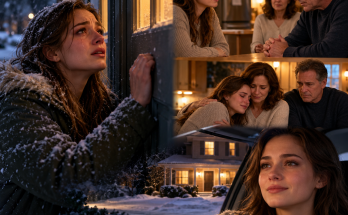
Dad called me several days after the holiday gathering.
I was home, putting away a few things I had bought earlier that afternoon.
When I saw his name, I paused.
Then I answered.
He asked whether I was busy.
I told him I wasn't.
He said he wanted to talk.
I sat down at the table.
For a moment, neither of us spoke.
Then he asked whether I thought our relationship was improving.
The question surprised me.
I had expected another complaint about the distance.
I had expected him to tell me that I needed to stop holding on to the past.
Instead, he was asking what I thought.
"I think we're speaking more calmly," I said.
He agreed.
Then he asked whether I still believed he had treated me unfairly during the blizzard.
I looked toward the kitchen window.
I knew what my answer was.
"Yes."
He let out a breath.
"I've been thinking about that night."
I waited.
He said that he had expected me to leave when I realized he wasn't going to open the door.
I listened.
He said he hadn't expected me to stay as long as I did.
For a moment, I felt the old frustration rise.
He was still describing his expectations rather than his decision.
But I reminded myself to listen before responding.
He continued.
He said he had believed that allowing me inside would have meant giving in after I had failed to follow the rules.
I closed my eyes briefly.
There it was.
He had treated opening the door as a defeat.
I had treated it as something a parent should do when his daughter needed help.
We had been standing on opposite sides of the same door, measuring two entirely different things.
I wanted safety.
He wanted authority.
I had never understood that so clearly before.
"I wasn't trying to defeat you," I said.
"I know that now."
I stopped moving.
For a moment, I wasn't sure I had heard him correctly.
He repeated himself.
He said he understood that I had not been trying to challenge him.
I took a slow breath.
That was something.
It wasn't everything.
But it was a change.
I asked him whether he understood why I had been frightened.
He said he did.
He said he should have considered how dangerous the weather was.
I held the phone more tightly.
I wanted to believe that he was finally reaching the point I had been waiting for.
Then he added that he still believed I needed to take responsibility for my decisions.
The old pattern returned.
I felt the disappointment immediately.
I told him I had taken responsibility by leaving when I realized I wasn't going to be allowed inside.
But I wasn't going to accept that my decision to visit the house made me responsible for his refusal to help me.
He became quiet.
Then he said he wasn't trying to blame me.
I asked him to listen to what he was saying.
He was explaining why he had done what he did.
He was explaining what he believed I should have done differently.
But he still hadn't said that refusing to open the door was wrong.
He didn't answer immediately.
For a while, all I could hear was the faint sound of movement on his end of the call.
Finally, he said he had not handled the night well.
I sat completely still.
The words were not the apology I had wanted.
But they were closer than anything he had said before.
I asked what he meant.
He said he should have thought more carefully about the weather and what might happen if I couldn't get somewhere safe.
I felt tears gathering in my eyes.
I had spent so long waiting for him to acknowledge that the situation had been serious.
Now he was finally saying part of it.
I didn't want to rush past that moment.
I also didn't want to fill in the rest of his apology for him.
"So you believe you should have opened the door?" I asked.
He was silent for several seconds.
Then he said yes.
I looked down at my hands.
I had imagined hearing those words many times.
I had imagined that relief would wash over me and erase the anger.
Instead, I felt sadness.
Because the answer had been so simple.
He should have opened the door.
He had known I was outside.
He had understood that I might be in danger.
He had chosen to let his authority matter more.
And it had taken months for him to say that he should have done something different.
I thanked him for acknowledging it.
He said he didn't want us to keep arguing about the past.
I told him I didn't either.
But I explained that I needed to know he understood why it mattered.
He said he was trying.
I believed that he was trying in that moment.
I did not yet know whether he would continue trying when the conversation became uncomfortable again.
We spoke for a few more minutes.
He asked whether I would visit soon.
I said I would think about it.
He didn't demand an answer.
When the call ended, I remained at the table.
I felt lighter, but not healed.
I wanted to call Mom and tell her what he had said.
I wanted to call Tyler, too.
Instead, I gave myself time to understand my own feelings first.
I had spent years responding to other people's emotions before examining my own.
I didn't want to return to that habit simply because Dad had finally admitted something important.
Later that evening, I called Mom.
I told her that Dad and I had spoken.
She asked whether he had apologized.
I considered the question.
"He acknowledged that he should have let me inside."
Mom became quiet.
Then she said she was glad.
I told her I was glad too.
But I explained that we still had work to do.
She agreed.
I asked her not to treat the conversation as proof that everything was repaired.
She said she wouldn't.
I hoped she meant it.
The following day, Tyler asked how things had gone.
I told him about the call.
He listened carefully.
Then he said he was proud of Dad for finally acknowledging that he should have opened the door.
I understood why he felt that way.
It was a step.
But I told Tyler that I needed to see whether Dad could carry that understanding into the future.
A single admission mattered.
What happened afterward mattered too.
Tyler nodded.
He said he hoped the conversation would help all of us move forward.
I hoped so as well.
That evening, I sat beside the window with a cup of coffee.
The light was fading.
I thought about the door at my parents' house.
For months, I had imagined that if Dad ever admitted he was wrong, the memory would finally stop hurting.
It hadn't stopped hurting.
But something had changed.
I no longer needed to wonder whether he understood that he should have opened it.
He had said so himself.
Now the question was whether he could learn to treat me differently when the next difficult moment arrived.
I couldn't answer that yet.
I didn't need to.
For the first time, I could let the future remain uncertain without rushing to fill it with promises.
Click here to continue reading: PART 19: My Father Finally Faced the Difference Between Being Right and Being a Parent, but His Admission Could Not Return the Night He Took From Me
The Night I Realized My Father’s Rules Mattered More to Him Than His Own Daughter’s Safety
Part 18 of 20