Dad contacted me on a Thursday evening.
His message arrived while I was putting away groceries.
I saw his name on the screen and stopped moving.
For a moment, I expected the familiar tightness in my chest.
It came, but it wasn't as strong as before.
I dried my hands and opened the message.
He asked whether I had time to talk.
Nothing else.
No accusation.
No explanation.
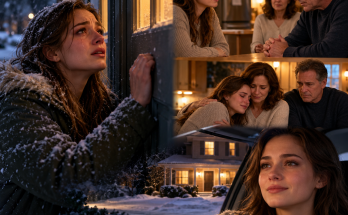
No mention of the blizzard.
I read it twice.
Then I placed the phone on the counter and finished putting the groceries away.
I wanted to answer carefully.
But I also wanted to avoid turning a simple message into another test I had to pass.
After a few minutes, I replied that I could talk.
He asked whether I was available that evening.
I said yes.
When the phone rang, I answered.
For a moment, neither of us spoke.
Then Dad asked how I was doing.
I told him I was fine.
He asked about work.
I answered.
The conversation felt awkward, as though we were two people who had met recently rather than a father and daughter who had known each other all their lives.
I wondered whether he felt the same.
Eventually, he said he wanted things to be different between us.
I sat down at the table.
"So do I."
He said he didn't like the distance.
He said it felt as though I was shutting him out.
I listened without interrupting.
Then he said that families shouldn't remain divided over one disagreement.
I looked at the kitchen window.
I thought about the night of the blizzard.
I thought about how many times he had called it a disagreement, as though we had simply argued about a household rule.
"I don't think we're divided because we disagree," I said. "I think we're divided because we haven't been able to talk honestly about what happened."
He sighed.
"I've told you why I did what I did."
"You've told me what you wanted me to learn."
He went quiet.
I continued.
"But you haven't acknowledged what it was like for me."
Dad said I had made the situation sound worse than it was.
I felt the old frustration rise.
I took a slow breath and reminded myself that I didn't need to convince him in a single conversation.
"I was outside in dangerous weather," I said. "I asked to come in. You knew I was there, and you refused."
He said he hadn't intended for me to be in danger.
I held on to that sentence.
It was the closest he had come to acknowledging the consequences.
But intention wasn't the same as responsibility.
"I understand that you may not have wanted me to get hurt," I said. "But you knew I was outside, and you chose not to open the door."
He didn't answer immediately.
I could hear him breathing through the phone.
Then he said he had expected me to leave.
I closed my eyes.
There it was.
He had made a decision about what I would do, then used that assumption to justify what he did.
I had waited because I still believed he might change his mind.
He had waited because he believed I would eventually go away.
We had both been waiting.
Only one of us had been standing in the cold.
I didn't say that aloud.
I wasn't trying to win the argument.
I was trying to understand whether we could have a different kind of conversation.
I asked him whether he could see why I had been frightened.
He said he understood that I had been upset.
I felt the distinction immediately.
Upset.
Not frightened.
Not abandoned.
Not unsafe.
He was still choosing a word that made the experience sound smaller.
I told him that being upset was not the same as being afraid for my safety.
He said he didn't want to argue about words.
I leaned back in my chair.
Neither did I.
But words mattered because they showed whether we were discussing the same event.
If I described a frightening night and he described a disagreement, we were not starting from the same place.
I told him I didn't expect him to agree with every feeling I had.
I expected him to accept that I had experienced the night differently from him.
He said he was trying to move forward.
I told him I was willing to move forward too.
But I couldn't move forward by pretending the past had been something else.
The conversation became quiet again.
For a moment, I thought he might end the call.
Instead, he asked what I wanted from him.
I had waited a long time for that question.
I could have given him a list.
I could have told him to apologize, admit he was wrong, and promise never to treat me differently from Tyler again.
Those things mattered.
But I knew that a promise made simply to end an uncomfortable conversation would not be enough.
"I want you to acknowledge that you should have let me inside," I said.
He didn't answer.
"I want you to understand that whatever lesson you thought I needed to learn, leaving me outside in that storm wasn't acceptable."
He took a breath.
Then he said he had been trying to teach me responsibility.
I closed my eyes.
We were back where we had started.
I felt disappointment, but I didn't let it turn into another long argument.
"I hear that," I said. "But I'm asking you to consider whether the way you handled it was wrong."
He said he needed time to think.
I told him he could take time.
I didn't demand an answer that evening.
We ended the call without resolving anything.
Afterward, I sat at the table and looked at my phone.
I had hoped for more.
I had hoped that his decision to reach out meant he was ready to take responsibility.
Instead, he had come as far as he was willing to come that night.
I could recognize that without pretending it was enough.
The following morning, Mom called.
She asked whether Dad and I had spoken.
I told her we had.
She wanted to know whether things were better.
I thought about the conversation before answering.
"We talked."
She waited.
"I don't know whether anything has changed yet."
Mom sighed.
She said Dad had been thinking about me.
I felt a small ache.
Part of me wanted to believe that meant he was beginning to understand.
But thinking about someone was not the same as understanding how you had hurt them.
I told Mom I hoped the conversation was a beginning.
Then I asked her not to turn it into a promise that everything would be fine.
She said she wouldn't.
I wanted to believe her.
Later that day, Tyler called.
Dad had told him that we had spoken.
Tyler asked whether I thought Dad might finally apologize.
I told him I didn't know.
Tyler said he hoped so.
I did too.
But I was learning to let hope exist without allowing it to make decisions for me.
I wasn't going to return to the old pattern simply because Dad had made one phone call.
I wasn't going to treat a conversation as a repair.
I would listen to what he said next.
I would pay attention to what he did.
And I would decide how close I could safely be based on the person he actually chose to become.
That evening, I went for a walk.
The air was cool.
The sky was clear.
I passed a house where someone was standing in the doorway, talking to a child who had just come inside.
The scene lasted only a few seconds.
I kept walking.
But I thought about it for the rest of the evening.
A door was such an ordinary thing.
It could be opened without ceremony.
It could be closed without explanation.
For me, it had become a symbol of something much larger.
I no longer wanted to spend my life waiting outside the emotional doors other people controlled.
If Dad wanted a relationship with me, he would have to meet me somewhere the truth could be spoken.
I was willing to leave the door open.
I was no longer willing to stand there begging him to walk through it.
Click here to continue reading: PART 15: The Family Began to Change in Small Ways, but I Learned That Progress Was Not the Same as Repair
The Night I Realized My Father’s Rules Mattered More to Him Than His Own Daughter’s Safety
Part 14 of 20