The weeks after Dad's call passed without another serious conversation.
He sent a few ordinary messages.
One asked whether I had heard about a problem in the neighborhood.
Another asked a practical question that he could easily have handled himself.
I answered both.
I didn't read more into them than they contained.
For years, I had treated every small sign of attention from Dad as evidence that our relationship might finally be improving.
A friendly question could make me hopeful for days.
A quiet response could make me worry that I had done something wrong.
I was trying not to live that way anymore.
I could appreciate a civil conversation without turning it into a promise.
I could enjoy a good afternoon with Mom without assuming that all our problems had been solved.
And I could love my father without pretending I was no longer hurt by him.
Those distinctions were becoming easier to understand.
Living by them was harder.
One Saturday, Mom invited me to help her with a few things around the house.
I agreed.
When I arrived, Dad was in the garage sorting tools.
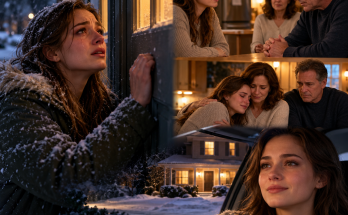
The sight brought back the night of the blizzard before I could stop it.
I remembered the garage door opening.
I remembered walking toward it.
I remembered watching it close before I reached the entrance.
For a moment, I stood beside my truck and couldn't move.
Then I took a breath and walked toward the house.
Mom met me in the kitchen.
She asked whether I wanted something to drink.
I said yes.
She poured me a glass of water and placed it on the counter.
We spent the next hour working on ordinary household tasks.
She asked me to help move a few things from one cupboard to another.
I washed some dishes.
She wiped the counter.
We talked about work and a television program she had been watching.
The conversation was comfortable.
I was grateful for that.
But when Dad came inside, I noticed how quickly Mom's attention shifted toward him.
She watched his expression before asking whether he wanted something to eat.
He answered casually.
Nothing dramatic happened.
Still, I saw the old pattern.
Mom was checking whether he was in a good mood.
I recognized the movement because I had done it myself for years.
I wondered whether she noticed she was doing it.
Later, Dad asked me whether I wanted to help him move something in the garage.
I hesitated.
I wasn't sure whether I wanted to spend time alone with him.
But I also didn't want every ordinary interaction to become a test of whether I could trust him.
So I agreed.
We walked into the garage.
He pointed toward a few items that needed moving.
I helped him shift them into place.
For several minutes, we worked without speaking.
The garage smelled of dust and old wood.
A small tool lay on the workbench beside a folded cloth.
I remembered Dad teaching me to use tools when I was younger.
He had been patient that day.
He had shown me how to hold something steady and how to avoid rushing.
It was a good memory.
I let myself have it.
Then Dad asked whether I was still upset about the blizzard.
I put down what I was holding.
I had hoped he wouldn't bring it up.
But I was glad he had asked directly instead of making another comment about responsibility.
"I'm still hurt by what happened," I said.
He nodded.
"I thought we'd talked about that."
"We talked about it. We didn't resolve it."
His expression changed slightly.
I waited for the familiar response.
Instead, he asked what I believed was missing.
I told him I still needed him to acknowledge that leaving me outside had been wrong.
He looked at the workbench.
"I told you I didn't intend for you to get hurt."
"I know."
He seemed to take that as an answer.
I continued.
"But I needed you to consider what could have happened, not only what you intended."
He picked up the folded cloth and moved it to one side.
I could see him thinking.
For a moment, I hoped he might finally say something different.
Then he said he had expected me to take responsibility for getting somewhere safe.
I felt the hope fade.
We were still talking about my choices.
I told him I had taken responsibility for myself by leaving when it became clear he wouldn't open the door.
But that didn't change the decision he had made.
He said he didn't see it the same way.
I nodded.
"I understand that."
He looked at me, perhaps surprised that I hadn't argued.
I explained that we didn't have to agree about every detail for me to know what I had experienced.
I had been frightened.
I had needed help.
He had refused to let me inside.
Those facts remained true even if he continued to describe the night differently.
Dad put the cloth down.
He said he didn't want us to keep having the same conversation.
I told him I didn't either.
Then I returned to the task we had been doing.
We finished moving the remaining items.
Neither of us said anything else about the blizzard.
When I went back into the kitchen, Mom looked at me carefully.
"Everything all right?"
I told her we had talked.
She asked whether Dad had apologized.
I shook my head.
She looked disappointed.
I felt disappointed too.
But I didn't want her to think the entire visit had been a failure.
I had spent time with her.
I had worked beside Dad without pretending the past had disappeared.
I had spoken honestly and stayed calm.
Those things mattered, even if they weren't enough to repair the relationship.
Before I left, Dad stood near the front door.
He asked whether I would come again.
I looked at him.
"Yes, when it makes sense."
He nodded.
There was no warmth in his expression, but there was no open hostility either.
I put on my coat and said goodbye.
As I walked toward my truck, I felt a mixture of sadness and relief.
I had wanted more from him.
I still did.
But I was beginning to understand that progress could be real without being complete.
A person could become less defensive in one moment and return to old habits in the next.
A family could learn to speak more honestly without suddenly becoming safe.
I didn't need to deny the small improvements.
I also didn't need to pretend they were enough.
That evening, Tyler called.
He asked how the visit had gone.
I told him about the conversation in the garage.
He listened, then said he wished Dad could see things from my side.
"So do I."
Tyler said he had been thinking about the night again.
He told me that before the blizzard, he had rarely questioned why Dad treated us differently.
He had accepted the advantages without thinking about what they meant for me.
Now he noticed those differences more often.
Sometimes Dad made a comment that would once have passed without challenge.
Tyler said he had started asking himself whether he would accept the same behavior if it were directed at someone else.
I was glad to hear that.
But I reminded him that noticing a problem was only the beginning.
He agreed.
We talked for a while longer.
After the call, I sat at the table and looked at the cup beside the sink.
I thought about the conversation with Dad.
I had not received the apology I wanted.
I had not convinced him to change his view.
But I had also not lost myself trying to make him understand.
That was different.
It was not the ending I had hoped for.
It was a step toward the kind of relationship I could live with.
And for now, I was willing to let that be what it was.
Click here to continue reading: PART 16: When Another Winter Came Into View, I Realized the Night Outside His House Would Always Matter, Even If My Father Never Admitted Why
The Night I Realized My Father’s Rules Mattered More to Him Than His Own Daughter’s Safety
Part 15 of 20