I turned seventy-six on a Tuesday.
No grand party.
That was deliberate.
David ignored me.
He invited everyone anyway.
Not everyone from the entire saga.
Thank God.
Brenda.
Richard.
Tommy.
Claire.
Lucas.
Laura.
Emily.
A few friends.
Dinner at my house.
Cake.
No speeches.
I threatened consequences.
They mostly obeyed.
Richard gave me pencils.
“Very subtle.”
“You should draw.”
“I can barely sign checks legibly.”
“Learn.”
“I’m seventy-six.”
“So?”
I hated when my own arguments returned.
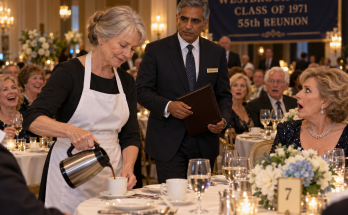
Brenda gave me a framed photograph.
Not prom night.
Not the reunion.
The worker-fund dinner.
We were standing beside Elena Ruiz.
All three wearing aprons.
I stared.
“When did this happen?”
“After you had wine.”
“I do not remember agreeing.”
“You didn’t.”
“Then this is evidence of wrongdoing.”
She laughed.
I put it on the shelf anyway.
Tommy brought nothing.
Excellent.
Then handed me an envelope.
I glared.
“Relax.”
“I have trauma.”
“It’s a birthday card.”
It was.
No hidden confession.
No deed.
No key.
Inside:
Sorry I laughed in 1971. Glad you laughed at me in 2027.
I smiled.
“Acceptable.”
After everyone left, I stood alone in the kitchen.
The old table remained downstairs.
Richard’s drawing hung above the fireplace.
Brenda’s terrible paintings occupied more wall space than they deserved.
Arthur’s photograph stood beside my mother’s.
Dad’s pocketknife lay in a small box in my desk.
No hidden meaning anymore.
Objects could finally become objects.
I opened the drawer containing the reunion apron.
White cotton.
Signatures fading slightly.
I tied it around my waist.
Not because anyone was present.
Not for symbolism.
I had dishes to wash.
That made me laugh.
Arthur would have enjoyed that.
I washed plates.
Loaded the dishwasher.
Wiped the counter.
Then I caught my reflection in the dark kitchen window.
Seventy-six.
Gray hair.
Apron.
No audience.
For one second, I saw the seventeen-year-old girl beneath everything.
Green-flowered dress.
Blue-check prom dress.
Cold arms walking home without a coat.
She had spent so long believing humiliation meant truth.
That laughter meant agreement.
That poverty could be seen through cloth.
That someone else’s confidence must be more accurate than her own uncertainty.
I wished I could speak to her.
Not tell her everything would be fine.
That would be dishonest.
Dad remained dead.
Mom would work too hard.
Arthur would lie by omission.
Business would almost fail.
Grief would come.
People would disappoint her.
She would disappoint herself.
Life would remain complicated.
I would tell her something simpler.
The room does not vote on your worth.
That was what Mom had been trying to teach me.
On the porch.
At the mirror.
In the note hidden in my dress pocket.
Nobody in that room knows your worth better than you do.
At seventeen, I did not know.
At seventy-six, I finally did.
Not because I became wealthy.
That distinction mattered.
Money helped.
Money gave options.
Stability.
Influence.
Safety.
Pretending otherwise would insult everyone who lacked it.
But wealth did not create the answer.
If anything, hiding my success at the reunion proved that.
Before Robert entered.
Before anyone knew Caldwell Linens.
I had already made the most important choice.
I stayed.
Brenda handed me the apron.
People laughed.
I felt seventeen again.
Then I tied it around my waist and carried coffee.
Not because serving proved humility.
Not because I was above status.
Because I knew the work could not diminish me.
That was the turning point.
Everything after nine o’clock mattered.
The revelation.
The trust.
The land.
Dad.
Harold.
Arthur.
Our mothers.
The worker fund.
But the part of my life I had actually gone to the reunion to test was decided before anyone knew who I was.
I could stay in the room.
That was enough.
The next morning, I drove to Oakridge High.
Not for an event.
I had agreed to meet Kayla’s younger brother, who wanted help finding a facilities-training program.
The counselor had asked whether I would speak with him.
I said yes.
He was seventeen.
Tall.
Nervous.
His shoes were worn.
He kept hiding them beneath the chair.
I noticed.
Because of course I did.
I did not tell him I noticed.
We talked about programs.
Costs.
Apprenticeships.
Scholarships.
Transportation.
He admitted he was worried he was not “college material.”
I hated that phrase.
“What does that mean?”
He shrugged.
“I’m not good at school.”
“Which part?”
“Tests.”
“Do you fix things?”
“Yes.”
“What?”
“Anything.”
His sister had told me that.
Broken blender.
Bicycle chain.
Neighbor’s lawn mower.
He liked machines.
“Then why are you judging yourself using tests?”
He stared.
“I don’t know.”
“Good answer.”
We found a mechanical systems apprenticeship.
Paid training.
Good.
He brightened.
Then asked:
“Were you good at school?”
“Some subjects.”
“Were you popular?”
I laughed.
“No.”
“Rich?”
“No.”
He looked surprised.
People knew Caldwell now.
They saw the outcome.
Not beginning.
“Did it bother you?”
“Yes.”
“What changed?”
I considered giving him the entire story.
Did not.
He did not need my history.
He needed his future.
“I learned embarrassment passes faster if you stop treating it like evidence.”
He frowned.
“What does that mean?”
“It means feeling ashamed does not prove you did anything shameful.”
He sat quietly.
Then nodded.
Maybe he understood.
Maybe later.
That was enough.
As I left, I walked past the gym.
Door open.
Students practicing basketball.
Shoes squeaking.
Whistles.
Laughter.
Normal sounds.
I stood at the entrance.
For decades, memory placed Brenda there permanently.
Pale dress.
Smile.
Hand pinching blue fabric.
Tommy laughing.
Everyone watching.
Now the room contained strangers.
No ghost waited for me.
Good.
I walked away.
At the Fairmont, the permanent display eventually became smaller.
Also good.
History did not need to dominate a functioning hotel.
One wall near the ballroom.
Grand Oak origins.
Worker-fund recovery.
Land records.
Our mothers.
My father.
Harold’s documented actions.
Charles.
Leonard.
James.
Samuel.
Anna.
Eleanor.
Margaret.
Arthur.
No one centered.
Below the display sat a small plaque explaining the worker fund.
Current website.
Programs.
Application instructions.
Useful.
That pleased me more than any historical caption.
The reunion apron photograph remained.
Brenda’s admission remained.
She never asked to remove it.
The historical society maintained the full archive.
Researchers used it.
A graduate student wrote a thesis on worker restitution structures.
Another studied women’s informal record preservation.
One article called Margaret, Eleanor, and Anna “domestic archivists.”
I still thought that sounded ridiculous.
Mom would have laughed.
But the work was serious.
The quarry continued operating within limits.
Not perfectly.
No enterprise was.
Monitoring caught problems.
Workers stopped operations twice more.
Wage support activated automatically.
Nobody had to choose between safety and immediate rent.
That was perhaps the best outcome of the entire mineral discovery.
The worker fund grew.
Not endlessly.
Rules capped administrative growth.
Money went outward.
Training.
Safety.
Emergency help.
Legal aid.
Second starts.
Open doors.
The trust remained.
Not sacred.
Audited.
Governed.
Amendable.
That was important.
Nothing should become so revered people stopped questioning it.
Vance Property reached thirty-two percent employee ownership.
Richard no longer complained publicly.
Privately, constantly.
Maria ignored him.
Lucas served one term as apprentice representative, then left when his own company became busy.
Richard was disappointed.
Did not pressure him.
That might have been his greatest achievement.
Brenda continued volunteering.
One afternoon she called because a student had been mocked for wearing secondhand clothes.
Her voice shook.
“What do I say?”
“Why are you asking me?”
“Because I don’t want to say the wrong thing.”
That alone showed how far she had traveled.
“Listen first.”
“I know.”
“Then ask what the student needs.”
“What if she wants me to tell her the other kids are jealous?”
“Don’t.”
“Why?”
“Because you don’t know that.”
Silence.
Then Brenda laughed.
“Right.”
“Do not make her pain about explaining the people who caused it.”
Another pause.
“You learned that the hard way.”
“Yes.”
“So did I.”
She listened to the girl.
Helped with a school response.
Did not tell my story.
Good.
Not every hurt needed to become our metaphor.
Years earlier, Brenda would have centered the aggressor’s intention.
Now she centered the person harmed.
Changed behavior.
That was forgiveness’s best evidence.
My relationship with Arthur remained private in ways the archive could never capture.
Researchers saw letters.
Trust documents.
The recording.
They knew he met me because of Margaret’s request.
They knew he hid the past.
They knew he preserved evidence.
They did not know how he danced badly in our kitchen.
How he always warmed my side of the bed with his feet and denied doing it.
How he cried when David was born.
How he hated bananas.
How he repaired dryers while singing songs with the wrong lyrics.
How he held my hand when Mom died.
How he forgot our anniversary once and drove forty miles at midnight for flowers because the only open store was near the interstate.
A marriage could not be audited.
Thank God.
His lie mattered.
His love mattered.
Neither erased the other.
That was the answer I eventually gave David when he asked again whether learning the truth changed how I remembered his father.
“Yes.”
“How?”
“I remember more honestly.”
“Better or worse?”
“Both.”
He nodded.
Adults eventually learned to tolerate that.
I never formally told Brenda I forgave her completely.
She stopped asking.
That mattered.
One spring afternoon, we sat on my porch.
She wore ugly sunglasses.
I told her.
She said mine were worse.
We drank lemonade.
No secrets.
No archive.
No family history.
Then she said:
“I was awful to you.”
“Yes.”
“I’m still sorry.”
“I know.”
“You don’t have to say anything else.”
“I know.”
We sat.
Birds.
Traffic.
Wind moving through trees.
Then I said:
“I forgive you.”
Brenda became very still.
I had not planned it.
No audience.
No dramatic setup.
The words simply became true enough to say.
Not because what she did became acceptable.
Not because understanding erased injury.
Not because she earned some moral prize.
Because I no longer needed to keep the account open.
Her eyes filled.
“Thank you.”
“That does not mean you can criticize my sunglasses.”
“They’re terrible.”
“I withdraw forgiveness.”
She laughed.
So did I.
That was all.
No music.
No applause.
Forgiveness turned out to be much smaller than people imagined.
A release.
Not a verdict.
And friendship?
I eventually admitted it.
Yes.
Brenda became my friend.
Late.
Unexpected.
Imperfect.
She annoyed me constantly.
That seemed to be part of the arrangement.
On the fifty-sixth anniversary of our prom, she came to my house with a bakery box.
Cinnamon rolls again.
“Why?”
“Tradition.”
“We do not have this tradition.”
“We do now.”
We ate them at the old kitchen table.
I had brought it upstairs again.
The newer table went to David.
I wanted Mom’s table where I could use it.
Not preserved beneath cloth.
Not displayed.
Used.
There were scratches.
Burn mark.
Arthur’s brace still underneath.
The place where the original deed had hidden.
All visible.
All ordinary.
Brenda touched the surface.
“Our mothers sat here.”
“Yes.”
“Arthur too.”
“Yes.”
“Your father.”
“Yes.”
“So did we.”
“Unfortunately.”
She smiled.
Then asked:
“Would you change anything?”
Impossible question.
Yes.
I would save Dad.
Tell Mom she could rest.
Force Arthur to speak sooner.
Stop Brenda before prom.
Tell Tommy not to laugh.
Protect Martin.
Expose Harold.
Undo Leonard’s first signature.
Give Eleanor a safer exit.
Let Anna survive.
A thousand changes.
But those belonged to fantasy.
Reality did not permit editing.
Only continuation.
“I would change many things.”
Brenda nodded.
“Me too.”
“But we don’t get to.”
“No.”
“So I’m more interested in what happens next.”
She smiled.
“What happens next?”
“I finish this cinnamon roll.”
“That ambitious?”
“Yes.”
She laughed.
I looked toward the hallway.
On one wall hung Richard’s drawing of Grand Oak.
On another, Brenda’s painting of our mothers.
In the drawer rested the signed reunion apron.
At David’s house, the blue dress waited for another generation.
Not secret.
Not shameful.
Just known.
That was perhaps the true outcome of everything.
The secrets did not vanish.
They became information.
The shame did not vanish.
It became context.
The hurt did not vanish.
It stopped governing.
Money stolen from workers returned, imperfectly, through systems they helped control.
Land once used for leverage became a source of monitored community wealth.
Families that inherited guilt learned, slowly, to inherit responsibility instead.
Harold’s lie did not become my father’s identity.
Arthur’s secrecy did not become our marriage’s entire meaning.
Brenda’s cruelty did not become the limit of who she could be.
And the frightened girl in the blue-check dress did not remain trapped in that gymnasium forever.
Before Brenda left that afternoon, she stood at the door.
“Martha.”
“Yes?”
“You know what’s funny?”
“This should be terrible.”
“If I hadn’t handed you that apron—”
“No.”
She stopped.
“No?”
“Do not give yourself credit.”
She laughed.
“I was going to say none of this would have happened.”
“Maybe.”
“Do you ever think about that?”
“Yes.”
“And?”
I looked at her.
“The apron opened a door.”
Then I thought of Mom.
Dad.
Arthur.
Eleanor.
Anna.
Leonard.
James.
Samuel.
Workers.
Students.
Everyone who had acted before we understood.
“But other people spent sixty years building the hallway.”
Brenda nodded.
That was better.
She left.
I closed the door.
The house became quiet.
I went to the kitchen.
Mom’s table waited.
I sat.
No letters.
No envelopes.
No evidence.
Just morning light across worn wood.
For once, I did not ask what had been hidden.
I did not wonder what else might surface.
I did not need another answer.
The central question had never really been who owned the hotel land, who stole which money, or even exactly what Harold intended on North Quarry Road.
Those things mattered.
But beneath them sat something older.
Who gets to decide what another person is worth?
Brenda had once believed popularity gave her that authority.
Harold believed money did.
Charles believed power did.
Arthur sometimes believed love did.
My mother knew better.
Worth was not handed down by wealthy families.
Not awarded by classmates.
Not measured by clothes.
Not proven by suffering.
Not created by success.
I had spent half a century building a company before understanding something my mother tried to put in my pocket at seventeen.
Nobody in that room knows your worth better than you do.
I finally knew.
And because I knew, I no longer needed the room to agree.
The End
Read more original stories on Feel Every Story.