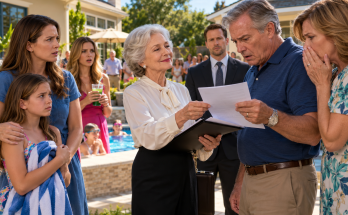
Silence spreads differently from noise.
Noise arrives from somewhere.
Silence moves everywhere at once.
Within seconds of Robert Sterling asking for my signature, conversations across the ballroom thinned and stopped.
I could hear silverware touching china.
A chair creaked.
Somewhere near the kitchen doors, a service cart rolled over a seam in the carpet.
Brenda remained standing.
“Event agreement?” she repeated.
Robert turned toward her with the professional courtesy he extended to every guest, including difficult ones.
“Yes, ma’am.”
She looked at him and then at me.
“I don’t understand.”
I wished, briefly, that Robert would simply hand me the papers.
Instead, he answered the question she had not quite asked.
“Mrs. Caldwell is the founder and principal owner of Caldwell Linens & Laundry.”
Someone behind me whispered my name.
Not Higgins.
Caldwell.
Brenda’s gaze dropped to the apron around my waist.
Then back to my face.
Robert continued.
“Caldwell Linens has supplied the Fairmont Plaza for twenty-two years.”
The silence deepened.
He opened the folder.
“And Mrs. Caldwell sponsored tonight’s ballroom rental, plated dinner, upgraded linen service, and dessert course.”
A voice from another table said, “Martha paid for this?”
Someone else whispered, “Caldwell Linens? That Caldwell?”
I resisted the urge to close my eyes.
This was precisely the spectacle I had feared.
Robert handed me a pen.
I looked at the overtime authorization first.
The stranded employees were still unable to reach the hotel, and the remaining banquet team had absorbed the additional workload.
I signed.
“Make sure everyone who stayed late receives the full overtime rate.”
“Already arranged.”
“Good.”
I signed the event agreement.
Then I handed the pen back.
Robert closed the folder.
“Anything else?”
“Yes.”
I glanced toward the kitchen.
“Bring out dessert.”
A laugh moved through the room.
Then someone clapped.
Another person joined.
Within seconds, applause spread across several tables.
I raised one hand.
“Please don’t.”
The clapping weakened.
Then stopped.
I untied the apron.
I folded it once.
Not ceremonially.
Not slowly for effect.
I simply folded it because my mother had taught me not to leave clean fabric crumpled.
I placed it over the back of an empty chair.
Brenda watched every movement.
I turned toward the room.
“I didn’t pay for tonight so anyone would applaud me.”
Nobody spoke.
“I certainly didn’t do it to embarrass anyone.”
Brenda’s expression changed slightly.
“I received the invitation, discovered the reunion would be here, and decided I wanted everyone to have a proper evening.”
I looked around.
“But there was another reason I came.”
My throat tightened unexpectedly.
“For a long time, I avoided these reunions because whenever I thought about Oakridge High, I remembered myself as a frightened seventeen-year-old girl.”
Carol was sitting near the front.
She leaned toward me.
“Do you still?”
A few people smiled.
I looked at her.
Then at Tommy.
Then at Brenda.
Finally I looked down at the folded apron.
“No.”
The answer came without effort.
“No, I don’t.”
Something inside me became quiet.
Not healed.
Healing was too grand a word for what happened.
The past remained exactly what it had been.
Brenda had still mocked me.
Tommy had still laughed.
I had still walked home cold and crying.
My mother had still found me on the porch.
Nothing changed.
Except my position inside the memory.
For fifty-five years, I had been standing in that gymnasium waiting for someone to tell me I was not ridiculous.
Now I understood I had never needed their permission.
“I don’t feel like that girl anymore,” I said.
Then I walked to an empty chair and sat down.
Robert returned to his duties.
The banquet staff resumed moving.
The room slowly exhaled.
A few minutes later, dessert appeared.
Chocolate cake.
Brenda had tried to eliminate it from the budget.
That detail amused me enough that I ate every bite.
I was halfway through when Tommy approached.
He stood beside the table with his hands in his pockets.
“May I sit?”
“That depends.”
“On?”
“Whether you’re going to make me regret saying yes.”
His smile was brief.
“I’ll try not to.”
I gestured toward the chair.
He sat.
For several seconds, neither of us spoke.
Then he said, “I owe you an apology.”
“Yes.”
He blinked.
Perhaps he expected me to rescue him.
I did not.
He rubbed one hand across his forehead.
“I’ve thought about that prom night more times than you probably imagine.”
“Probably.”
“I should have defended you.”
“Yes.”
“I was seventeen.”
“So was I.”
He looked down.
“I know.”
I waited.
“I was scared of Brenda.”
“Of Brenda?”
“Of becoming the next person everyone laughed at.”
There it was.
The truth was not flattering, but at least it was honest.
“So you laughed at me instead.”
His face tightened.
“Yes.”
“You decided it was safer if I stayed the target.”
“Yes.”
I took another bite of cake.
He almost smiled at the absurdity of my calmness.
“I was a coward.”
“Yes, Tommy.”
“I’m sorry.”
This time I put down my fork.
I studied him.
He was not the boy from the gymnasium.
Neither was I the girl in the blue dress.
“Thank you for saying it.”
“Does that mean you forgive me?”
“I didn’t say that.”
He nodded slowly.
“Fair enough.”
“But I’m glad you apologized.”
His shoulders lowered.
Perhaps he had been carrying his own version of that night.
Not as heavy as mine.
But weight did not have to be equal to be real.
Carol approached next.
Unlike Tommy, she did not ask permission before sitting.
“I always hated Brenda for what she did to you.”
I looked at her.
“Did you?”
“Yes.”
“Why didn’t you say anything?”
She stopped.
The question clearly surprised her.
“Martha—”
“You said you hated it.”
“I did.”
“But you never told her to stop.”
Carol looked down at her hands.
“I was afraid.”
“Of what?”
“You know what she was like.”
“I do.”
“If anyone challenged her, she found something about them.”
“And?”
Carol’s eyes met mine.
“I didn’t want it to be me.”
The answer hurt more than I expected.
Not because it was new.
Because it confirmed what I had understood while carrying coffee.
Brenda’s cruelty had been effective because everyone around her had calculated the cost of intervening and decided I was cheaper.
“I understand being afraid,” I said.
Carol nodded gratefully.
“But fear doesn’t make silence harmless.”
Her gratitude disappeared.
For a moment, I worried I had been too severe.
Then she nodded.
“No.”
Her voice was quiet.
“It doesn’t.”
She remained at the table.
Soon another classmate joined us.
Then another.
Something about the evening had shifted.
Perhaps seeing Brenda’s little hierarchy collapse made everyone less interested in maintaining their own.
The conversations changed.
Earlier, people had discussed grandchildren’s accomplishments, vacations, home renovations, golf, retirement accounts, and carefully edited versions of their careers.
Now the polished stories began cracking open.
A man named Dennis admitted he had nearly lost his family because of alcohol.
“I haven’t had a drink in nineteen years,” he said.
Nobody laughed.
A woman across from him talked about caring for her mother through nearly a decade of dementia.
Another classmate confessed that his business had failed and taken his savings with it.
Someone mentioned an estranged daughter.
Someone else described losing a husband.
Divorce.
Cancer.
Bankruptcy.
Loneliness.
Children who moved away.
Children who never moved out.
The things that had seemed to divide us at seventeen suddenly appeared absurd.
Popular.
Unpopular.
Rich.
Poor.
Beautiful.
Plain.
Athlete.
Bookworm.
Winner.
Loser.
At seventy-three, life had reached all of us.
No one had escaped carrying something.
I thought about how terrified I had once been of these people.
They had seemed like judges.
Now they were simply human beings who had survived long enough to become complicated.
Brenda did not join us.
For almost an hour, she moved around the room attending to reunion business that no longer required much attention.
Occasionally, I caught her looking toward me.
I did not call her over.
Shortly before the event ended, I stepped away from the table and walked toward the ballroom entrance.
My feet hurt.
I was tired.
But I felt lighter than when I had arrived.
“Martha.”
I stopped.
Brenda stood behind me.
We were nearly alone near the doors.
“You arranged all this.”
“I paid for the evening.”
“Why?”
“So everyone could enjoy it.”
Her mouth tightened.
“You wanted to humiliate me.”
I looked at her.
“If I wanted to humiliate you, Brenda, paying for your dinner would be a very inefficient strategy.”
“That’s not funny.”
“I wasn’t joking.”
She crossed her arms.
“You hid it.”
“Yes.”
“You let me think you were—”
She stopped.
“Were what?”
Brenda looked away.
I waited.
She would not finish.
“Poor?” I asked.
“No.”
“Unsuccessful?”
“I didn’t say that.”
“You didn’t have to.”
Her face reddened.
“You were testing me.”
“No.”
“You obviously were.”
“I was testing myself.”
That stopped her.
“What does that mean?”
“It means I wanted to know whether I could walk into this room without needing you to think well of me.”
Brenda stared.
“And?”
I glanced back at the tables.
People were exchanging telephone numbers and taking photographs.
Tommy was helping Carol with her coat.
Elena and the banquet staff were beginning to clear dessert plates.
I looked at Brenda again.
“I can.”
She swallowed.
I continued.
“I wanted to know whether I was still afraid of you.”
Her voice became quieter.
“Are you?”
“No.”
The answer seemed to land harder than anger would have.
Brenda looked at the apron draped over the chair several yards away.
“I shouldn’t have given you that.”
“No.”
“I thought…”
She stopped.
“What?”
“Nothing.”
“You’ve been saying ‘nothing’ to me for fifty-five years whenever you almost tell the truth.”
Her eyes snapped back to mine.
“That’s unfair.”
“Maybe.”
I was tired of pretending certainty.
“Then tell me what you thought.”
She pressed her lips together.
“I thought it was a joke.”
“It was a joke.”
“I didn’t mean—”
“You meant for people to laugh.”
She had no answer.
“That was the purpose.”
Her shoulders lowered.
“Yes.”
“Then don’t tell yourself you meant nothing by it.”
Brenda looked suddenly old.
Not physically.
The arrogance simply disappeared from her posture.
“I’m sorry.”
Two words.
I had imagined them before.
Years ago, I had imagined Brenda apologizing in front of everyone.
In those fantasies, she cried.
I was magnificent.
Everyone finally understood.
Reality was smaller.
She stood in a hotel ballroom near midnight and gave me an imperfect apology while looking at the carpet.
Oddly, that made it more believable.
“Thank you,” I said.
She looked surprised.
“That’s it?”
“What else do you want?”
“I don’t know.”
“Neither do I.”
She gave a faint laugh.
For the first time, I heard no cruelty in it.
We stood in silence.
Then Brenda said, “Your company really supplies this hotel?”
“For twenty-two years.”
“And the hospitals?”
“Two.”
“The restaurants?”
“Six.”
She shook her head.
“I had no idea.”
“That was the point.”
Her eyes narrowed.
“What?”
“You treated me according to what you thought I was.”
“That isn’t fair.”
“Isn’t it?”
She looked toward the apron.
I did too.
Finally she said, “Good night, Martha.”
“Good night, Brenda.”
I watched her walk away.
I thought that would be the end of it.
It would have been enough.
I drove home through quiet streets with my shoes on the passenger-side floor because my feet hurt too much to keep wearing them.
At a red light, I laughed aloud.
Arthur would have loved that detail.
I could imagine him asking why a woman wealthy enough to sponsor a hotel ballroom had not bought more comfortable shoes.
When I reached home, I hung the gray dress in my closet.
Then I sat on the edge of the bed.
The house was silent.
For the first time in decades, I deliberately remembered the prom dress.
I tried to summon Brenda’s voice.
It came.
Then Tommy’s nervous laugh.
That came too.
But something else arrived before either memory could take over.
My mother.
Standing behind me at the mirror.
Her hand rising to cover her mouth.
Her eyes shining.
You look beautiful.
I closed my eyes.
For fifty-five years, Brenda’s voice had been louder.
That night, finally, my mother’s was.
A week later, I was in my office reviewing quarterly contracts when David walked in carrying a manila folder.
He dropped it onto my desk.
“What’s this?”
“Something interesting.”
“That description usually means expensive.”
“Possibly.”
I opened the folder.
The first page carried the Oakridge High alumni board letterhead.
The Fairmont Plaza logo appeared beneath it.
I looked at David.
“What have you done?”
“Nothing.”
“That is exactly what people say immediately before explaining what they’ve done.”
He pulled out a chair.
“They want to establish a scholarship.”
I looked down again.
“A scholarship for what?”
“Hospitality education.”
I continued reading.
The proposed fund would help students from low-income families pursue culinary arts, hotel management, commercial textile services, and related programs.
Something tightened in my chest.
“They want to name it after you,” David said.
“No.”
He laughed.
“You didn’t even finish reading.”
“I don’t need to.”
“Mom.”
“No.”
“You funded the reunion.”
“I bought dinner.”
“You did considerably more than buy dinner.”
“I am not putting my name on a scholarship.”
David smiled in a way I recognized immediately.
Arthur used to smile like that when he knew something I did not.
“What?”
“Keep reading.”
I turned the page.
Then I stopped.
Across the top, in bold letters, was a different proposed name.
THE ARTHUR CALDWELL MEMORIAL HOSPITALITY SCHOLARSHIP.
For several seconds, the words blurred.
I removed my glasses.
David waited.
“You planned this?”
“Dad and I discussed something similar years ago.”
I looked up sharply.
“What?”
“He never told you?”
“No.”
David leaned forward.
“He wanted to create a training fund for kids who couldn’t afford college or trade programs. We talked about it shortly before he got sick.”
My hand rested on Arthur’s name.
“He never said anything.”
“He wanted to wait until he had a complete proposal.”
That sounded exactly like him.
I laughed once, but it came out uneven.
“He would have hated having his name printed this large.”
“Probably.”
“He would have complained the sign cost too much.”
“Definitely.”
I wiped my eyes.
David pretended not to notice.
“Tell them yes.”
His expression softened.
“Yes?”
“Yes.”
I closed the folder.
“Before I change my mind.”
He stood.
At the doorway, he stopped.
“There’s something else.”
“What now?”
“The alumni board contacted several classmates about helping with the mentorship side of the program.”
“All right.”
“One person volunteered before anyone asked.”
I waited.
David looked almost reluctant to say the name.
“Brenda Vance.”
I stared at him.
“What?”
“She specifically asked to work with students who feel excluded because their families don’t have much money.”
For a moment, I genuinely could not speak.
David watched me.
“Do you think she means it?”
I looked at Arthur’s name on the folder.
“I have no idea.”
And that was the truth.
An apology was easy.
A changed life was harder.
I had spent fifty-five years learning the difference.
But somewhere in Oakridge, apparently, Brenda Vance had decided two words in a hotel ballroom were not enough.
I did not yet know whether she was trying to repair the past, repair herself, or merely repair the way others saw her.
Six months later, a handwritten letter would arrive at my house and answer a question I had carried since prom night.
It would tell me why Brenda had chosen my blue-check dress.
Why she had lied about it.
And why, out of every girl in that gymnasium, she had been so determined to make everyone laugh at me.