
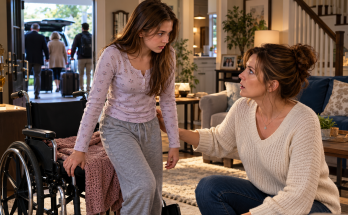
Claire moved again three years after the first morning Maya stood in front of her.
Not because of Mark.
Not because of court.
She had accepted a job in another city.
Smaller apartment.
Better commute.
More sunlight.
Maya volunteered to help.
Then complained about every box.
“You own too many mugs.”
Claire looked offended.
“You gave me three.”
“Then I am part of the problem.”
“Yes.”
They packed the kitchen last.
Maya stood near the island.
Different apartment.
Different counter.
But the posture of the room pulled memory forward.
Claire noticed.
“What?”
Maya shook her head.
“Nothing.”
“Your face says something.”
“You all learned that from me.”
Claire smiled.
Maya placed newspaper around a coffee mug.
Then said:
“Do you remember exactly what you thought when I stood up?”
Claire stopped packing.
“That morning?”
“Yes.”
“I thought you were going to fall.”
Maya laughed.
“Seriously?”
“Yes.”
“Not that Dad lied?”
“That came second.”
“What was third?”
“That maybe you were having some medical emergency.”
Maya smiled.
“Reasonable.”
Claire continued.
“Then you spoke.”
“And?”
“I thought my entire understanding of the house had just broken.”
That answer felt right.
Maya taped the box.
“Do you ever wish I hadn't told you?”
Claire stared.
“No.”
“Not even during divorce?”
“No.”
“Money?”
“No.”
“Court?”
“No.”
“Losing the house?”
“No.”
Claire stepped closer.
“I wish the truth had been different.”
Maya looked at her.
“That is not the same as wishing you hadn't told me.”
Good distinction.
Maya nodded.
The manuscript had become a book by then.
Not published yet.
Editing nearly complete.
Names changed where necessary except her own.
Legal review completed.
Medical details minimized where they did not serve the story.
No sensational title.
The publisher hated Maya's preferred title at first.
She insisted.
The title was:
I Was Already Standing.
Tessa loved it.
Sarah cried.
Daniel said:
“Legally unobjectionable.”
Which Maya considered high praise.
The book did not end with sentencing.
It did not end with Mark's apology.
It did not end with forgiveness.
It ended with a question.
Maya had been rewriting that final page for months.
She wanted something honest without becoming inspirational.
No rising sun.
No triumphant walk.
No claim that trauma made her stronger.
Sometimes trauma simply cost things.
She refused to turn loss into a gift.
The editor suggested ending with the morning she stood.
Circular.
Maya agreed partly.
But the last scene had to come later.
Years later.
When standing no longer mattered.
Claire closed another box.
“Are you nervous?”
“About publication?”
“Yes.”
“Terrified.”
“You can still stop.”
“I know.”
Maya smiled.
“That is why I'm not.”
Not because stopping was impossible.
Because it was allowed.
The book would release in six months.
Early reviewers had already asked questions.
Did Maya forgive Mark?
Was he mentally ill?
Did he have a disorder?
Was Sarah planning to sue?
Would Maya reconcile?
Maya refused all speculation.
The book contained actions.
Records.
Choices.
No amateur diagnosis.
No final verdict about someone's soul.
That mattered to her.
Mark had read no advance copy.
Maya decided not to offer one.
He would see the published version like everyone else.
That was not punishment.
It was authorship.
He no longer received privileged editorial access to Maya's story.
He did send one message through Daniel before publication.
I understand the book is yours. I will not respond publicly unless required for legal reasons.
Maya stared at it.
Then replied:
Thank you.
That was all.
No reconciliation.
No renewed relationship.
They had spoken only once since the final supervised conversation.
A phone call after Richard had minor surgery.
Practical.
Brief.
Maya asked how Richard was.
Mark answered.
No detours.
No apology.
No pressure.
It lasted four minutes.
Maybe that would be their relationship.
Maybe not.
Blank.
The criminal conviction remained part of Mark's life.
He found work again eventually, but not in the same leadership role.
He completed counseling.
Paid restitution.
Made no unauthorized statements about Maya.
Barbara said he changed.
Maya did not ask her to prove it.
Change belonged to Mark.
Trust belonged to Maya.
Separate things.
Sarah rebuilt her life around something other than the custody fight.
She worked.
Gardened badly.
Dated a man named Paul for six months, then ended it because he chewed too loudly.
Maya supported the decision wholeheartedly.
“You dumped him for chewing?”
“I dumped him because I didn't like him enough to tolerate chewing.”
“Reasonable.”
Their relationship became mother-daughter rather than rescue-and-return.
They fought about holidays.
Money.
Maya forgetting to call.
Sarah buying unnecessary kitchen gadgets.
Ordinary intimacy.
Barbara and Maya developed something cautious.
Monthly lunch occasionally.
No automatic holidays.
No medication conversations unless Maya raised them.
Barbara never touched Maya's medical information again.
That boundary remained absolute.
Richard aged into his role as provider of vegetables and unsolicited household advice.
He once tried to reorganize Maya's tool drawer.
She threatened legal action.
He stopped.
Claire remarried years later.
Small ceremony.
Maya attended.
Mark did not.
No one discussed him.
That mattered.
Tessa remained Tessa.
Insufferable.
Loyal.
Still convinced Maya's book needed a more dramatic title.
Maya ignored her.
The book's publication week arrived.
Interviews were controlled.
No live ambushes.
No medical sensationalism.
Maya declined television programs that wanted dramatic reenactments.
Accepted one long-form interview focused on patient voice and records.
The interviewer asked:
“Do you think your father loved you?”
Maya answered:
“Yes.”
The interviewer looked surprised.
“And yet he did what you describe.”
“Yes.”
“How do you reconcile that?”
“I don't.”
Silence.
Maya continued.
“I don't think love automatically makes behavior safe.”
That was enough.
Another question:
“What would you say to people who think your father was only trying to protect you?”
Maya thought.
“Protection should survive being questioned.”
The interviewer paused.
“If someone cannot ask why, cannot say no, cannot seek another opinion, and cannot leave when capable of leaving, then protection needs another name.”
No speech.
No label.
Just criteria.
The interview ended.
The book came out.
Some people believed every word.
Some doubted parts.
Some defended Mark.
Some attacked Sarah.
Some called Maya brave.
Some called her ungrateful.
The internet did what the internet did.
Maya read comments for one day.
Then stopped.
The most important responses arrived privately.
Patients.
Parents.
Doctors.
Teachers.
One father wrote that he had begun asking his disabled adult son directly before answering questions for him.
One mother wrote that the book made her realize her daughter's independence frightened her because caregiving had become her identity.
A doctor wrote that he changed his note template to separate patient report from caregiver report.
A teacher wrote that her district now required direct student participation in homebound planning whenever possible.
Those mattered.
Not because Maya had become a symbol.
Because specific practices changed.
Still, she refused the role of universal example.
In interviews she repeated:
My story does not mean parents are untrustworthy.
My story does not mean fluctuating illness is fake.
My story does not mean wheelchairs equal oppression.
My story does not mean every disagreement is abuse.
My story means one person's account should not become reality without continued checking when the person being described can speak for themselves.
That complexity frustrated some audiences.
Good.
Reality had frustrated Maya for years.
They could tolerate it too.
One year after publication, Maya returned to Claire's new apartment.
They made coffee.
Sat at the kitchen counter.
Claire had kept one old mug from the house.
Maya recognized it.
The mug Claire had been holding the morning Maya stood.
“You kept that?”
Claire looked embarrassed.
“I like the mug.”
“Liar.”
“It is a good mug.”
Maya took it.
Small chip near the handle.
Blue glaze.
Nothing magical.
She set it down.
Claire asked:
“Do you ever think about what would have happened if you didn't stand up that morning?”
Maya looked at her.
Mark had answered that once.
Guardianship.
Continued medication.
Wheelchair.
Maybe forever.
For years, that counterfactual terrified her.
Now it felt less useful.
“I used to.”
“And?”
“I think I asked the wrong question.”
Claire waited.
Maya looked toward the window.
“The real question wasn't what would have happened if I didn't stand.”
“What was it?”
“What happened because I did.”
Claire smiled.
Maya shook her head.
“That sounds too inspirational.”
“It does.”
“Terrible.”
They laughed.
Then Maya became serious.
“I stood before.”
“Yes.”
“Lots of times.”
“Yes.”
“I told people before.”
“Yes.”
“I tried before.”
“Yes.”
“So that morning wasn't special because I was suddenly brave.”
Claire nodded.
“It was special because something finally connected.”
Maya thought.
“You saw.”
“Yes.”
“And believed enough to check.”
“Yes.”
“And then other people saw.”
“Yes.”
Witness.
Not miracle.
That remained the word.
Later, Maya went home.
Her own home now.
Not Sarah's.
A small apartment filled with books, plants she frequently forgot to water, and furniture she chose badly.
She placed the book on a shelf.
Not prominently.
Between two novels.
Then she made dinner.
Burned the onions.
Ordered takeout.
Normal failure.
Her phone rang.
Sarah.
“Did you eat?”
“Yes.”
“What?”
“Food.”
“Maya.”
“Why are you asking?”
“Because I am your mother.”
Maya smiled.
“Takeout.”
“What kind?”
“Thai.”
“Good.”
No interrogation.
No location check.
No medical interpretation.
Then Barbara called.
Maya ignored it because she was eating.
Called back later.
Richard texted a photo of a tomato he considered unusually impressive.
Claire sent a picture of the old coffee mug.
Tessa sent a terrible review of Maya's book with one star and the comment:
Too many feelings. Needs car chase.
Maya laughed.
The evening filled with small contacts.
Chosen.
Mutable.
Ordinary.
Before bed, Maya opened the manuscript file one last time.
The published version was final.
But her working document remained.
Revision history visible.
Thousands of changes.
Deleted explanations.
Rewritten scenes.
Questions.
Corrections.
Uncertainty.
At the bottom, after the official final paragraph, she had once written a private note to herself.
Do not let the ending pretend everything is fixed.
She smiled.
Everything was not fixed.
Her relationship with Mark remained limited.
She might never forgive him.
She might.
Barbara might disappoint her again.
Sarah might overstep.
Maya might become ill.
Need help.
Make terrible decisions.
Change careers.
Stop writing.
Write forever.
Nothing guaranteed.
Exactly right.
She added one final private sentence.
Not for publication.
For herself.
I am allowed to revise.
Then closed the file.
The next morning, Maya woke with a sore throat.
Her first reaction was fear.
Body memory.
Then irritation.
Then common sense.
She checked her temperature.
Normal.
Drank water.
Went back to bed.
Texted work that she would be late.
No catastrophic story.
No permanent label.
No one else deciding what the symptom meant before she did.
At noon, she felt better.
She stood in the kitchen.
Bare feet on cool tile.
Glass of water in her hand.
No audience.
No camera.
No one to prove anything to.
For one second, she remembered being fifteen.
Then seventeen.
Then eighteen.
The wheelchair.
The dock.
The courtroom.
The school.
The trust.
The book.
All of it.
Then the refrigerator hummed.
A car passed outside.
Maya drank the water.
Nothing happened.
And that was the true outcome.
Not that Maya proved she would never need help.
Not that every person who failed her became good.
Not that the past disappeared.
The central conflict ended because Mark no longer controlled the facts of Maya's life, her medical decisions, her relationships, her money, her records, or the meaning of her voice.
The important clues had resolved.
Her original illness had been real.
Her recovery had also been real.
Medication had worsened some later symptoms but did not explain everything.
Mark had known she could walk and speak long before he admitted it.
He had restricted Sarah because Maya's independence threatened custody and control.
He had exaggerated limitations to maintain benefits, reputation, financial support, and authority.
He had pursued guardianship while knowing Maya could make decisions.
Kessler had not invented the scheme but had compromised documentation and failed to protect his patient's voice.
Barbara had known and chosen her son.
Richard had known enough and stayed silent.
Claire had been deceived and then became the first person Maya trusted who checked instead of explaining her away.
Sarah had never abandoned her.
And Maya had never suddenly become capable the morning she stood.
She had already been capable.
What changed was that the truth finally escaped the room with her.
Years later, the legal cases were closed.
The records were corrected.
The trust was reformed.
Restitution was paid.
Mark lived with consequences and remained at the distance Maya chose.
Sarah remained her mother.
Claire remained family.
Barbara and Richard remained complicated.
Maya remained herself.
Not cured as a symbol.
Not broken as a symbol.
Not inspirational as a symbol.
A person.
Sometimes strong.
Sometimes tired.
Sometimes certain.
Sometimes wrong.
Allowed all of it.
She rinsed the glass.
Placed it on the drying rack.
Then left the kitchen without thinking about whether anyone had seen her walk away.
The End
Read more original stories on Feel Every Story.

One Comment on “PART 47 – Years After That Morning in the Kitchen, Maya Returned to the Question That Changed Everything and Chose Her Own Answer”