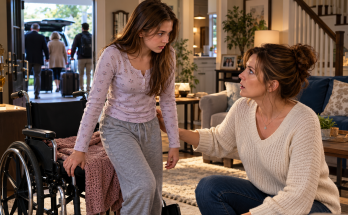
By spring, the manuscript had become a problem.
Not because Maya hated writing it.
Because she had started using it the way she once used her evidence notebook.
Every bad feeling went into the file.
Every memory.
Every old document.
Every unexpected fear.
If she had a dream about Mark, she wrote three pages.
If someone at school used the word unstable casually, she went home and wrote five more.
If Sarah asked whether she was tired, Maya sometimes heard Mark inside the question and wrote about that too.
The manuscript grew to nearly two hundred pages.
Tessa called it “the world's most organized nervous breakdown.”
Maya threw a pillow at her.
“Insensitive.”
“Accurate.”
Maya hated that it might be.
She showed the manuscript to her psychology professor, not because he was an editor, but because he was the only person she knew who could tell her something uncomfortable without turning it into a family emergency.
He read selected pages.
Then asked:
“What is this for?”
Maya frowned.
“To tell what happened.”
“That explains the subject.”
He tapped the stack.
“Not the purpose.”
She hated academic questions that sounded simple.
“I don't know.”
“Publication?”
“Maybe.”
“Personal record?”
“Partly.”
“Advocacy?”
“Maybe.”
“Trying to make sure nobody can ever rewrite it again?”
Maya stopped.
The professor watched her.
“That one?”
“Yes.”
He leaned back.
“Then you're still giving other people's future interpretations a lot of power.”
Maya looked irritated.
“If I leave things out, people can misunderstand.”
“They can misunderstand if you include everything.”
“That is not helpful.”
“No.”
He smiled.
“It is true.”
Maya went home angry.
Which usually meant someone had said something useful.
She opened the manuscript.
Read fifty pages.
The problem became obvious.
She had written every ambiguity as though resolving it permanently might protect her.
The exact medication sequence.
The exact legal language.
The exact dates of each provider.
Every caveat.
Every correction.
The work was becoming another file built around proving her credibility.
She closed it.
For two weeks, she did not write.
That frightened her.
Not because she missed the manuscript.
Because without writing, memories felt loose.
What if she forgot?
What if forgetting made the past less true?
Then one afternoon, she opened the box upstairs.
Notebook.
Photographs.
Medical summary.
Barbara's letter.
Richard's card.
The class schedule.
The ordinary childhood photo.
Physical evidence.
Records existed.
She did not have to hold every detail actively in her mind.
That had been Mark's trap too.
He made himself necessary by becoming the only person who supposedly knew everything.
Maya did not want to make her own memory another centralized system.
She could forget ordinary pieces and remain truthful.
That realization felt radical.
She returned to the manuscript.
Deleted thirty pages.
Then twenty more.
Tessa came over and found her grinning at the laptop.
“What?”
“I deleted fifty-two pages.”
“Finally.”
“You haven't even read them.”
“I support destruction.”
Maya laughed.
She began restructuring.
Part One:
What happened.
Part Two:
How people failed.
Part Three:
What repair looked like.
Part Four:
What uncertainty remained.
That last section mattered most.
She wrote:
I still do not know exactly how much of my later weakness came from medication, deconditioning, lingering illness, fear, or combinations of all four.
That sentence would once have terrified her.
Now it felt honest.
I do not know whether my father would have kept the guardianship forever.
He said maybe.
I believe he might have.
Belief and fact separated.
I do not know whether every person who failed me could reasonably have done more.
Some clearly could.
Others saw fragments.
I do not know what forgiveness means for me yet.
Good.
No forced ending.
Then Maya wrote one more uncertainty.
I do not know whether I will become ill again someday.
Her fingers stopped.
That was the fear beneath everything.
Not Mark.
Illness.
What if she lost strength again?
What if speech became difficult?
What if she needed a wheelchair?
What if Sarah became worried?
What if doctors doubted her?
What if dependence returned?
Would she become trapped inside the old story immediately?
She had avoided the question.
Recovery had become part of identity.
Freedom had become tied to function.
The irony was brutal.
Mark had once treated disability as permanent incapacity.
Maya sometimes caught herself treating ability as proof of personhood.
Both were wrong.
The neurologist had told her no current specialist care was necessary.
But no physician promised lifelong health.
Nobody could.
Maya closed the manuscript.
The next morning, she called the neurologist's office.
Not because symptoms had changed.
Because she wanted one appointment.
A conversation.
The doctor agreed.
Maya sat alone in the exam room.
No Sarah.
No Claire.
No one answering first.
“What is worrying you?” the neurologist asked.
Maya felt embarrassed.
“What happens if I get sick again?”
The doctor waited.
“Medically?”
“Everything.”
Maya looked at her hands.
“What if I need help again and I can't tell whether someone is helping too much?”
The neurologist understood.
“That is a reasonable fear.”
“I don't want to become the person who refuses care because it reminds me of Dad.”
“That would be another form of letting the past control treatment.”
Maya hated how accurate it was.
“What do I do?”
“Build systems while you are well.”
That sounded alarmingly like Mark.
Maya's expression must have changed because the doctor added:
“Systems you choose.”
Better.
They reviewed her advance directive.
Health proxy.
Privacy choices.
Patient portal access.
Second-opinion rights.
Medication documentation.
A note in the chart that direct patient communication should be prioritized even during future illness.
Maya asked:
“If I can't talk?”
“Your proxy speaks according to your stated preferences.”
“Mom.”
“Yes.”
“And if she starts answering things I could answer?”
The doctor smiled.
“Then I remind her whose appointment it is.”
Maya laughed.
She asked another difficult question.
“What if I need a wheelchair someday?”
The doctor looked confused.
“Then you use one.”
Maya stared.
“That simple?”
“Yes.”
“It wouldn't mean I failed.”
“No.”
“Wouldn't mean Dad was right.”
“No.”
“Wouldn't mean everything starts again.”
“No.”
Maya breathed out.
The chair had carried too much symbolism.
Maybe the final act of freedom was allowing herself to need one someday without shame.
The doctor said:
“Mobility equipment is a tool.”
“I know.”
“I suspect you know intellectually.”
Maya smiled.
“Annoying.”
“Occupational hazard.”
Daniel had infected everyone.
Maya left feeling lighter.
Not because illness became impossible.
Because dependence no longer felt identical to losing voice.
That evening, she added a passage to the manuscript.
Independence is not the permanent absence of need. If I ever need help again, the goal is not to prove I can do without it. The goal is that help remains accountable to me.
She stared.
Kept it.
The phrase became important outside the manuscript too.
Sarah asked whether Maya wanted help with taxes.
Maya said yes.
Then insisted on sitting beside her during every step.
They argued about deductions.
Sarah was wrong about one.
Maya was wrong about two.
Nobody became incapacitated.
Claire helped Maya compare transfer schools.
Not choosing.
Comparing.
Richard taught her how to replace a windshield wiper.
Barbara remained distant but exchanged short notes occasionally.
No reconciliation ceremony.
No grand reunion.
A slowly changing relationship.
Mark remained farther away.
One summer afternoon, Maya received a permitted message through Daniel.
Not from Mark.
From Mark's therapist, with Mark's written consent.
The therapist wanted to confirm whether a statement Mark hoped to make in a caregiver accountability group could reference “his daughter” without identifying details.
Maya laughed when she read it.
“He's asking permission.”
Daniel replied:
Yes.
The irony was not lost on either of them.
Maya asked to see the proposed sentence.
It read:
I confused being responsible for my daughter's care with being entitled to define her reality.
Maya sat with it.
Then answered:
He can use that sentence if I am not identified and no details are included.
Permission.
Specific.
Revocable.
The therapist confirmed.
No more.
Months later, Maya heard from Richard that Mark had spoken to the group.
She did not ask how it went.
She was not responsible for his rehabilitation either.
Her own life grew.
She transferred to the university whose campus she had toured with Tessa.
Not psychology.
Not public policy.
Writing.
With a minor in health communication.
Tessa accused her of becoming predictable.
Maya said:
“I contain multitudes.”
Sarah shouted from the kitchen:
“That's my line.”
Moving out became the next challenge.
Maya chose a shared apartment near campus.
Sarah pretended to be normal about it.
Failed spectacularly.
“You have renter's insurance?”
“Yes.”
“Smoke detector?”
“Yes.”
“Medication?”
“I take almost nothing.”
“First aid kit?”
“Yes.”
“Emergency contacts?”
“Mom.”
Sarah stopped.
Maya smiled.
“You're first.”
Sarah cried.
Maya regretted telling her.
“No crying in the apartment.”
“This is the house.”
“Preparing.”
Claire helped move boxes.
Richard brought tools.
Barbara sent kitchen towels only after asking.
Maya accepted.
Mark sent nothing.
Exactly right.
The first night alone in the apartment, Maya could not sleep.
No surveillance.
No Sarah nearby.
No old house sounds.
Her roommate was away visiting family.
Maya walked into the kitchen at two in the morning.
Poured water.
Then stopped.
The memory arrived.
Fifteen.
Walking into the kitchen.
Mark seeing.
The first lie he later admitted.
Maya stood there holding the glass.
Same action.
Different life.
She started laughing.
Then crying.
Then both.
No one came running.
No one labeled the reaction.
Eventually she went back to bed.
The next morning, she wrote:
A glass of water should never have become evidence.
Then:
Now it is just water.
That became the opening of the final section.
Her manuscript found a small publisher through an instructor.
Not a commercial deal yet.
An editor wanted to work with her on an essay collection first.
Maya agreed.
Slow.
Controlled.
No sensational title.
No photograph of a wheelchair.
No headline about a miracle recovery.
Her contract gave her approval over medical excerpts.
Daniel reviewed it once.
Then told her:
“Congratulations. Please stop making me read publishing contracts.”
She laughed.
The first essay appeared under Maya's name.
No pseudonym.
That decision frightened her.
But she wanted ownership.
She did not name Mark.
Not because she protected him.
Because the essay was not about him.
It was about source labeling in medical records.
One line received more attention than she expected:
A caregiver can be loving, informed, observant, exhausted, frightened, and still wrong.
Clinicians shared it widely.
Maya felt strange.
She had written something people used.
Not because she was tragic.
Because the idea mattered.
Then an email arrived from a seventeen-year-old girl.
No dramatic disclosure.
Just:
My mom always answers my neurologist before I do. I showed your essay to my doctor. At my next appointment, she asked my mom to wait outside for ten minutes. Nothing huge happened. But I got to answer first.
Maya read it three times.
That email affected her more than the publication.
She showed Sarah.
Sarah cried.
Naturally.
Maya let her.
Then Maya responded carefully.
Thank you for telling me. I am glad you got space to speak. I cannot know what is best in your situation, but I hope the adults around you keep making room for your voice.
No heroics.
No advice to rebel.
No assumption every mother was Mark.
That mattered.
The story was becoming useful without becoming universal.
One afternoon, Maya visited the old county office to retrieve a certified copy of a corrected record.
The same building where she once sat terrified before investigators.
The receptionist did not recognize her.
Good.
Maya waited under fluorescent lights.
A father sat nearby with a teenage boy in a wheelchair.
The father spoke to the receptionist.
The boy rolled his eyes.
Ordinary.
Maya smiled.
Not every chair was a trap.
Not every involved parent was controlling.
Not every disagreement was abuse.
Her story did not get to swallow other people's either.
The clerk called:
“Maya Bennett?”
She stood.
Walked to the counter.
Received the document.
Signed.
Then left.
Outside, she looked at the paper.
She no longer needed it urgently.
That was the point.
She folded it into her bag.
Her life no longer depended on proving itself every morning.