The document stayed one sentence for three weeks.
Maya opened it almost every night.
Added nothing.
Closed it.
Then one Sunday morning, she wrote two pages.
Not the beginning of the illness.
Not the hospital.
Not Mark.
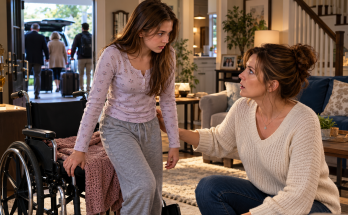
She started with coffee spilling across Claire's kitchen counter.
The morning she stood.
She wrote about the sound of her bare feet on hardwood.
Claire turning.
The look on her face.
The first sentence.
Please don't call him.
Maya stopped.
That opening felt too dramatic.
Then laughed.
It had been dramatic.
She had spent years rejecting clickbait versions of her life.
That did not mean the truth itself lacked tension.
She continued.
The strange part, she wrote, was not standing. I had stood many times before. The strange part was doing it where someone else could see and deciding not to sit back down when she looked frightened.
That sentence stayed.
She wrote about Claire.
Not as rescuer.
As witness.
A person who believed Mark until evidence changed her mind.
That mattered.
Maya did not want to replace one false narrative with another where Claire had always known.
Then Sarah.
Not abandoned mother.
Not perfect mother.
A woman who fought, compromised, lost, returned, and told the truth when it hurt her.
Barbara.
Love and betrayal.
Richard.
Silence and late courage.
Kessler.
Not cartoon villain.
Professional failure.
Mark.
Maya stopped.
The cursor blinked.
How do you write someone who loved you and harmed you without making one fact cancel the other?
She tried:
My father was afraid.
Deleted.
Too sympathetic.
My father was controlling.
Deleted.
Too flat.
My father lied.
True.
Insufficient.
My father loved me.
Also true.
Dangerous if left alone.
She closed the document.
At dinner, Sarah noticed.
“Writing?”
“How do you know?”
“You make the same face you made during algebra.”
“Rude.”
“What is the problem?”
“Dad.”
Sarah nodded.
Of course.
Maya explained.
“If I make him horrible from the first page, it isn't true.”
“No.”
“If I make him scared, people will excuse him.”
“Some might.”
“If I explain too much, it sounds like forgiveness.”
“Maybe.”
Maya glared.
“You are supposed to solve this.”
“I am not your editor.”
Maya groaned.
The next day, she asked her psychology professor.
Hypothetically.
“A person can have an understandable motive and still be responsible for harmful choices, right?”
The professor looked confused.
“That is not hypothetical.”
“Answer.”
“Yes.”
“Why do people act like explanation equals excuse?”
“Because moral stories are easier when motive and blame point in the same direction.”
Maya wrote that down.
Not because she would quote it.
Because it unlocked something.
She returned to the document.
My father did not begin by wanting me dependent. He began by being terrified that I would die. Later, when I improved, he discovered that my dependence had solved problems his fear had created. By the time he understood what he was doing, stopping required him to admit too many things he did not want to lose.
She stared.
Better.
Then:
Understanding that sequence does not make the choices less his.
There.
Mark could be comprehensible without becoming excused.
Maya wrote quickly after that.
Illness.
Recovery.
The first hidden walks.
Sarah's messages.
School.
Therapy.
Lake Norman.
Medication.
The trust.
Guardianship.
Claire's signature.
The secret videos.
The plea.
Sentencing.
But something felt wrong.
The draft still centered Mark.
Even when Maya tried to reclaim the story, every chapter turned around what he did.
She highlighted half the document.
Almost deleted it.
Stopped.
Maybe that was the problem.
The story of escape naturally began with the cage.
But the life after did not have to.
She created a second document.
After.
The first paragraph:
Nothing happened on Wednesday.
She laughed.
Then kept going.
Wednesday contained class.
Bad coffee.
Statistics.
A text from Tessa.
Sarah asking whether she wanted pasta.
Maya driving home.
No legal call.
No medical event.
No confrontation.
Nothing happened.
That was the point.
She wrote about normal days.
The school dance.
Driving lessons.
College applications.
Borrowing the car.
Barbara respecting boundaries.
Richard asking for tomatoes.
The panel.
The trust paying tuition.
The first time Maya needed help carrying boxes and asked without panic.
That document felt more alive.
Maybe there were two stories.
What happened.
What happened after.
Maya did not need to decide yet.
Revision rights.
One afternoon, Tessa read a few pages.
Maya watched her face too closely.
“Stop.”
“What?”
“Monitoring.”
“I am waiting for your reaction.”
“That is monitoring.”
“Fine.”
Tessa finished.
Then said:
“You make yourself sound calmer than you were.”
Maya looked offended.
“I was calm.”
“You once threw a notebook at a wall because Daniel said ‘context.’”
“That was a controlled expression.”
“Sure.”
Maya took the pages back.
Tessa was right.
Maya had polished herself.
Evidence discipline had become style.
Careful.
Qualified.
Measured.
But sometimes she had screamed.
Sometimes she hated Mark.
Sometimes she wanted every adult punished.
Sometimes she believed terrible things before evidence corrected them.
Sometimes she was petty.
She added those.
Not for drama.
For truth.
Sarah read a later section about their first weeks together.
“You make me look too good.”
Maya groaned.
“You too?”
“I made mistakes.”
“I wrote the custody settlement.”
“Yes.”
“You want more?”
“I once told you I knew what was best because I was your mother.”
Maya remembered.
They had argued after a doctor's appointment.
Sarah apologized within ten minutes.
Maya had forgotten.
“Why include that?”
“Because you are writing about autonomy.”
Fair.
Maya added it.
Claire objected to a different part.
“You said I immediately believed you.”
“I basically did.”
“No.”
Claire pointed.
“I believed what I saw. I did not immediately believe every explanation.”
Maya thought.
True.
She had taken Maya to the clinic because she believed enough to investigate.
Not because she instantly accepted every allegation.
Correction.
Barbara declined to read anything.
“I don't think I should influence how you write me.”
Maya respected that.
Richard offered only one comment.
“Make me less wise.”
Maya laughed.
“You became wise later.”
“I am still mostly tomatoes and avoidance.”
Fair.
She changed one scene.
Then Mark.
The question hung.
Should he read it?
Everyone gave different answers.
Sarah:
“No obligation.”
Claire:
“Maybe if you want factual corrections.”
Daniel:
“Depends whether publication is contemplated.”
Tessa:
“Absolutely not, he will become annoying.”
Maya laughed hardest at that.
She decided no.
Not yet.
This was not a deposition.
Not a negotiated statement.
Not a joint family record.
Her writing could contain perspective.
She would verify facts where necessary.
But Mark did not get editorial authority over how his choices felt to her.
That distinction mattered.
Then an email arrived from him through the old channel.
No request for contact.
No emotional message.
The subject:
Photographs found.
He had found another box of childhood pictures while moving.
Daniel asked if Maya wanted them.
“Yes.”
The folder contained ordinary life.
Birthday cakes.
Zoo trips.
School projects.
A camping trip.
Mark asleep on a couch while ten-year-old Maya drew on his face with washable marker.
She laughed so hard Sarah came upstairs.
“What?”
Maya showed her.
Sarah smiled despite herself.
“He always fell asleep anywhere.”
Maya looked at the picture.
Then another.
Mark teaching her to ride a bicycle.
His hand on the back of the seat.
Maya furious.
Another.
Her first volleyball game.
Mark holding a handmade sign.
GO MAYA.
She felt grief.
Not because she wanted him back in her life exactly.
Because before fear became control, something had existed that was worth losing.
Maya added a passage.
One of the hardest things about telling the truth is resisting the temptation to make the person who hurt you retroactively incapable of love. If I say my father never loved me, I make the story easier and less true. He loved me. That did not stop him from choosing control over me. Maybe that is why I need to tell it accurately.
She stared.
That might be the heart.
Not because love excused harm.
Because love did not automatically prevent it.
People needed to know that.
Especially caregivers.
Especially parents.
The document grew.
Twenty pages.
Then forty.
Maya started waking early to write.
Not obsessively.
Mostly.
Tessa accused her of becoming a writer.
Maya denied it.
The professor encouraged her to submit an essay to a student journal.
Maya said maybe.
The first piece she submitted was not the full story.
It was an essay about medical records and source labeling.
Technical.
Specific.
No names.
The title:
Who Said It?
The argument was simple.
Patient report.
Parent report.
Clinician observation.
Teacher observation.
Each should be labeled.
Merging them creates authority without accountability.
The journal accepted it.
Maya stared at the acceptance email.
Sarah screamed.
Maya threatened to withdraw the submission if she kept screaming.
Claire brought cake.
Tessa wrote WHO SAID IT? in icing.
Maya hated everyone.
The published essay received modest attention.
A few clinicians shared it.
A disability-rights group asked permission to link it.
Maya said yes.
A parenting blog asked to republish it with the headline:
Girl Escapes Years of Medical Lies and Teaches Doctors a Lesson.
Maya said no.
Very no.
The blog asked for a personal interview.
No.
They asked for a photograph.
No.
The difference was almost funny.
Maya wanted ideas to travel without surrendering herself with them.
Some outlets understood.
Others wanted the girl.
She stopped answering those.
One night, while editing the longer manuscript, Maya reached the end of Part One.
Mark's sentencing.
She had written everything through the courtroom.
Then stopped.
Where should the story of Mark end?
At conviction?
Too legal.
At their supervised conversation?
Too neat.
At his final explanation of why he stopped?
Maybe.
At the childhood photographs?
Too sentimental.
At the no-contact boundary?
Too procedural.
Maya walked downstairs.
Sarah was asleep on the couch.
Television still on.
Maya turned it off.
Covered her with a blanket.
Then went to the kitchen.
The room was different from Claire's old kitchen.
Different counters.
Different light.
But she remembered standing that first morning.
Bare feet.
Coffee.
Claire's face.
The moment she refused to sit back down.
Maybe Mark's version should end there.
Not chronologically.
Structurally.
The moment he lost exclusive control of the story.
Everything after was consequence.
Maya went upstairs.
She moved the opening passage.
Then wrote an ending to the first section.
For years, my father controlled the story because he controlled who could see me, who could speak to me, and what records followed me. The morning I stood in front of Claire, I did not become capable. I became witnessed.
She paused.
Then:
The rest took longer.
That was the transition.
Not ending.
Transition.
Maya saved.
At midnight, an email notification appeared.
Mark's channel.
Subject:
Correction request.
Maya froze.
He had not seen the manuscript.
What correction?
She opened it.
It concerned an old legal record Mark's attorney had discovered while closing files.
A custody filing stated Sarah had failed to appear at a hearing years earlier.
Mark now acknowledged the hearing notice had been sent to an outdated address despite his office having Sarah's newer address in another file.
Maya stared.
One more old distortion.
He was asking for permission to send the document directly to Sarah's attorney so the record could be corrected if appropriate.
No emotional commentary.
No excuse.
Maya almost laughed.
Even now, paperwork.
She forwarded it to Sarah.
Sarah replied:
Yes. Let them correct it.
Maya sent the authorization.
Then returned to her manuscript.
Another old record could be fixed.
But Maya no longer needed to add every correction to the story.
Some truths could simply be repaired and left behind.
She closed the laptop.
Tomorrow she would write about driving lessons.
Or the panel.
Or nothing.
The choice belonged to her.