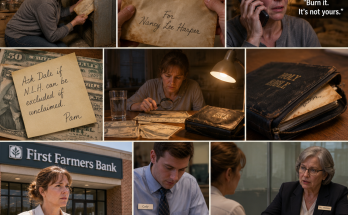
A year after I found the bonds, I stopped counting anniversaries.
Not because the date meant nothing.
Because I no longer wanted my life divided into before the basement and after it.
There had been a life before.
There would be one after.
The bonds belonged to the middle.
The legal cases had not all vanished.
Real consequences move slowly.
Martin ultimately resolved several of the strongest charges through a combination of plea agreements and contested proceedings.
Some accusations connected to events decades earlier remained unproved.
The archive labeled them that way.
Alleged.
Supported.
Unresolved.
No family certainty substituted for a court finding.
Eric’s cooperation helped recover additional funds, though not everything he moved.
He received his own sentence.
I read the summary once.
Then closed it.
He had become part of the record rather than part of my daily life.
That felt appropriate.
Dale served his sentence.
His restitution obligations continued beyond it.
When he eventually returned home under supervision, he did not return to management.
The governance documents would not have allowed it anyway.
He found work with a regional equipment-repair company after disclosing his convictions.
They hired him provisionally.
He wrote to tell me.
I replied:
GOOD.
Nothing more.
I did not call the employer.
I did not recommend him.
I did not warn them beyond what public records already showed.
I kept my promise.
His future belonged to him.
So did the work required to build it.
The old green truck Grandpa left him needed more repairs than it was worth.
Dale repaired it anyway.
Of course.
One Saturday he drove it to my house.
I heard the engine before I saw him.
The truck coughed into the driveway and stopped crooked.
I came outside.
“You know there are laws against noise.”
“It passed inspection.”
“That feels corrupt.”
“Different county.”
He looked older.
Not dramatically.
Just less certain of the space around him.
He stood beside the truck.
“I brought something.”
I pointed at him.
“No documents.”
He laughed.
“No documents.”
He opened the truck bed.
Grandpa’s old basement workbench.
I stared.
“How?”
“The buyers didn’t want it.”
“They bought the house furnished?”
“Some basement stuff stayed.”
“And they gave you this?”
“I asked.”
“Why?”
Dale shrugged.
“I thought you might want it.”
The scarred wooden top still carried paint marks.
A burn near one corner.
The vise Grandpa used to clamp pipe.
I ran my fingers over the edge.
For a moment I was back in the basement.
Dust.
Furnace heat.
The loose wall panel.
The envelope.
N.L.H.
Seventeen bonds.
Pam calling.
Dale asking whether I had gotten behind the furnace.
The entire story waiting behind one ordinary piece of paneling.
“Do you want it?” Dale asked.
I thought.
“No.”
He looked surprised.
“No?”
“No.”
“What should I do with it?”
“Do you want it?”
He looked at the bench.
“Maybe.”
“Then keep it.”
He nodded.
No argument.
He started closing the tailgate.
“Wait.”
“What?”
I pointed at the vise.
“That.”
“The vise?”
“Yes.”
“You want Grandpa’s vise but not the bench?”
“I have the toolbox.”
He unbolted it.
We spent twenty minutes fighting rusted hardware.
Dale swore.
I criticized his technique despite knowing less than he did.
Eventually the vise came free.
He set it in my garage beside Grandpa’s red toolbox.
“That all?”
“That’s all.”
He looked around.
“No secret compartments?”
“Leave.”
He laughed.
At the driveway, he stopped.
“Nancy.”
“Yes?”
“I am sorry about the three hundred dollars.”
I looked at him.
Not the forgery.
Not the inheritance.
Not the company.
The insult that started everything.
“I know.”
“I wanted you to feel small.”
“I know.”
“You didn’t.”
“I did, actually.”
That surprised him.
“For a little while.”
He looked down.
“I’m sorry.”
I nodded.
“Thank you.”
Forgiveness did not arrive like a verdict.
I never woke up thinking Dale was absolved.
I simply noticed one day that remembering him no longer tightened every muscle in my body.
Maybe that was enough.
The new company completed its first expansion on the retained portion of Tract C.
Forty-one new employees in the first phase.
Fewer than promised initially.
More than zero.
The logistics development on the sold acreage opened too.
Trucks moved through Junction Commerce Drive every day.
Nobody knew the road had once been part of a family war.
Good.
The employee ownership fund grew modestly.
Not magically.
Some years would be better than others.
Employees received reports.
Asked questions.
Complained.
Voted through their representatives.
Ordinary governance.
The best thing we built was not wealth.
It was friction.
Rules that made secrecy harder.
Independent signatures.
Multiple approvals.
Disclosure requirements.
Audit committees.
Conflict policies.
Systems designed on the assumption that decent people can make bad choices and frightened people can justify worse ones.
Grandpa trusted character too much when it suited him.
Then trusted nobody when it did not.
We chose something less dramatic.
Verification.
My sons continued refusing direct family-company roles.
My oldest changed jobs.
My youngest bought a house.
Neither asked the trust to pay for everything.
Neither was required to refuse it either.
When they wanted distributions available under the trust, they requested them openly.
Information first.
Choice second.
No moral test.
No loyalty oath.
No surprise.
I updated my estate plan annually.
They received copies.
The first year, my youngest called.
“Why did you send me eighty-six pages?”
“Because you’re a beneficiary.”
“I preferred ignorance.”
“Too bad.”
“Isn’t that deciding for me?”
“No. You may choose not to read it.”
He paused.
“That’s annoyingly consistent.”
“Thank you.”
He did read it eventually.
The archive became unexpectedly popular with local researchers.
Not because of the scandal alone.
Harper Industrial had employed generations of families.
Workers brought photographs.
Pay stubs.
Union newsletters.
Retirement watches.
Machine manuals.
Stories.
The archive expanded beyond the Harpers.
Exactly as it should.
One display included the seventeen bond dates beside corresponding disputed transactions.
Another explained the uncertainty around some interpretations.
The 17-at-age-17 story appeared with careful wording:
According to Peter Holloway’s recollection, relayed by his daughter Laura, Henry Harper associated the number seventeen with Nancy’s refusal at age seventeen to follow his preferred career path. No surviving document confirms that this alone determined the final number of bonds.
Perfect.
Story labeled as story.
Evidence labeled as evidence.
I loved that more than I should have.
Mrs. Whitaker retired.
We held lunch for her.
She insisted she had merely done her job.
I reminded her that her job included telling me not to sign anything my relatives put in front of me.
“Excellent banking advice generally,” she said.
Thomas attended.
He and Mrs. Whitaker argued about whether Grandpa had intentionally chosen certain bond denominations.
I left them to it.
Pam attended without tracking anyone.
As far as we knew.
Alan gave Mrs. Whitaker flowers.
Robert arrived on time.
I called him Dad twice without noticing.
The word had stopped feeling like a verdict.
It was simply becoming a relationship.
Not the one I should have had.
The one we had now.
He never asked me to forgive his disappearance.
I never told him it was fine.
It was not.
We built something anyway.
That taught me another thing my family had repeatedly failed to understand.
Repair did not require pretending the damage never happened.
Mom remained harder.
She was not alive to answer questions.
Her letter helped.
Her notebook helped.
Robert’s memories helped.
None could replace conversation.
I still got angry with her sometimes.
That surprised people when I admitted it.
Dead mothers are supposed to become sacred.
Mine did not.
I loved her.
She lied to me.
She was afraid.
She tried to protect me.
She deprived me of my father.
She preserved evidence.
She made mistakes.
All true.
I stopped forcing those facts to fight.
Grandpa became easier in the same way.
I could remember the man who paid my electric bill when I had almost nothing.
The man who remembered my coffee.
The man who hid bonds behind a furnace.
The man who forged corrective documents.
The man who manipulated an estate sale.
The man who delayed truth until everyone had built lives around lies.
The man who eventually admitted his choices were not his to make.
Love did not require editing him.
That may have been the final inheritance.
One autumn afternoon, Helen from the archive called.
“We’re changing the bond exhibit.”
“What’s wrong with it?”
“Nothing.”
“Then why call me?”
“We want to add audio.”
“Grandpa’s voicemail?”
“Possibly a short excerpt.”
I hesitated.
“Which part?”
She read the proposed section.
My intentions were often good.
That did not make the choices mine to make.
I sat quietly.
“That one.”
“You approve?”
“Yes.”
“Any concern about context?”
“Put the transcript around it.”
“Of course.”
“No inspirational quote treatment.”
She laughed.
“I promise.”
“Seriously.”
“No giant lettering.”
“Good.”
The exhibit opened quietly.
I visited a week later when nobody expected me.
A teenager stood listening to Grandpa’s voice through headphones.
She removed them and read the bond labels.
Then moved on to a display about plant workers.
No revelation.
No tears.
No knowledge that the woman standing six feet away was Nancy.
Perfect.
History did not need me hovering over it.
Outside, the weather had turned cold.
I drove home.
The three-hundred-dollar dining table had acquired another scratch.
I left it.
Grandpa’s vise sat mounted on a small work surface in the garage.
I used it badly but enthusiastically.
The red toolbox remained beneath it.
The mild coffee stayed in my kitchen.
These were the pieces I kept.
Not because they were most valuable.
Because I chose them.
The remaining original bonds stayed with the archive under permanent custody arrangements.
The redeemed ones existed only in records now.
Their money had become travel.
Dinner.
Shoes.
A washing machine.
Part of a ridiculous old table.
Things.
Experiences.
Nothing sacred.
That was probably healthy.
On the anniversary of Grandpa’s funeral, Dale asked whether I wanted to meet at the cemetery.
I said no.
He went anyway.
I visited another day.
Choice.
At Grandpa’s grave, I found no mysterious envelope.
Thank God.
Just grass.
Stone.
A few leaves.
I sat for ten minutes.
“I think we finished it.”
The statement sounded ridiculous spoken aloud.
There was no answer.
Good.
“I know you wanted me to find the bonds.”
Wind moved through the trees.
“I know you wanted Dale to panic.”
Nothing.
“I know you built the estate sale to force things into the open.”
Still nothing.
“And I know you didn’t know exactly what would happen.”
That mattered.
For a long time, I had imagined Grandpa as a chess player who anticipated everything.
He did not.
He prepared.
Manipulated.
Backed up records.
Placed clues.
But once I found the envelope, events escaped him.
Pam improvised.
Dale panicked.
Alan lied.
Robert returned.
Thomas fought.
My sons chose employee ownership.
I refused control.
None of that was Grandpa’s script.
That was why the ending belonged to us.
I touched the top of his headstone.
“You were right to leave evidence.”
A pause.
“You were wrong to leave us a maze.”
Both.
Always both.
I stood.
At the car, my phone rang.
My oldest.
“Where are you?”
“Cemetery.”
“Why?”
“Talking to a dead man.”
“Productive?”
“He listened better than usual.”
My son laughed.
“We’re at your house.”
“We?”
“Me, my brother, Dad, Alan, Pam.”
I stopped.
“Why?”
“Dinner.”
“At my house?”
“Yes.”
“Who invited you?”
“You did.”
“When?”
“Last week.”
I had forgotten.
“Fine.”
“Dale called too.”
“He can’t come tonight.”
“I know. He just wanted to say hi.”
“Did Pam let herself in?”
Silence.
“Tell Pam I changed the alarm code.”
Another silence.
Then my son shouted away from the phone, “SHE CHANGED THE CODE.”
I could hear Pam complaining.
I laughed.
“Twenty minutes.”
I drove home.
Cars filled the driveway.
Robert—Dad—was carrying groceries.
Alan stood at the grill.
Pam was arguing with my youngest about the alarm.
My oldest had brought dessert.
Nobody had matching information.
Nobody was coordinating a secret plan.
Nobody had hidden documents.
It was chaos.
Normal chaos.
Dad held up a bag of coffee.
“Dark roast.”
I stared at him.
“Leave.”
He laughed.
“I’m kidding.”
He pulled out mild roast.
“You’ve learned.”
“I’m trainable.”
We ate at the scratched oak table.
Conversation moved everywhere.
Work.
Weather.
The plant expansion.
My son’s house.
Alan’s cabinet repair.
Mrs. Whitaker’s retirement trip.
Thomas’s latest argument with the archive.
At one point Pam mentioned Grandpa.
Nobody froze.
That was new.
Later, after everyone left, I cleared plates.
Dad stayed to help.
“You don’t have to.”
“I know.”
He washed.
I dried.
At the door he said, “Good night, Nancy.”
“Good night, Dad.”
This time I noticed.
Still said it.
He smiled.
Then left.
I locked the door.
Not because I was afraid of family breaking in.
Because locking the door at night is normal.
That distinction mattered.
I walked into the kitchen.
The house was quiet.
On the table lay one piece of paper.
For half a second, my body reacted.
Another note.
Another clue.
Another secret.
I picked it up.
Grocery receipt.
Pam had left it.
I laughed so hard I had to sit down.
There was no message on the back.
I checked anyway.
Then laughed harder at myself.
The next morning I threw it away.
That may sound insignificant.
It was not.
For a year, paper had meant evidence.
Handwriting meant danger.
Numbers meant theft.
Phone calls meant revelations.
Silence meant someone was hiding something.
Eventually ordinary things had to become ordinary again.
That was the part nobody puts in stories about inheritance.
After the discovery.
After court.
After money.
After betrayal.
You still have to live in a kitchen where a receipt is sometimes just a receipt.
I made coffee.
Mild roast.
Sat at my three-hundred-dollar table.
Opened my bank statement.
Not Grandpa’s.
Mine.
The trust statement was available separately.
I could look later.
Nothing required immediate action.
Outside, morning light moved across the yard.
I thought about the woman who entered Grandpa’s basement expecting three hundred dollars.
She had believed she knew her family.
Then believed she knew nothing.
Both beliefs were wrong.
She knew pieces.
Everyone did.
The problem was that each person had treated their piece as permission to control the whole story.
The seventeen bonds changed that.
Not because they made me rich.
Not because they proved Grandpa was right.
Not because they defeated Dale.
They forced separated truths into the same room.
Raymond had stolen.
Dale had expanded the theft and forged documents.
Martin had weaponized Peter’s history and other people’s fear.
Eric had exploited every weakness he could find.
Grandpa had protected evidence while controlling people.
Mom had loved me while lying to me.
Dad had survived while choosing absence.
Pam had protected people through surveillance and forgery.
Alan had obeyed promises he should have broken.
Thomas had preserved records while crossing legal lines.
Robert Ellis had taken money for silence and signature samples.
And I had inherited enough power to repeat the pattern if I wanted.
That last part mattered most.
Once the records were mine, I could have become the next person who believed knowing more entitled me to decide more.
I could have taken control.
Punished everyone.
Locked the wealth into another secret structure.
Made my sons carry it.
Called all of that justice.
Instead, my sons said no.
Employees received a voice.
Independent directors received authority.
Dale kept what was legitimately his and lost what was not.
My trust received what could be established.
Lenders were protected where law and fairness required.
Records went into an archive.
Uncertainty stayed labeled uncertainty.
And the future stopped belonging to whichever Harper held the strongest key.
I finished my coffee.
The red toolbox waited in the garage.
Grandpa’s hardware-store list remained inside.
I could have framed it.
I did not.
It stayed where a hardware-store list belonged.
Among tools.
I had no idea whether Grandpa would approve of everything we did.
He would probably hate the independent board.
He would complain about the road name.
He would think I sold too much land.
Or too little.
He would object to some archive disclosures.
He would insist his method had been necessary.
Then maybe, if he was being honest, he would admit that was exactly why he could not be the one deciding anymore.
I did not need his approval.
That realization came quietly.
No dramatic music.
No courtroom.
No envelope.
I simply knew it.
The inheritance was not the seventeen bonds.
It was not Tract C.
Not the trust.
Not the settlement.
Not the shares.
Not even the truth.
Truth can become another weapon if the person holding it believes it grants authority over everyone else.
The inheritance I kept was simpler.
Information without obedience.
History without destiny.
Money without ownership of other people.
Love without permission to control.
And the right to say no.
At seventeen, I had used that word because I wanted a library job.
Grandpa remembered.
Decades later, seventeen bonds brought the same lesson back to a family that had spent generations avoiding it.
No.
No, you cannot forge my name because you think you know what protects me.
No, you cannot hide my father because truth is inconvenient.
No, you cannot steal property because someone once promised you a future.
No, you cannot use another person’s grievance as permission for your own crime.
No, you cannot make my sons inherit a role they never chose.
No, you cannot call control love and expect the word to change what control does.
And no, finding the truth does not mean I have to become the next person who owns everyone else’s choices.
I stood and carried my cup to the sink.
My phone buzzed.
A message from my youngest.
DINNER SUNDAY?
I replied:
YES.
Then another.
CAN GRANDPA ROBERT COME?
I looked at the screen.
Grandpa Robert.
My sons had chosen their own name for him.
Their own relationship.
I smiled.
YES.
A final message:
PAM TOO?
I typed:
ONLY IF SHE LEAVES ALL TRACKING DEVICES AT HOME.
Three laughing reactions appeared.
I set the phone down.
Outside, the day had fully started.
There were bills to pay.
Groceries to buy.
A dentist appointment I had already postponed once.
The washing machine Grandpa’s bond helped buy was making a noise I did not like.
I would probably call a repairman.
Normal problems.
Normal decisions.
Mine.
I thought once more about that first envelope.
N.L.H.
My maiden initials.
Grandpa had written them carefully.
He wanted me to know the bonds belonged to me.
It took me much longer to understand the more important part.
Because they belonged to me, I was allowed to decide what they meant.
I did not owe Grandpa the ending he imagined.
I did not owe Dale the fight he expected.
I did not owe my sons an inheritance shaped like an obligation.
I did not owe the Harper name another generation of secrecy.
I had gone into the basement because my cousin offered me three hundred dollars to clean out what everyone else wanted thrown away.
I came out carrying seventeen old bonds.
For a while, I thought I had found a fortune.
Then I thought I had found proof.
Then betrayal.
Then a family history.
Eventually I understood that I had found a choice.
And for the first time in a very long Harper story, the person given that choice was allowed to make it for herself.
I did.
The End
Read more original stories on Feel Every Story.
Three Hundred Dollars for a Basement Nobody Wanted to Enter Became the Cheapest Mistake My Cousins Ever Made
Part 35 of 35