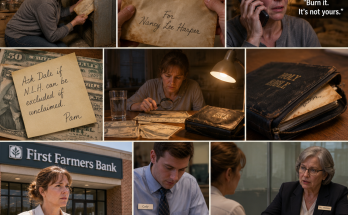
Dale’s last message stayed on my phone longer than it deserved.
SO DID I.
Three words.
No argument.
No excuse.
No request that I answer.
I put the phone facedown beside my coffee and tried to enjoy the fact that one question had finally produced an answer without exposing another shell company.
That lasted until breakfast.
My oldest son came through the kitchen, saw the photograph of the seventeen bonds still open on my laptop, and asked, “So that’s really why there were seventeen?”
“Maybe.”
“Maybe?”
“Peter remembered Grandpa saying it.”
“That sounds pretty convincing.”
“It’s convincing as a family story. That’s different from proving it.”
He poured coffee.
“Mild roast?”
“Don’t start.”
He grinned.
Then he asked the question I had somehow avoided.
“What happened when you were seventeen?”
“I told Grandpa I wasn’t working at Harper Industrial.”
“I know that part.”
“What else do you want?”
“What made it important enough that he remembered it decades later?”
I opened my mouth.
Nothing came out.
The memory I had carried was simple.
Grandpa wanted me at the company.
I wanted the library.
We argued.
I won.
Except family memories rarely stayed simple once someone asked where the edges were.
“I don’t remember.”
My son leaned against the counter.
“That means you don’t remember, or you don’t want to?”
“Careful.”
“Fair.”
He took his coffee and left.
But the question remained.
That afternoon I drove to the archive.
Not because I expected another revelation.
I wanted to see the timeline from 1984 through 1985.
If seventeen mattered to Grandpa, perhaps something in that period explained why.
The historian, Dr. Helen Marsh, was cataloging correspondence from the succession collection.
She had developed the useful habit of refusing to treat my curiosity as an emergency.
“I’m looking for anything from the summer I was seventeen.”
“Year?”
I told her.
“Subject?”
“Me refusing a job at Harper Industrial.”
She glanced over her glasses.
“That is impressively specific compared with where we started.”
“I’m improving.”
“Debatable.”
She searched the catalog.
There were three relevant folders.
Grandpa’s calendars.
Personnel notes.
Correspondence with Thomas.
No secret envelope.
No warning written in red.
Just records.
Grandpa’s calendar contained an entry on June 3:
NANCY — OFFICE SUMMER?
June 6:
NANCY SAID NO.
Nothing else.
I laughed.
“That’s it?”
Helen smiled.
“Apparently he documented rejection efficiently.”
The personnel folder contained a blank summer employment form with my name typed at the top.
Department:
ACCOUNTING / INVENTORY.
Supervisor:
T. REED.
Thomas.
I called him.
“You were supposed to supervise me?”
He groaned.
“Henry’s summer project.”
“What project?”
“You.”
“That sounds ominous.”
“It was.”
He remembered immediately.
Grandpa wanted me learning basic company records.
Invoices.
Inventory.
Purchase orders.
Nothing executive.
Nothing glamorous.
“Why?”
“Henry said you noticed discrepancies.”
“At seventeen?”
“You noticed when numbers didn’t match.”
“That sounds like every person who can subtract.”
“You’d be surprised.”
“What did I notice?”
Thomas went quiet.
“I don’t remember exactly.”
I knew that tone.
“You do.”
“I remember part.”
“Thomas.”
“You found duplicate equipment numbers.”
I sat straighter.
“Where?”
“On paperwork at Henry’s house.”
I had no memory of that.
“Why was company paperwork at his house?”
“He took work home.”
“What did I say?”
“You asked why two forklifts had the same serial reference but different purchase prices.”
My skin prickled.
“Was that connected to Raymond?”
“Yes.”
There it was.
The summer job had not merely been Grandpa trying to drag me into the family business.
I had accidentally noticed evidence.
“What happened after I asked?”
“Henry dismissed it.”
“Of course.”
“He told you it was probably a clerical mistake.”
“Was it?”
“No.”
“Then he offered me a job.”
“Yes.”
“To teach me accounting?”
Thomas hesitated.
“Partly.”
“What was the other part?”
“To see what else you noticed.”
I stared at the archive wall.
Grandpa had wanted to use my attention.
At seventeen.
Not maliciously, perhaps.
But deliberately.
“Did he tell me that?”
“No.”
“So I thought he was planning my future.”
“Probably.”
“And I told him no.”
“Yes.”
Thomas sounded amused.
“You were spectacularly unimpressed by Harper Industrial.”
“I remember that.”
“You said the place smelled like hot metal and men who shouted into telephones.”
I laughed.
“That sounds like me.”
“It did then too.”
“What happened to the duplicate forklift records?”
“Henry investigated.”
“And?”
“They linked to one of Raymond’s vendor arrangements.”
The timing suddenly made sense.
Grandpa remembered my refusal because it had done more than assert independence.
I had noticed something adults had been trained not to question.
Then refused to become part of the system that wanted to absorb me.
“Did Grandpa ever tell you that was why seventeen mattered?”
“No.”
“So Peter’s version is still just Peter’s version.”
“Yes.”
“But plausible.”
“Very.”
I thanked him.
Before hanging up, Thomas said, “Nancy.”
“Yes?”
“Henry was proud of you.”
I did not answer immediately.
“He was furious.”
“Those conditions coexisted comfortably in Henry.”
That sounded right.
Helen found another item.
A letter Grandpa wrote to Peter years later.
Not the original.
A photocopy Laura had recently supplied.
Grandpa described my refusal.
No mystical language.
No declaration that seventeen would become a sacred number.
He wrote:
Nancy said no to me today and took the library job. I was angry because she was right. I had decided what would be good for her before asking what she wanted.
I read it again.
“How old is this?”
“Same week.”
Grandpa knew.
Even then.
That surprised me more than if he had learned the lesson at eighty.
He understood the problem when I was seventeen.
He simply kept repeating it.
That was harder.
People like to imagine harmful patterns continue because nobody recognizes them.
Sometimes they continue because recognition is easier than change.
The letter continued:
She also found Raymond’s duplicate equipment entries without knowing what they meant. Perhaps distance from this company lets her see it better than those of us inside it.
There it was.
Distance.
Grandpa had noticed something important.
Then ignored his own insight for decades by continuing to pull everyone into the same struggle.
I asked Helen for a copy.
“For personal use?”
“Yes.”
“Archive copy stays?”
“Of course.”
On my way out, I saw Laura.
She had come to review another batch of Peter’s papers.
I showed her the letter.
She smiled.
“Dad talked about that.”
“My library job?”
“Your grandfather told him you escaped.”
“I worked eight weeks shelving books.”
“To them, apparently that qualified as escape.”
Fair.
“Did Peter know why Grandpa picked seventeen?”
“Dad believed he did.”
“Believed?”
“He never said Henry formally declared it.”
“Good.”
“You sound relieved.”
“I’m tired of turning every memory into evidence.”
Laura nodded.
“My father would approve.”
We sat in the archive reading room.
For a while neither of us spoke.
Then Laura said, “You know Peter wasn’t brave all the time.”
“I never assumed he was.”
“He ran.”
“So did Robert.”
“He let Martin frighten him for years.”
“So did everyone.”
“He sometimes wanted revenge.”
“That sounds human.”
She looked at me.
“I’m telling you because archives make dead people look cleaner than they were.”
That sentence deserved its own plaque.
“Then we should put the mess in.”
“Some of it.”
“Enough.”
She agreed.
The archive had become one of the few parts of this entire experience I trusted precisely because it did not demand a neat conclusion.
The following week brought a less philosophical problem.
The employee fund had received its first distribution.
Some workers wanted cash.
Others wanted reinvestment.
A few believed the twelve-percent interest meant they should receive enormous immediate checks because local news had repeated valuations of the company without explaining debt.
Carl Benton called me.
“People are confused.”
“I don’t run the fund.”
“I know.”
“Good.”
“But your sons donated the interests.”
“They elected to direct them there.”
“You know what I mean.”
“What do you need?”
“Nothing from you.”
That surprised me.
“I wanted to tell you before someone asks you to intervene.”
“And you don’t want me to.”
“No.”
I smiled.
“You’re learning how to motivate me.”
He laughed.
The employee trustees held their own meeting.
They explained valuation.
Debt.
Vesting.
Distributions.
Voting rights.
I did not attend.
My sons did not attend.
Dale obviously could not.
The workers handled it.
That may have been the strongest proof the restructuring worked.
A Harper problem occurred without requiring a Harper solution.
Two days later Carl called again.
“Meeting went fine.”
“Good.”
“That’s all.”
“Carl?”
“Yes?”
“Thank you.”
“For what?”
“For not needing me.”
He laughed so hard he coughed.
That evening Robert came for dinner.
Not a family summit.
Just dinner.
He arrived at 6:02.
Two minutes late.
“I considered calling.”
“For two minutes?”
“You’ve become strict.”
“Trauma does that.”
He accepted the joke carefully.
We ate at the three-hundred-dollar table.
He ran his fingers over the repaired edge.
“Henry would have fixed this better.”
“Henry had seventy years of practice.”
“He would have complained about whoever repaired it.”
“That was me.”
“Then I withdraw the comment.”
My sons laughed.
After dinner, Robert helped carry plates.
I asked him about being seventeen.
“What?”
“Me.”
“You were difficult.”
“I mean the library job.”
“Oh.”
He remembered hearing about it through Grandpa.
“Henry called me.”
“Where were you?”
“Still hiding.”
“You spoke regularly?”
“Sometimes.”
“What did he say?”
“That you refused the plant.”
“Was he angry?”
“Yes.”
“Proud?”
“Yes.”
“Thomas said that.”
Robert dried a plate.
“He said you were the first one who didn’t seem to need Harper Industrial to tell you who you were.”
That landed differently coming from him.
“Did you?”
“Need it?”
“Yes.”
He thought.
“For a while.”
“And Grandpa?”
“Absolutely.”
“Dale?”
“Yes.”
“Raymond?”
“Yes.”
“Alan?”
“No.”
“Pam?”
“Pam needs information the way other people need oxygen.”
I laughed.
Accurate.
“And me?”
Robert looked at me.
“You spent decades outside it.”
“Because I didn’t know.”
“Partly.”
That was fair.
Then he said, “You could have taken control when you finally had the chance.”
“I didn’t want it.”
“Exactly.”
I looked at him.
Maybe the most important thing about the bonds was not that they revealed ownership.
It was that ownership arrived after I had already built a life without it.
Money could change that life.
It did not have to replace it.
Before Robert left, he stood near the front door.
“Nancy?”
“Yes?”
“I need to ask something.”
I waited.
“Would you be comfortable if I told people you’re my daughter?”
The question hit me strangely.
“You’ve been telling people I’m your daughter for fifty years?”
“Not really.”
“Why ask now?”
“Because I don’t want to decide what relationship we have without asking.”
Grandpa’s voicemail echoed.
Every time I loved someone, I found a reason to decide for them.
Robert had learned too.
“Yes.”
He nodded.
“But,” I added, “don’t turn me into your redemption story.”
His expression tightened.
“I won’t.”
“I’m serious.”
“I know.”
“You surviving doesn’t make what happened beautiful.”
“I know.”
“You coming back doesn’t repair the years.”
“I know.”
“You can say I’m your daughter.”
He swallowed.
“Thank you.”
That was enough.
After he left, my youngest son asked, “Do you think you’ll ever call him Dad?”
“I don’t know.”
“That bother you?”
“No.”
It surprised me that I meant it.
Some questions did not require deadlines.
A month later the first retained Tract C expansion plan was approved.
The company would lease the land from the trust at independently reviewed market rates.
No sweetheart deal.
No family discount.
No hidden option.
The employee board representative voted yes.
The independent directors voted yes.
The trust representative abstained because of related-party concerns.
I liked the abstention almost as much as the approval.
The development projected forty-eight initial jobs, potentially more later.
Not sixty.
The original estimate had been optimistic.
Another small victory for ordinary truth.
The logistics developer began construction on the sold portion.
The first time I drove past, earthmovers were cutting roads across land that had existed in family arguments longer than I had understood.
I expected grief.
Instead I felt curious.
Land changed.
Companies changed.
Ownership changed.
Maybe permanence had been another family illusion.
That night Dale sent another approved message.
DID THEY START DIGGING?
YES.
FEELS WEIRD.
YES.
GRANDPA WOULD COMPLAIN ABOUT THE ROAD ALIGNMENT.
DEFINITELY.
Then:
THANKS FOR NOT SELLING ALL OF IT.
I stared.
I could have ignored him.
Instead I wrote:
THANK MY SONS, EMPLOYEES, TRUSTEE, BOARD, AND YOUR IDEA TO SPLIT IT.
His reply came quickly.
THAT IS AN ANNOYINGLY LARGE NUMBER OF PEOPLE.
I smiled.
EXACTLY.
That was the point.
No single decider.
No throne.
A week later, the archive requested permanent permission to display digital images of all seventeen bonds.
I signed.
Then hesitated over the original envelope.
It was still mine.
Dust-stained.
Grandpa’s N.L.H. on the front.
I had imagined eventually bringing it home.
Instead I signed a permanent donation.
The historian looked surprised.
“You’re sure?”
“Yes.”
“You could keep it.”
“I know.”
“Why donate it?”
“Because I don’t need to hide it.”
She accepted the form.
No ceremony.
I walked out lighter.
That evening, I opened the old Bible that had once hidden the bonds after I found them.
The cracked leather cover had been replaced after the break-in.
The Bible itself survived.
Mom’s church programs remained inside.
One fell onto the floor.
I picked it up.
On the back, in my mother’s handwriting, was a grocery list.
Milk.
Eggs.
Coffee.
Apples.
At the bottom:
Call Nancy Sunday.
Nothing else.
I sat on the edge of my bed holding it.
Not every surviving scrap needed interpretation.
Maybe Mom had called.
Maybe she had forgotten.
Maybe we talked about nothing.
I put the program back.
No archive.
No forensic scan.
No question for Pam.
It belonged in the Bible.
That night I slept without dreaming about documents.
In the morning, an email from Evelyn waited.
Annual trust review.
Ordinary.
Scheduled.
Transparent.
I opened it with coffee.
Assets.
Distributions.
Tax estimates.
Tract C lease.
Investment performance.
No surprises.
At the bottom was a section titled:
BENEFICIARY COMMUNICATION PREFERENCES.
My sons had each selected full annual disclosure.
No restrictions.
No delayed access.
No surprise inheritance.
I smiled.
Then I noticed an optional box for me.
Do you wish to designate successor decision-makers for discretionary family distributions?
I selected:
NO.
The form asked whether I wished to explain.
I typed:
They can decide when the time comes.
Then I deleted that.
Too vague.
I wrote:
Eligible beneficiaries should receive the relevant information and make their own elections. No family member should decide for another competent adult.
Better.
I submitted the form.
No hidden clue.
No dramatic revelation.
Just one small administrative decision refusing the oldest habit in my family.
For once, saying no did not open another secret.
It closed one.
Click here to continue reading: PART 34: Dale’s Sentencing Letter Asked Me for Something I Could Not Give, and Robert Finally Faced the Cost of Coming Home
Three Hundred Dollars for a Basement Nobody Wanted to Enter Became the Cheapest Mistake My Cousins Ever Made
Part 33 of 35