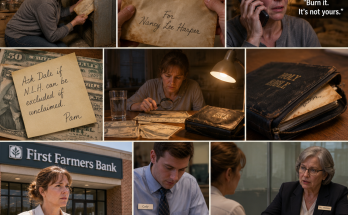
Mrs. Whitaker did not answer immediately.
Instead, she rose and crossed her office to an old filing cabinet tucked beside a bookcase.
“I’ve been with this branch and its predecessor institutions for twenty-eight years,” she said. “Your grandfather banked through this network for most of his adult life.”
“You remember him?”
“I remember Henry Harper.”
The way she said his name made my skin prickle.
She opened a drawer and removed a worn folder whose edges had softened with age.
“This isn’t a complete record,” she warned. “Some of what I remember is personal recollection, not documentation.”
“Tell me what you remember.”
She placed the folder between us.
“About thirty years ago, Henry came into the bank with a young woman.”
“My mother?”
“I can’t say with certainty.”
“What happened?”
“They spent a long time with an officer. The woman was distressed. Your grandfather kept trying to calm her.”
“About what?”
“Money.”
I looked at the seventeen bonds spread across the desk.
“What money?”
“That is what I’m trying to establish.”
She opened the folder.
Inside were photocopies of documents faded almost to gray.
The first page carried Grandpa’s full name and a date.
October 14, 1984.
I looked at the oldest bond.
Same year.
Mrs. Whitaker followed my gaze.
“These weren’t purchased casually whenever your grandfather happened to have extra money.”
“What were they?”
“Part of a recurring arrangement.”
“For Grandpa?”
Her expression told me the answer before she spoke.
“For you.”
I stared at her.
“That doesn’t make sense.”
“Why?”
“Because nobody ever told me.”
“That does not change what the records say.”
I picked up one of the bonds.
“Then why do some list Grandpa or me?”
“That registration is one reason I need the archived material.”
“How much are they worth?”
She gave me a measured look.
“That wouldn’t be my first question.”
“What would?”
She leaned back.
“I would ask why somebody wanted them destroyed before you could bring them here.”
Dale’s voice returned immediately.
Burn them.
I looked at the closed office door.
“Can you tell whether somebody tried to claim them?”
“Not yet.”
“Can you tell whether Pam’s note means I could have been excluded?”
“Not from what I have.”
She picked up the phone and called the records department.
I listened to half a conversation filled with dates and account numbers.
Then she said Grandpa’s full name.
Her expression changed.
She wrote something down.
“You’re certain?”
A pause.
“Read the notation to me.”
She listened.
Then hung up.
“What?”
“There is a beneficiary restriction.”
I gripped the arms of my chair.
“What does that mean?”
“In this case, instructions were placed on the underlying account records beyond the ordinary registration.”
“By Grandpa?”
“It appears so.”
“Who is named?”
“You.”
I almost laughed from sheer confusion.
“If I’m the protected beneficiary, why is my family acting as though I stole something?”
“I can’t answer that.”
“Dale told me to burn them.”
She went completely still.
“Exactly what did he say?”
I repeated the conversation.
When I finished, she looked down at the folder.
“Do not discuss these bonds with your cousins again until you understand what you have.”
“Why?”
“Because people generally do not demand the destruction of documents that cannot affect them.”
She copied the identifying information, then returned every original to me.
“Keep these somewhere secure.”
“Can I leave them here?”
“Not without establishing the proper account process. For now, retain possession.”
I slid them back into the battered Bible cover.
Mrs. Whitaker reached for another sheet.
“There’s something else.”
She turned it toward me.
Grandpa’s handwriting filled a short note.
I recognized the oversized H in Henry. It was the same H he had used on every birthday card.
The message instructed the bank to release information about the bonds only to Nancy.
Me.
If I never came, the assets were to remain untouched.
Then I reached the final instruction.
Dale was specifically barred from accessing the file.
I read the sentence twice.
“Why would Grandpa name Dale?”
“I don’t know.”
“When did he write this?”
She pointed to the date.
November 1998.
My chest tightened.
That year carried too many memories.
My first husband, Robert Ellis, had left.
I had been pregnant with my second son.
Money had been so tight that I sometimes stood in grocery aisles calculating whether I could afford milk and laundry detergent in the same trip.
Grandpa had shown up repeatedly during those months.
He brought groceries.
Fixed the heater.
Paid an electric bill I had hidden under a stack of magazines because I was too embarrassed to ask for help.
One night he sat at my kitchen table while my oldest boy slept in the next room.
I remembered his face now.
Not the words exactly, but the warning beneath them.
Family, he had told me, could convince itself that taking control of your life was the same thing as protecting you.
I thought he meant my divorce.
Then he had glanced toward the room where my son slept and said he worried about what other people might take from me.
At the time, I assumed he meant custody.
Sitting in Mrs. Whitaker’s office almost three decades later, I wondered whether he had meant something entirely different.
“I need to go back to the house.”
Her eyebrows lifted.
“Why?”
“Because I stopped searching when I found the bonds.”
“You were searching?”
“I thought I was cleaning.”
She looked at me for a moment.
“Don’t go alone.”
“I’ll be careful.”
“That isn’t what I said.”
But I was already standing.
The drive to Moberly took less than an hour.
It felt longer.
Pam’s handwritten question kept returning to me.
Could N.L.H. be excluded if unclaimed?
Maybe she had known I was entitled to something.
Maybe the estate sale was being rushed because Grandpa’s death created a deadline.
Or maybe I was connecting things that had nothing to do with one another.
Then I turned onto Grandpa’s street and saw Dale’s pickup beside the garage.
I stopped at the curb.
He had told me he would be working that afternoon.
The basement window was open.
I knew I had closed it.
The front door was unlocked.
Inside, drawers had been pulled from Grandpa’s desk. Cabinet doors stood open in the kitchen.
Someone was searching the house.
“Dale?”
No answer.
Then I heard metal scrape concrete below me.
I opened the basement door.
The light was already on.
At the bottom of the stairs, Dale knelt beside the furnace with a screwdriver.
The loose panel had been completely removed.
He turned.
His eyes went first to my face.
Then to my purse.
“You went to the bank.”
Not a question.
“Yes.”
He stood slowly.
“What did they tell you?”
“Why did you tell me to burn the bonds?”
“Because they’re worthless.”
“Then why are you tearing apart the wall where they were hidden?”
His face tightened.
For a second I saw something unfamiliar in him—not anger exactly, but calculation.
“You don’t understand what you’re getting into.”
“Then help me understand.”
“I can’t.”
“You mean you won’t.”
He rubbed one hand across his mouth.
“Grandpa didn’t leave those bonds to you.”
“The bank disagrees.”
Color drained from his face.
“Who did you speak with?”
“Mrs. Whitaker.”
He took a step backward.
“You shouldn’t have gone to her.”
“Why?”
“Because now they’ll open the old records.”
“Good.”
“No.”
The word cracked through the basement.
I held my ground.
“What happened, Dale?”
His eyes moved toward the stairs.
Then he said, quieter, “Your mother wasn’t supposed to find out.”
The sentence hit harder than anything else he had said.
“My mother?”
He immediately looked as though he regretted speaking.
“What did she find out?”
“Ask Alan.”
“My brother?”
“Ask him why Grandpa stopped speaking to him.”
“That never happened.”
Dale gave a humorless laugh.
“You saw Alan at Christmas. That isn’t the same thing.”
“Grandpa loved Alan.”
“Yes.”
“Then what are you saying?”
“That loving somebody doesn’t mean trusting them.”
He moved toward the stairs.
I stepped aside rather than let him brush against me.
“Were the bonds meant for me?”
He stopped.
“Leave them alone.”
“No.”
His shoulders sagged.
“Then you’re going to find out why Grandpa hid them.”
He went upstairs.
By the time I followed, his truck was backing into the street.
I stood at the kitchen window until it disappeared.
A small click sounded behind me.
I turned.
Grandpa’s old wall clock beside the pantry hung crooked.
He had been obsessive about that clock. Every Sunday he wound it. Every time one of us bumped it, he straightened it without thinking.
I lifted it from the hook.
Behind it was a narrow opening cut into the plaster.
Inside rested a brass key tied to faded blue string.
A handwritten tag hung from it.
Storage — Moberly First National — Box 114.
The fourth number from the empty folder.
114.
I slipped the key into my palm.
My phone rang.
Alan.
“Where are you?” he asked.
“Grandpa’s.”
A long silence.
“You need to leave.”
“Dale told you I’m here?”
“He told me what you found.”
“How much?”
“Enough.”
I closed my fingers around the key.
“Did Grandpa leave those bonds for me?”
Silence.
“Alan.”
“Yes.”
My throat tightened.
For the first time since entering the bank, I had an answer nobody could soften.
“Why didn’t you tell me?”
“Dad made us promise.”
Dad.
Our father.
The man I had believed dead since childhood.
“What promise?”
“That we’d let you have them when the time was right.”
“Who is ‘we’?”
He stopped breathing for a second.
“Alan?”
“I have to go.”
“Who else knew?”
The call ended.
I stared at my phone.
Then at Grandpa’s desk.
Then at the labels attached to everything my relatives planned to sell.
The walnut hutch.
The tractor.
The desk.
The file cabinet.
Until then, the estate sale had seemed merely rushed.
Now it looked different.
If Grandpa had hidden documents throughout the house, emptying it quickly would accomplish something far more useful than settling an estate.
It could erase whatever he had left behind.
I put Box 114’s key in my pocket.
The estate sale could wait.
Before anyone emptied Grandpa’s house, I was going to discover what he had locked away.
Click here to continue reading: PART 4: Box 114 Contained My Forged Signature, a Photograph of a Dead Man, and a Letter Grandpa Never Wanted Anyone Else Reading
Three Hundred Dollars for a Basement Nobody Wanted to Enter Became the Cheapest Mistake My Cousins Ever Made
Part 3 of 35