The decision took months.
We didn't publish the names.
Instead, Alvarez helped establish a confidential process.
The people who had assisted the children could choose whether their identities became part of the historical record.
Most chose anonymity.
A few agreed to speak.
Evelyn was one of them.
Her testimony became part of the archive.
Not as an accusation.
As a record.
She described the first time she realized the children were being moved without proper authorization.
She described the paperwork.
The coded labels.
The false transfers.
The adults who looked away.
And the people who quietly resisted.
Her testimony was difficult to read.
But it answered questions that had remained open for years.
Renata read portions of it with me.
She became quiet afterward.
“What?”
“I used to think courage meant being fearless.”
“It doesn't.”
“I know that now.”
She touched the page.
“Evelyn was terrified.”
“Yes.”
“She still did it.”
“Yes.”
“Then courage is doing something while you're afraid.”
“Sometimes.”
She considered that.
“What about you?”
“What about me?”
“Were you scared when you called 911?”
“More than I can explain.”
“But you called.”
“Yes.”
She smiled.
“Then you were brave.”
I shook my head.
“I was your mother.”
“Maybe those things aren't different.”
I didn't argue.
The state eventually created a permanent collection devoted to the children affected by the organization.
Families could contribute photographs.
Letters.
School records.
Personal memories.
The purpose was not to glorify suffering.
It was to restore identities.
For every altered name, researchers documented the real one when it could be confirmed.
For every false transfer, they recorded the actual family connection.
For every recovered child, they added a note explaining how the reunion occurred.
The work was meticulous.
Slow.
Sometimes frustrating.
But it was honest.
Daniela contributed the red scarf.
Sofia contributed her mother's letters.
Lily's family sent photographs from childhood.
Evan's parents sent his old baseball card.
Noah's family sent a drawing he had made while away.
Renata contributed nothing at first.
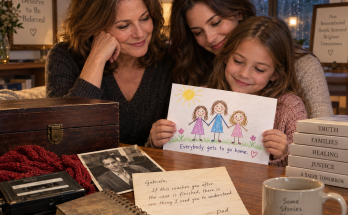
Then, one evening, she handed me a folded sheet.
“What is this?”
“A note.”
“For the archive?”
“Maybe.”
I opened it.
She had written about the night she returned from camp.
Not the investigation.
Not the police.
Just the moment she saw me at the door.
She wrote:
“I didn't know if my mother would understand what I was trying to say. I didn't know if I could say it correctly. I only knew I was scared. She listened anyway.”
At the bottom she had written:
“That was the beginning.”
I asked if she was sure.
“Yes.”
We submitted it.
Years later, people would read it.
Not as a dramatic statement.
As a child's account of what it meant to be heard.
The archive director asked whether Renata wanted to speak at the opening.
She declined.
“Why?”
“Because it isn't my job to explain everyone's pain.”
I smiled.
She had learned boundaries I hadn't known how to teach.
The opening ceremony was small.
Families stood together.
Some people cried.
Others didn't.
A few left before the speeches ended.
No one judged them.
The collection included a section on the people who had helped.
Evelyn stood beside it.
She looked uncomfortable.
“You should be proud,” I told her.
“I don't know how.”
“Why?”
“Because I waited too long.”
“You still helped twenty-three children.”
“I could have helped more.”
I looked at her.
“You're measuring yourself against the worst possible outcome.”
She shook her head.
“Maybe.”
Renata approached.
“Evelyn?”
The older woman smiled.
“Yes?”
“Thank you.”
Evelyn's eyes filled.
“I didn't do it alone.”
“I know.”
She touched Renata's shoulder.
“You sound like your grandfather.”
Renata laughed.
“That's not always a compliment.”
“No.”
Evelyn laughed too.
That moment felt strangely peaceful.
Not because the past had become good.
It hadn't.
But because the people who had survived it were no longer isolated from one another.
The archive became a place where families could meet.
Some came searching for information.
Others came to leave it.
One afternoon, a woman arrived carrying a photograph.
She believed her brother had been one of the missing children.
His name wasn't in the official list.
The photograph showed a boy standing beside a lake.
On the back was a date.
And a name.
Alvarez investigated.
The boy had been listed under another identity.
He had survived.
He had built a life elsewhere.
He had never known that his family had continued searching.
The woman was his sister.
They eventually found him.
He was sixty-three.
The reunion happened privately.
No cameras.
No reporters.
No public ceremony.
Just two siblings sitting at a kitchen table.
That was enough.
Renata heard about it later.
“Did they forgive each other?”
“I don't know.”
“Do they have to?”
“No.”
She nodded.
“That's important.”
“What is?”
“That people can love each other and still be angry.”
I looked at her.
“Where did you learn that?”
“Life.”
She was right.
Healing was not always forgiveness.
Sometimes it was simply understanding what happened.
Sometimes it was setting a boundary.
Sometimes it was choosing to stay.
Sometimes it was choosing to leave.
There was no single ending.
The court cases ended.
The investigation ended.
The archive opened.
But families continued living with the consequences.
That was something I had learned to respect.
The past didn't end because paperwork said it did.
One evening, Renata and I sat outside.
Maya was older now.
She was reading on the porch.
Renata watched her.
“She knows the basics.”
“Does she know everything?”
“No.”
“Will she?”
“When she's ready.”
I nodded.
“That's the right way.”
Renata smiled.
“I learned from you.”
“I hope you learned some things I did better than I did.”
She laughed.
“Definitely.”
The sun went down.
Maya closed her book.
“Mom?”
“Yes?”
“Can we go get ice cream?”
Renata stood.
“Absolutely.”
They walked toward the car.
I watched them.
Mother and daughter.
Grandmother and granddaughter.
Three generations separated by years, but connected by something simple.
The right to tell the truth.
And the right to choose when to tell it.
That night, I returned to the shelf where my father's letter sat.
I didn't hide it.
I didn't lock it away.
It belonged to the past.
And the past, finally, had a place.
Click here to continue reading: PART 27: The Last Unanswered Question Was Not About the Camp at All, but About What Gabriela Would Do With the Truth Her Father Left Behind
The Bus Arrived Late, and One Small Detail Made Me Realize My Daughter Had Come Home Carrying Something No Child Should Have
Part 26 of 27