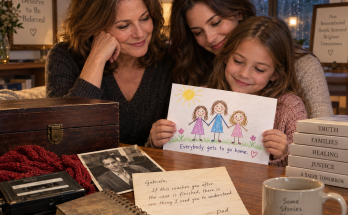
The letter arrived on a Tuesday.
Renata was at work when the courier knocked on my door.
I almost signed for it without looking at the return address.
Then I saw the handwriting.
My father's.
Not a copy.
Not an old envelope forwarded through an archive.
His actual handwriting.
The letters leaned slightly to the right, just as I remembered.
My fingers tightened around the envelope.
The return address belonged to the state archive.
I called Renata.
“Are you sitting down?”
There was a pause.
“Mom, what's wrong?”
“I received something.”
“What?”
“A letter from Grandpa.”
Silence.
Then she said, “I'm coming.”
She arrived twenty minutes later.
She didn't take off her coat.
I placed the envelope on the table.
Neither of us touched it.
“Did the archive know about this?”
“They sent it.”
“Why now?”
“I don't know.”
She pulled out a chair.
“Open it.”
“You're sure?”
“Yes.”
I slid a letter opener beneath the seal.
Inside was a single folded page.
There was no apology.
No warning.
No explanation.
Only a date.
It was written three days before my father's death.
My breath caught.
Renata leaned closer.
“What does it say?”
I read the first line aloud.
“Gabriela, if this reaches you after the case is finished, there is one thing I need you to understand.”
I stopped.
Renata looked at me.
“Keep going.”
The letter explained that my father had known some evidence would survive even if the archive was discovered.
He had deliberately separated certain documents.
Not because they contained another secret organization.
Because they contained the names of people who had helped children escape.
People who could have been punished if their identities became public.
He had hidden those names separately.
The final sentence made me sit back.
“One of them is still alive, and she has never told you who she is.”
Renata stared at the page.
“Who?”
“I don't know.”
There was another sheet beneath the letter.
It contained a name.
Evelyn Hart.
Neither of us recognized it.
I called Alvarez.
She arrived that afternoon.
She read the letter carefully.
“This wasn't in the archive.”
“No.”
“Where did the state archive get it?”
“They said it was sealed in a private evidence box.”
“Who submitted the box?”
I showed her the paperwork.
Her expression changed.
“Your father.”
“But he died years ago.”
“Yes.”
She turned the document over.
“There was a secondary evidence deposit.”
“When?”
“Three days before his death.”
I stared at her.
“Why didn't anyone tell me?”
“Because the box was sealed under a court restriction.”
“Until when?”
“Until all active investigations connected to the organization were closed.”
The restriction had expired only recently.
That explained the timing.
But it didn't explain Evelyn.
Alvarez searched the database.
There were hundreds of Evelyn Harts.
Then she narrowed the search.
One woman had worked at Saint Emily's Academy more than twenty years earlier.
She had been listed as a temporary nurse.
The employment record ended abruptly.
“No address,” Alvarez said.
“Can you find her?”
“Maybe.”
Renata looked at the letter.
“What did Grandpa mean by saying she helped children escape?”
Alvarez didn't answer immediately.
“Your father may have been protecting her identity.”
“From whom?”
“Anyone who still believed she was a traitor.”
The thought unsettled me.
The case had ended.
But history was never as neat as a court judgment.
People had cooperated.
People had betrayed others.
People had changed sides.
Some had done terrible things.
Some had tried to stop them.
And some had done both.
Two days later, Alvarez found Evelyn.
She lived alone in a small town near the coast.
She agreed to meet us.
When we entered the café, she stood.
She was in her seventies.
Gray hair.
Plain clothes.
A weathered leather bag.
She looked at me for several seconds.
Then she said, “You have your father's eyes.”
I sat down.
“You knew him.”
“Yes.”
“Why didn't you come forward?”
“Because I was afraid.”
“Of the organization?”
“Of everyone.”
She opened her bag.
Inside was a photograph.
A younger version of herself stood outside the retreat house.
Beside her was my father.
Behind them were three children.
“They were the first ones I helped.”
I studied the photograph.
“Where did they go?”
“Home.”
“All three?”
“Yes.”
“Then why was it hidden?”
“Because the organization could not know who helped them.”
“What did you do?”
“I altered the transportation records.”
Alvarez leaned forward.
“How many children?”
Evelyn looked down.
“Twenty-three.”
My stomach tightened.
“Twenty-three?”
“Over seven years.”
“Why stop?”
“I was discovered.”
“By whom?”
“Margaret.”
Of course.
Evelyn explained that Margaret had suspected someone was altering records.
She had followed Evelyn one night.
My father intervened.
He took responsibility.
Margaret believed he was the only person involved.
That gave Evelyn time to disappear.
But my father continued helping children quietly.
The letter suddenly made sense.
He had not only collected evidence.
He had created a network of people willing to move children back toward their families.
People whose names had never appeared in the archive.
“Why did my father never tell me?”
Evelyn looked at me.
“Because he wanted you to have an ordinary life.”
I almost laughed.
“He wasn't very good at that.”
“No.”
She smiled.
“He wasn't.”
Then Evelyn reached into her bag again.
She produced a small notebook.
My father's handwriting filled the first pages.
Dates.
Locations.
Names.
But the final page contained only one sentence.
“Gabriela should decide whether the story ends here.”
I looked at Alvarez.
“What does that mean?”
Evelyn answered.
“He wanted you to decide whether the people who helped should remain anonymous.”
I understood.
The evidence could expose them.
It could also expose their families.
Some had children of their own.
Some had never wanted recognition.
They had helped because they believed it was right.
Not because they wanted their names remembered.
Renata sat quietly beside me.
“What do you think?”
I looked at her.
“I don't know.”
She shrugged.
“Then don't decide today.”
That simple answer relieved me.
For years, every revelation had demanded an immediate response.
Call the police.
Open the door.
Find the child.
Read the document.
Follow the evidence.
This time there was no emergency.
No one was in danger.
We could wait.
Before we left, Evelyn touched my hand.
“Your father believed the truth belonged to everyone.”
“Did he?”
“He believed people deserved the truth about what happened to them.”
I nodded.
“That isn't the same thing as telling every secret.”
“No.”
Outside, Renata and I stood beneath the afternoon sun.
“What are you thinking?” she asked.
“That Grandpa left me one more decision.”
“Do you know what you'll do?”
“Not yet.”
She smiled.
“Good.”
“Why good?”
“Because you always told me not to make big decisions when I'm scared.”
I laughed.
“You remember everything.”
“Unfortunately.”
We walked toward the car.
For the first time, the unfinished part of my father's story didn't feel like a threat.
It felt like a choice.
Click here to continue reading: PART 26: The People Who Had Quietly Saved Children Were Finally Given a Voice, but Their Stories Forced Renata to Rethink What Courage Really Meant
The Bus Arrived Late, and One Small Detail Made Me Realize My Daughter Had Come Home Carrying Something No Child Should Have
Part 25 of 27